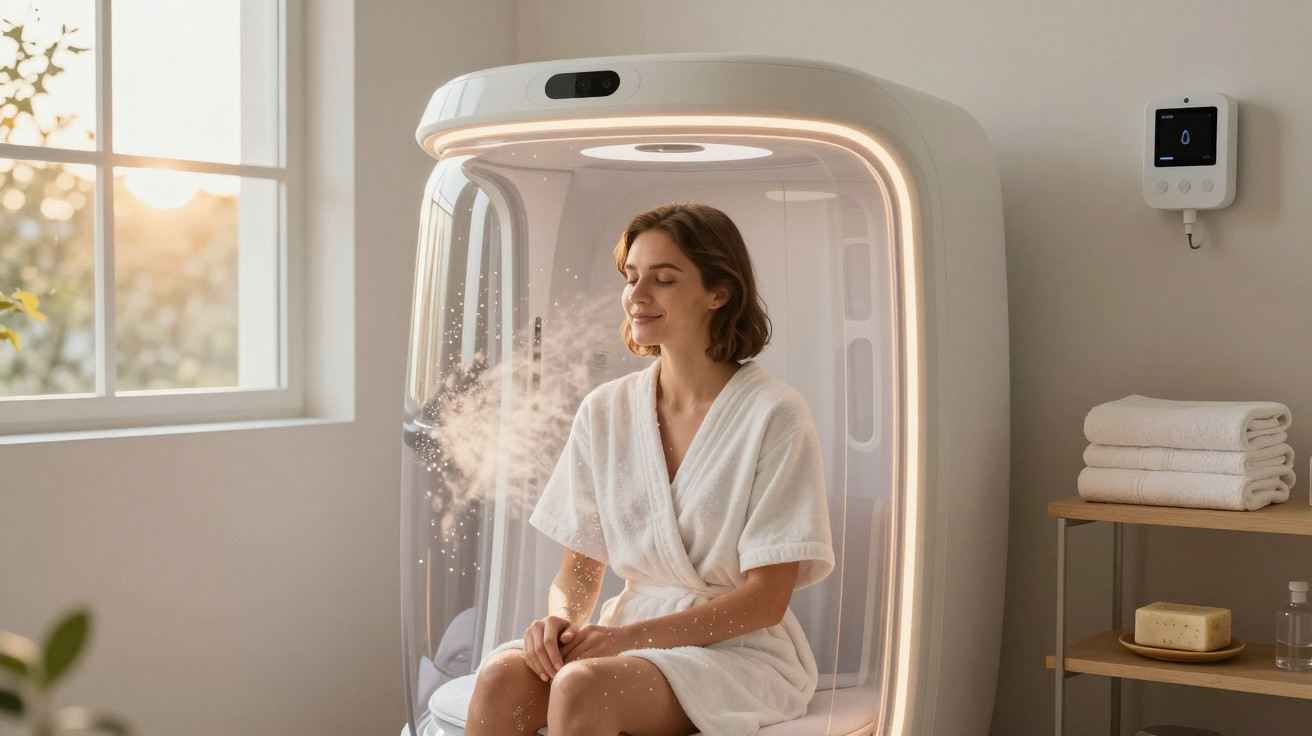
In Japan, a “human washing machine” is attracting attention: a high-tech capsule designed to wash and dry the entire body while assessing health data, all in just 15 minutes. Although it sounds like science fiction, it may offer a real indication of why people could shower conventionally less often in future - and how our entire concept of hygiene may change.
How a human washing machine could challenge the daily shower
In Osaka, Science Co. has unveiled a device that could turn everyday bathroom routines on their head. It is called the “Mirai Ningen Sentakuki”, which roughly translates as the “washing machine for humans of the future”.
Rather than stepping beneath a shower, the user sits inside an enclosed capsule. Once the door closes and water fills the unit, a combination of microbubbles, sensors and artificial intelligence takes over.
The idea: the person does nothing - within 15 minutes, the machine handles cleansing, drying, relaxation and a health check.
The system is intended to clean so thoroughly that many users may no longer need a conventional daily shower. This is where the shift begins: hygiene would no longer be defined chiefly by how often somebody showers, but by the effectiveness and quality of the cleansing process.
How the capsule works - showering without lifting a finger
Microbubbles instead of scrubbing with a flannel
Inside the capsule, the system uses so-called microbubbles: exceptionally tiny bubbles capable of reaching the smallest contours of the skin. They loosen dirt, sebum and skin particles without the need for scrubbing.
- The capsule is filled with water.
- A system produces billions of microscopic bubbles.
- The bubbles surround the skin and lift away impurities.
- The body is gently rinsed without mechanical friction.
Comparable technology already exists in spa treatments, where it is generally offered as a luxury experience. The Japanese capsule seeks to bring that concept into daily life, combining elements of a whirlpool, shower and medical cabin.
Sensors that detect more than dirt
At the same time, a dense network of sensors comes into operation. These can monitor, for example:
- pulse and heart rate
- signs of stress
- physical exhaustion
- changes in vital signs during the session
Artificial intelligence analyses the information in real time and adjusts the programme accordingly. If stress levels rise, the lighting and sound change. If the body appears particularly fatigued, the system softens the water temperature and pressure.
Hygiene is combined with health monitoring here - “a quick shower” becomes a 15-minute blend of washing, a check-up and a mini spa.
From a 1970s Expo concept to an everyday capsule
The ambition to create an automated body-washing machine is not entirely new. An early prototype appeared at the Osaka Expo during the 1970s. At that time, however, the sensors, AI and precision needed to turn the idea into a viable product did not yet exist.
Science Co. is now revisiting the concept with considerably more technology behind it. What was once simply a futuristic exhibition attraction is intended to become a practical proposition: a capsule that could theoretically be installed in hotels, care homes, gyms or even private homes.
| Feature | Conventional shower | Human washing machine |
|---|---|---|
| Duration | 5–10 minutes, often daily | Around 15 minutes per use |
| Active effort | Lathering, rinsing, drying | User sits down; the machine does everything |
| Skin cleansing | Mechanical rubbing, shampoo, shower gel | Microbubbles penetrate skin contours |
| Health data | No systematic recording | Sensors measure pulse, stress and condition |
| Experience factor | A routine, often done in passing | Spa-like session with tailored light and sound |
Showering less - more high-tech? The real trend behind it
Why might a capsule like this result in people using an ordinary shower less frequently? Its central promise is deeper, more targeted cleansing that would not be required every day. Someone booking a complete machine session once or twice a week might only need a brief wash on the remaining days, instead of taking a full shower each time.
Other factors have already been encouraging people to shower less often:
- Dermatologists caution that daily hot showers can damage the skin barrier.
- Many people are cutting water and energy use for sustainability reasons.
- Working from home and more flexible hours are weakening the old routine of “a morning shower before the office”.
Instead of a strict “every day, at the same time” ritual, body care tailored to need and guided by technology is moving to the fore.
What the human washing machine could mean for health and daily life
From bathroom to mini check-up centre
One particularly interesting aspect concerns health. If a capsule records vital data every time it is used, it could build up a background record: how does the body react during periods of stress? How does pulse change over several weeks? In time, this information could potentially be shared with doctors or health apps.
Such a combination of personal care and monitoring could be especially relevant for older people or those with chronic illnesses. Care workers might also be relieved if part of personal hygiene were automated while signs of potential problems became visible at an early stage.
More wellness, less of a chore
The developers are positioning the capsule not as clinical equipment, but more as a luxury product with a wellness focus. Interior lighting, calming sounds and pleasant water temperatures are all intended to make each session feel like a short spa visit.
If the concept catches on, showering could lose its current character: rather than being a quick obligation, it could become a less frequent but more intensive, carefully planned block of cleansing and relaxation. In between, a quick wash at the basin or a spray of deodorant may be enough.
Risks, limitations and unanswered questions
Despite the appeal, several concerns arise. First is the question of cost: a device with this level of technology is likely, initially, to appear in hotels, wellness venues or premium residential developments rather than an ordinary rented flat.
There is also data security. Anyone regularly sitting in a capsule that measures pulse, stress and physical condition is generating highly sensitive information. Where would those data be stored? Who would be allowed to view them? And could they reveal illnesses or psychological strain?
A third issue is trust. For many people, personal hygiene is closely tied to a sense of control. They want to decide for themselves how and where they wash, which products they use and how warm the water should be. A machine that manages all of this independently will not automatically be welcomed.
What everyday life with less showering could look like
Imagine a typical weekday in a household with such a capsule. On Monday evening after work, someone spends 15 minutes in the washing machine. The capsule provides a full care programme. On Tuesday and Wednesday, a quick face wash, deodorant and perhaps a brief wash of particular areas of the body are enough.
Another complete capsule session takes place on Thursday, including a fresh health scan. After exercising on Saturday, the programme is adjusted: greater water pressure, a longer microbubble phase and a stronger emphasis on relaxing the muscles. The regular shower becomes the exception, used mainly when time is short or when visitors do not feel comfortable trying the capsule.
Bathroom products would change in parallel: fewer conventional shower gels, with more gentle between-wash skincare, sprays, dry shampoos and fabrics that neutralise odours more effectively. Hygiene would become modular, split between a few major care sessions and many smaller measures.
What terms such as “personalised hygiene” really mean
At first glance, the expression “personalised hygiene” may sound like a marketing slogan. In technical terms, it describes the idea of a machine learning from every use: which water temperature suits the individual? How does the skin respond to longer microbubble phases? When do vital signs appear unusual?
Over time, the capsule could create profiles much like streaming services do: a kind of “hygiene algorithm” that adapts washing programmes to the time of day, stress level or physical condition. A user who appears highly stressed late at night would receive a calmer, warmer programme than someone entering the capsule full of energy in the morning.
This personalisation is precisely why the standard daily shower could become less important. Rather than receiving the same treatment every day, the body would get targeted input at selected times. That lowers water and energy consumption, reduces skin irritation and establishes a new technology-supported routine that goes far beyond “getting clean quickly”.


Comments
No comments yet. Be the first to comment!
Leave a Comment