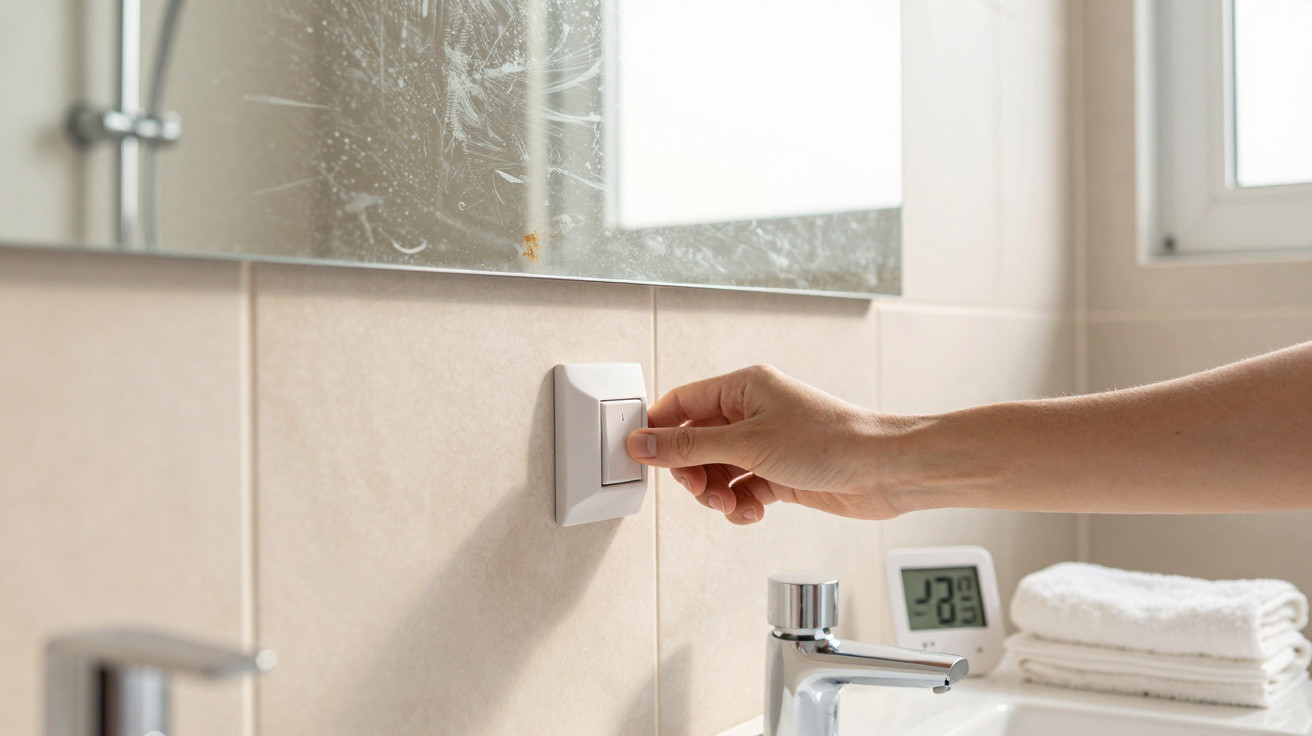
There is a familiar moment after stepping out of the shower: the bathroom mirror resembles a blurred crime scene.
Droplets cover every tile, while the air feels dense and almost chewy. You open the window, wipe the mirror with your hand and perhaps use a towel on the vanity. Yet 10 minutes later, the room remains damp and carries a faintly… mushroom-like smell.
A plumber once joked to me that most bathrooms are “slow-cooking their own walls.” I laughed at first, until black specks began appearing in the grout behind my shampoo bottles. Later, while visiting for an unrelated matter, a building inspector casually indicated a small switch near the fan that I had never noticed.
“Use that properly,” he said, “and your moisture problem drops by almost half.”
I had lived there for three years without ever using it.
The small humidity switch nearly everyone overlooks
In many properties, particularly new-build homes and refurbished flats, the bathroom fan does more than simply switch on and off. It may have an unobtrusive switch or dial connected to a humidity sensor: a little-known humidity control switch that determines when the fan continues running and when it stops. Most people turn on the light and fan, take a shower, then carry on with their day.
This modest control is often positioned beside the light switch, or integrated into the fan cover with small markings such as “30 / 50 / 70”. These figures indicate relative humidity. With the right setting, the switch allows the fan to continue extracting moisture well after you have closed the bathroom door. If it is set incorrectly, or never used, it may as well not be there.
It may sound like an insignificant technical feature. In reality, research by building scientists indicates that bathrooms with a properly configured humidity switch can reduce lingering moisture by nearly half compared with a basic routine of running the fan only while the room is occupied. Reduced residual moisture means mould develops more slowly, paint is less likely to peel and timber is less prone to warping. It is a dull but useful detail that can quietly determine whether your bathroom ages well or deteriorates from within.
At a small block of flats in Portland, the building manager began seeing brown marks forming on ceilings above showers. Residents reported a musty odour in hallway cupboards, unaware that the cause began in the bathroom. After inspecting the building, a ventilation contractor found the same issue in every flat: each had a fan with a humidity switch, but the controls had either been left at their default setting or switched off at the wall.
They carried out a straightforward comparison. People showered normally in two identical bathrooms. In one room, the fan ran during the shower only before being switched off. In the other, the humidity switch was set to around 50%, and residents were asked not to alter it. Measurements taken half an hour after showering found that the humidity-controlled bathroom retained nearly 45% less moisture in the air and on surfaces.
You will not necessarily notice that difference in a day. Over several months, however, it appears as cleaner grout, fewer dark patches and less condensation on the inside of windows. Residents barely had to change their routines; the switch did most of the work.
The principle is simple. A hot shower fills the room with warm, moisture-laden vapour. When that vapour meets cooler surfaces, including tiles, mirrors and painted walls, it condenses into water. Extractor fans are designed to remove humid air and bring in drier air from outside or elsewhere in the home. An ordinary on/off system only works if you remember to leave the fan running for long enough.
The humidity switch gives the system some intelligence. Rather than relying on guesswork, it tracks the actual moisture level. Once humidity rises, it makes the fan work harder and keeps it operating until levels return to normal. There is no need to count minutes or decide whether the room is dry enough. When used correctly, this small control shortens the period during which surfaces remain wet - precisely the period in which mould flourishes.
Most people never adjust the control, which helps explain why so many bathrooms are technically ventilated but still feel swamp-like for half the year.
How to set the bathroom humidity switch correctly
The key is to think of the fan not as a light switch, but as a background assistant. Where your fan has a separate humidity switch or dial, begin by turning it on and leaving it on. If the dial displays figures, choose a target humidity between 40% and 50%. That range is high enough to avoid over-drying the room, while remaining low enough to limit condensation.
The difficult part is then to stop adjusting it. You can still turn the fan on when you shower, but allow the humidity control to decide when it should stop. It may continue running for 20, 30 or even 40 minutes after you finish. That is not wasted electricity; it is moisture being extracted rather than absorbed by your walls.
If your fan uses a combined control, such as a button labelled “AUTO” or “HUM”, select that setting instead of standard “ON”. In many systems, the fan runs quietly at low speed in the background before increasing its output as the room fills with steam. It is effectively cruise control for bathroom air.
There is a reason fogged mirrors and damp towels are so common. Ventilation is often treated as an optional chore that we intend to handle properly another time. Let’s be honest: nobody really does that every day. You emerge from the shower late for something, children are shouting and your phone is buzzing in the next room. The fan goes off with the light, and the moisture remains.
Using the small switch correctly works because it does not depend on willpower. You do not need to remember anything more complex than leaving it alone. The usual errors are very human: some people set the humidity level too low, so the fan never activates. Others choose such a high setting that it responds only once the bathroom has already become a sauna. Some turn off the circuit breaker to silence a “noisy fan that won’t shut up”, without realising it is doing exactly what it was designed to do.
If the bathroom still smells damp despite the setting, the principle is rarely at fault. The fan may be underpowered, dirty, or venting directly into a cold loft space where moisture simply collects rather than leaving the home.
As one building scientist said during a workshop for landlords:
“Most of the moisture damage I see in bathrooms isn’t from leaks. It’s from showers that ended an hour ago and air that never really dried out.”
Many homeowners privately assume their bathroom is simply “like that”, as though certain rooms are destined to feel clammy. A humidity switch offers a quiet way to test that belief without removing tiles or buying expensive equipment. Use it for several weeks, and notice not only the mirror but also the smell when you enter the room first thing in the morning.
- If your fan has a visible humidity dial, begin at around 50% and make small adjustments over several days.
- Clean the fan cover and grille once or twice a year so it can move air at the rate for which it was designed.
- Leave the bathroom door slightly ajar after showering, allowing the fan to draw drier air from the rest of the home.
- If the fan never switches off, the setting is likely too low or there may be another source of moisture in the room.
- If it scarcely ever starts, the setting may be too high or the sensor could be blocked with dust.
Why this small change affects how your bathroom ages
Once you begin watching how moisture behaves, it becomes impossible to ignore. You notice how long droplets remain on the window, how grout in shaded corners stays wet, and how a towel on the back of the door never quite dries. That little bathroom control stops seeming like an arbitrary feature on the wall and becomes more like a volume dial for how forcefully your home counters all that water.
This is not solely about mould spots that can be scrubbed away with cleaner at the weekend. Persistent high humidity gradually works into vanity joints, distorts door frames, lifts paint and sealant, and reduces the life of the extractor fan itself. A bathroom that reliably dries within 20–30 minutes of a shower has a very different lifespan from one that remains humid for hours. The cost is only a few additional minutes of fan operation, controlled by a feature that probably came with your home or flat at no extra charge.
The more openly people discuss these small elements of home infrastructure, the more they change what we notice in our own spaces. Someone mentions their “magic humidity switch” at work, and colleagues suddenly return home to find the same little dial above their basin. A tenant asks a landlord why their bathroom always smells stale and, rather than receiving a scented candle, gets a new fan and a correctly configured sensor.
It creates a quiet chain reaction: one small switch, less moisture and fewer problems. Once you have watched your mirror remain clear after a hot shower on a cold morning because the fan continued humming automatically, it is difficult not to tell someone else.
| Key point | Detail | Benefit for the reader |
|---|---|---|
| Find the humidity switch | Often a small button or dial near the fan, marked with a percentage or “HUM/AUTO” | Helps you identify an existing feature in your home at no cost |
| Choose the right setting | Aim for around 40–50% humidity and let automatic mode manage the running time | Reduces condensation and the long-term risk of mould |
| Adopt helpful habits | Leave the door ajar after showering, clean the fan and do not cut the power supply | Extends the life of the bathroom and improves everyday comfort |









Comments
No comments yet. Be the first to comment!
Leave a Comment