You have just come out of a hot shower, your skin still tingling from the warmth, and instinctively reach for the towel. Then the usual irritation hits: the mirror has disappeared. Your face is hidden behind a veil of steam, while the bathroom begins to seem tighter, more oppressive and almost claustrophobic.
You sweep your hand across the glass; it clears for a moment, then the mist returns as though offended by the attempt. A towel produces the same result. A few minutes disappear, frustration builds, and with eyeliner or a razor in hand, you are already behind schedule.
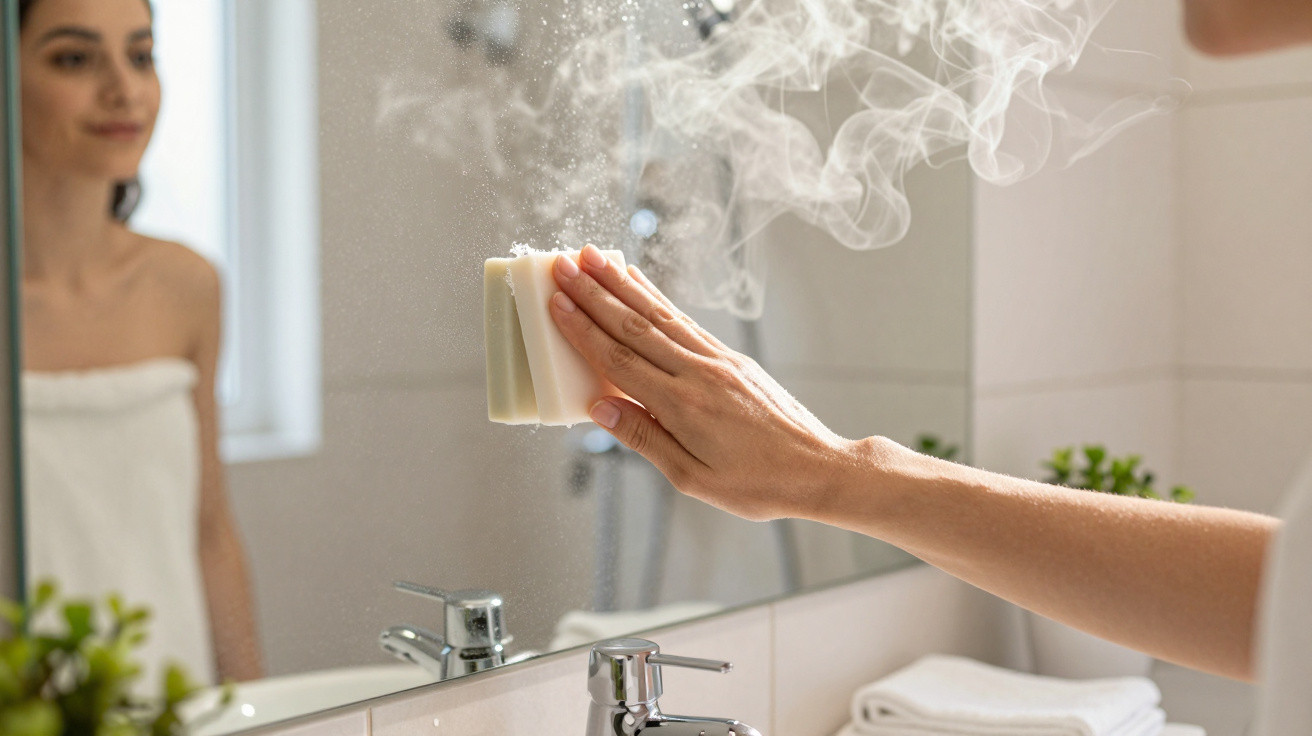
Now imagine exactly the same situation: the hot shower, the dense steam… yet the mirror remains clear. There is no device or heated glass involved, only an inexpensive white bar of soap rubbed over it two days earlier. It may sound like an odd online trick, but it is not.
Why your bathroom mirror fogs up - and how soap changes the rules
A fogged mirror is not magic; it is visible physics. Hot shower water warms the air and fills it with tiny particles of moisture. When this humid air reaches the colder mirror surface, the water condenses. It sticks to the glass, becomes droplets and then a film, until your reflection vanishes as if in a bad dream.
A bare, smooth mirror is an ideal surface for those droplets to settle on. Although glass appears perfectly even, its microscopic texture gives water sufficient hold to remain in place. This thin, irregular layer of condensation scatters the light reflected towards your eyes, making everything appear blurred, milky and slightly dirty.
When you rub a bar of soap over the same mirror, you subtly alter that surface. Rather than simply cleaning it, you deposit an almost invisible layer of surfactants and fats. This coating changes the way water spreads. Instead of acting like thousands of tiny lenses, it behaves more like a flat layer that allows your reflection to show through.
Most of us know the feeling of being late for work or a date, razor in hand, with the bathroom resembling a Turkish bath. You stand half-blind in front of the mirror, wiping it with your forearm and leaving streaks while trying to locate your jawline or the edge of your eyeliner. The harder you wipe, the more determined the steam appears to be.
Picture instead a small flat in a damp seaside town. Amy, a reader we spoke to, learnt the soap trick from her grandmother. She tested it once, almost as a game, before an early shift. After two more showers, the mirror was still clear enough for her to apply mascara without interruption. “It felt like the bathroom finally understood me,” she laughed.
There is no costly appliance or noisy extractor fan, only a 50p bar of soap on the basin. Amy is far from alone. Across forums and social media feeds, thousands of people report the same thing: apply a few gentle strokes of soap to glass and the steam loses the battle. The outcome seems remarkably significant for such little effort.
The science behind it is almost disappointingly straightforward. Soap contains surfactants, molecules attracted to both water and fat. Rubbing the bar over the mirror leaves a fine, transparent coating that alters how water droplets develop and spread across the glass.
Rather than creating countless tiny beads that scatter light in every direction, moisture settles into a more uniform film. With much less distortion, light can pass through and your reflection stays visible. The mirror does still become damp; the difference is that the moisture no longer behaves like fog, but like an almost transparent veil.
The soap coating also introduces a slight hydrophobic effect. It mildly discourages water from clinging together in heavy blobs. Showers and splashes gradually wear the layer away over several days, although some molecules remain within the glass’s microscopic imperfections. This is why the result can survive several steamy mornings before another application is needed.
How to apply soap to your mirror so it really works
The process could hardly be simpler. Use a dry solid bar of soap - plain white soap tends to work best - on a completely dry mirror. Glide the bar softly over the glass in long, gentle passes. The aim is not to create thick chalky lines, but a fine and even haze.
After covering the part of the mirror where your face normally appears, take a soft dry cloth or microfibre towel. Buff the glass in small circular movements until all visible soap marks have disappeared. The mirror should look clear, perhaps with a very faint trace visible only from the side in bright light.
Next comes the test. Run the hot water, shut the door and allow the room to become steamy. Within minutes, droplets will form on the tiles and the air will feel denser. Check the mirror. A very light haze may appear, but you should still be able to make out your eyes, skin and the small details usually lost behind the cloud. That is the understated effect of the invisible layer you have created.
People trying this for the first time tend either to apply far too much soap or polish it off too vigorously. The right balance is subtle: enough soap to leave a coating, but not enough to leave clear white residue. If heavy marks remain after buffing, continue polishing with a clean section of the cloth.
It is also worth beginning with a clean, grease-free mirror. Residue from old hairspray, toothpaste splashes or bathroom cleaning products can disrupt the soap coating. Washing and drying the glass thoroughly before the first application can substantially improve how long the anti-fog effect remains.
Let us be honest: nobody is likely to do this every day. Fortunately, there is no need to. In many homes, one careful application will keep the mirror practical for several showers. During particularly humid weather, or in a small bathroom with limited ventilation, you may need to refresh it roughly once a week rather than every morning.
“The first time I tried the soap trick, I thought it was one of those internet myths,” admits Daniel, 32, who lives with two roommates and one eternally foggy bathroom. “But three showers later, I could still shave without wiping the mirror. It felt like bending the laws of physics with a bar of soap.”
- Choose a dry bar of plain, non-gel soap for the cleanest and least visible coating.
- Apply it to a cool, fully dry mirror, then buff until no streaks can be seen.
- Depending on how much steam your bathroom produces, expect the effect to last from a few days to a week.
The understated comfort of a clear mirror in a steamy room
At first glance, preventing a mirror from fogging up may seem like a minor win: simply a way to save seconds during a hurried weekday morning. Yet there is a quiet satisfaction in gaining this small measure of control over a space that can so often feel chaotic, particularly when the day begins too early or finishes too late.
A clear mirror after a hot shower shifts the whole rhythm. There is no need to battle steam with your sleeve or stand by the door waiting for fresh air. You can see your own face clearly again, as it happens, without the milky filter of condensation. That small moment of clarity can feel surprisingly grounding when the rest of the day is already filled with notifications and deadlines.
The idea stays with you beyond the bar of soap itself. The bathroom becomes somewhere that simple, almost old-fashioned actions can still make a difference. You begin to see how a tiny coating, invisible to the naked eye, can transform your perception. An inexpensive supermarket bar of soap becomes a modest piece of everyday engineering, quietly changing the behaviour of moisture.
It is an easy story to pass on. One friend tells another, a neighbour repeats it, and a comment beneath a social media post leads to hundreds of “wait, this actually works?” responses. In these exchanges, people are not only discussing glass and water droplets. They are sharing a way to make mornings a little less hostile, evenings a little gentler and routines slightly more human.
| Key point | Detail | Benefit for the reader |
|---|---|---|
| Soap creates an invisible film | Surfactants from the soap bar coat the glass with a thin, transparent layer | Explains how a simple product can alter the mirror’s response to steam |
| Fog becomes a clearer film | Water spreads more evenly rather than forming small droplets that scatter light | Keeps the reflection visible during and after a hot shower |
| The effect lasts for several days | The soap layer remains in the glass’s microscopic imperfections despite repeated showers | Provides a low-effort, affordable anti-fog option for daily life |




Comments
No comments yet. Be the first to comment!
Leave a Comment