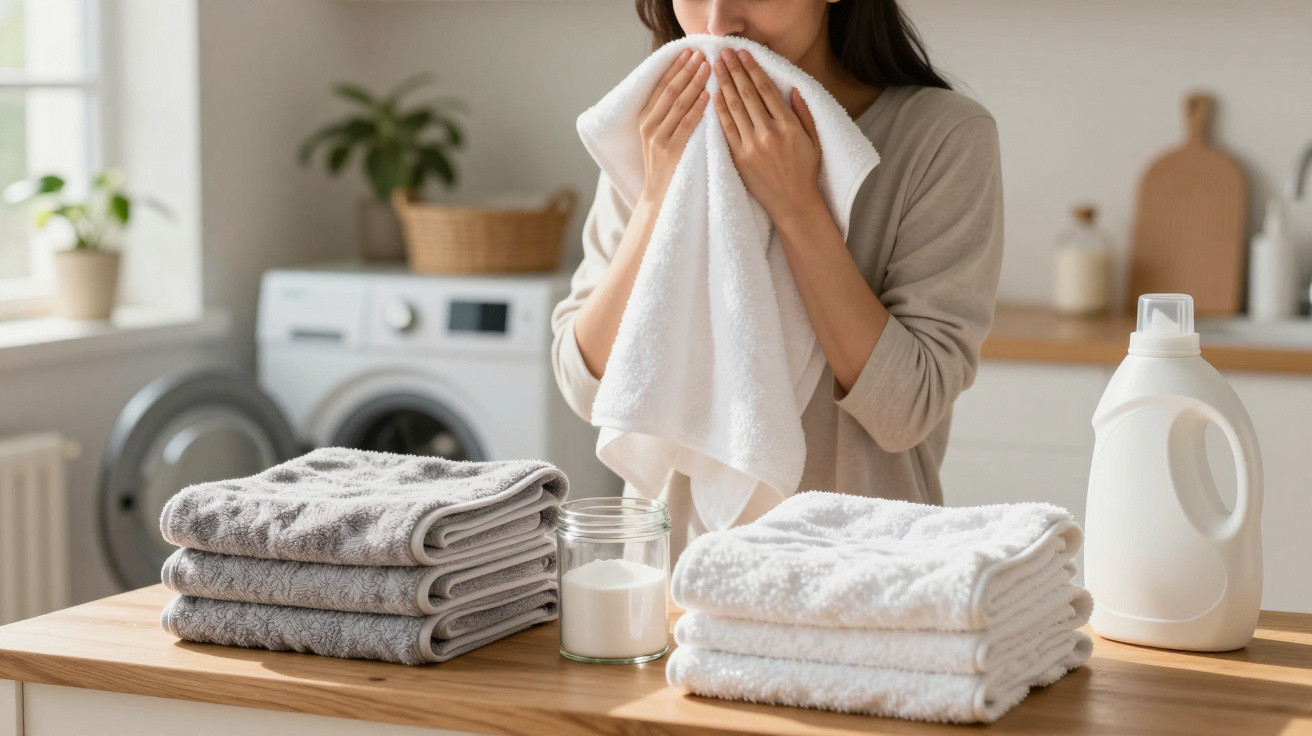
There is a very specific sort of let-down that comes after a hot shower: you reach for a freshly “clean” towel and detect a faint, musty smell. It is not quite wet dog, yet it is nowhere near spa-fresh. You press your face into the pile, tell yourself you must have imagined it, and sniff once more. Nope. It’s there. It smells like your airing cupboard in November. In an instant, what should have been a lovely self-care ritual feels faintly grubby.
Most of us wash towels faithfully, choose the “right” detergent and perhaps add a splash of fabric softener too. On wash day, they appear perfectly acceptable, stacked tidily in the cupboard and looking Instagram-worthy. But when steam reaches them, their true state emerges: worn-out, flattened and a little sour. It can feel oddly personal, as though your entire home has failed an invisible hygiene inspection. Fortunately, there is a surprisingly pleasing ritual that can change matters, giving towels a “reset” soak that would not look out of place in a skincare routine.
The quiet embarrassment of smelly “clean” towels
It is rarely discussed, but towels that smell sour despite being washed can feel like a small household humiliation. If you have ever offered a guest a towel while thinking, “Please don’t sniff that,” you are certainly not the only one. Towels absorb the evidence of everyday life: post-gym showers, hurried children’s baths and late-night hair washes before an early train. They endure plenty, then spend hours slightly damp on the back of a door, gradually becoming a miniature science experiment.
The discovery is especially stressful when it happens at exactly the wrong time. Perhaps your in-laws are coming to stay, or a friend is sleeping on the sofa. You put out a carefully arranged pile of towels, only to realise far too late that they smell as though they have spent days locked inside a forgotten gym bag. Most of us have had the experience of quietly smelling every towel in the cupboard, desperately hoping one will pass inspection.
In truth, hardly anyone washes towels as frequently or as flawlessly as laundry labels recommend. Life is hectic, washing machines are overfilled and the extra spin cycle you intended to use simply does not happen. With time, detergent accumulates, fabric softener remains on the cloth, and a mixture of dead skin cells and hard-water minerals settles deep within the fibres. That is the unseen part, and it is the odour another speedy 40°C wash cannot properly remove.
What’s really hiding in your towels
The mildly unpleasant reality is that, in laundry terms, “clean” can mean “looks fine” instead of fully refreshed. A trace of something is left behind after every wash. Detergent does not always rinse away fully, particularly if you favour a generous dose. Softener creates a waxy layer which initially feels pleasant but gradually smothers the material. Add body oils, perspiration and invisible flakes of skin caught in the centre of the towel loops.
Towels in hard-water areas have even more to contend with. Minerals in the water, including calcium and magnesium, settle into the fibres like tiny stones. Across months and years, this residue makes the loops heavy and rigid. Rather than feeling like a soft cloud, they begin to resemble a slightly resentful dishcloth. You can add as much fragrance as you wish, but the fabric beneath is genuinely burdened by build-up.
That is why an item may be washed ten times yet still smell strange as soon as it becomes damp. The odour is not merely sitting on the surface; it is trapped in layers of old detergent and soap scum. When you think of towels as small sponges holding years of leftovers, it becomes clear why an ordinary quick wash no longer does the job. This is where strip washing helps-not as a fashionable gimmick, but as the thorough clean your towels may have needed for years.
Strip washing: the oddly satisfying “reset” for tired towels
Strip washing sounds rather extreme, perhaps like a trick from an excessively produced cleaning-hack video, but its principle is straightforward. Rather than depending on a standard washing-machine cycle, you soak textiles in hot water for an extended period to draw out accumulated detergent, minerals, stale odours and everyday grime. It is a little like a digital factory reset for laundry that has lost its soul.
Some strip-washing methods use powerful powders and laundry boosters with vaguely radioactive-sounding names. A milder, more traditional approach relies on the sort of supplies your nan probably kept beneath the sink: bicarbonate of soda and white vinegar. There are no fluorescent blue liquids or hard-to-find ingredients, only two unassuming staples which can restore a towel when used correctly. The process is partly scientific, partly ceremonial, and remarkably satisfying to observe.
Why vinegar and bicarbonate of soda actually work
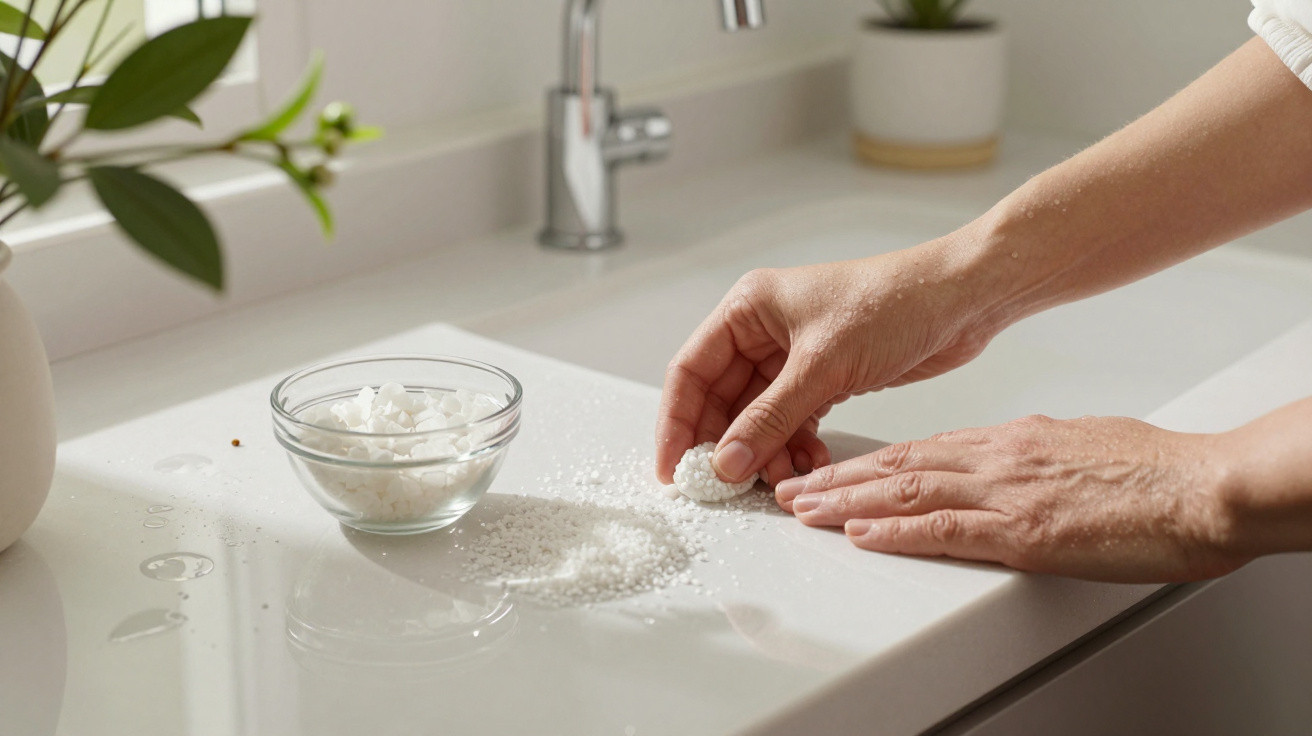
Bicarbonate of soda, the modest box found in the baking aisle, works as a gentle abrasive for fabrics. When dissolved in hot water, it can help lift grime, neutralise smells and improve the softness of fibres without damaging them. White vinegar, by contrast, is mildly acidic. This acidity helps break down hard-water mineral deposits and dissolve the persistent residue that detergents and softeners leave behind.
Applied in the correct order, they do more than disguise odours: they help reverse the accumulation responsible for them. Instead of a synthetic “summer meadow” fragrance that disappears with the first burst of steam, the result is closer to neutral. The fabric smells of almost nothing, which is ideal. Rather than battling your towels, you find they are working with you again.
How to strip wash towels with vinegar and bicarbonate of soda
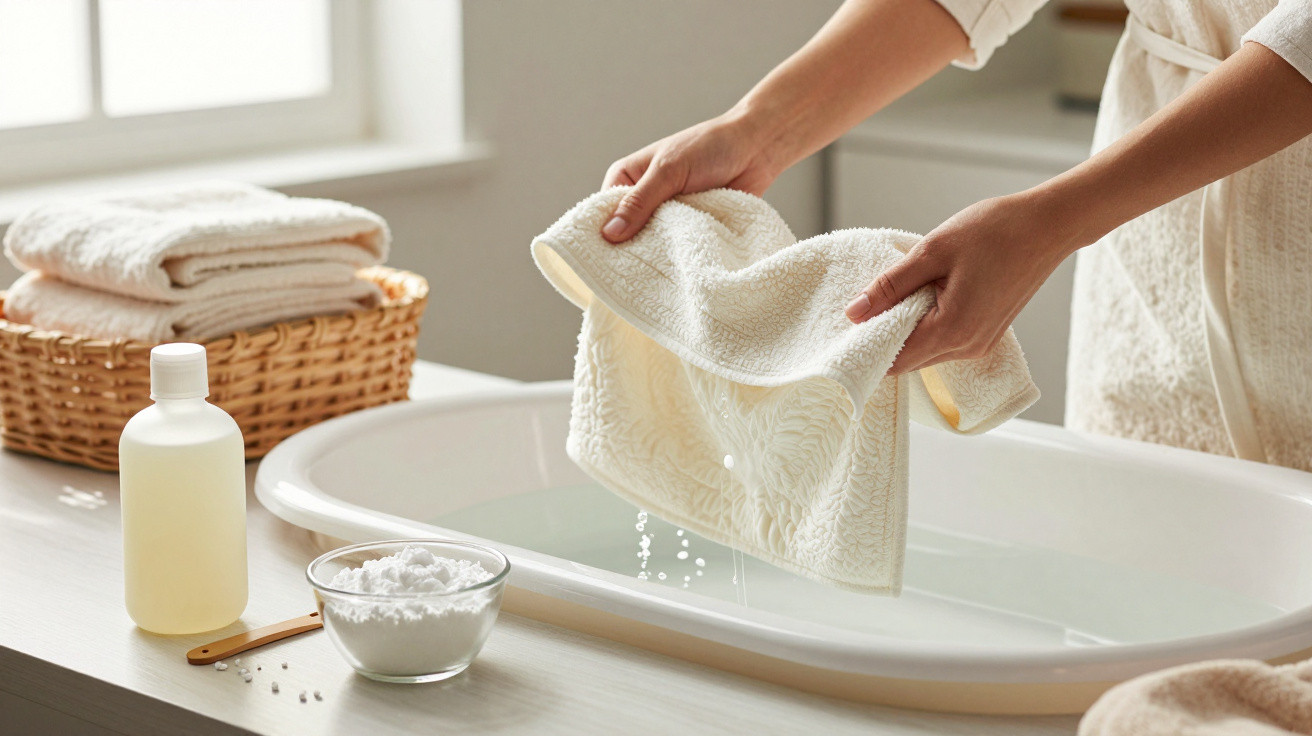
The method itself can feel unexpectedly soothing, like a modest spa treatment for items normally thrown straight into a machine drum. You will need a bath, large basin or sizeable plastic storage box capable of holding very hot water. Choose several towels in real need of help: greyed towels that smell “off” when wet, children’s bath towels or guest towels that secretly make you cringe.
The slow soak
Fill the bath or container with the hottest tap water you can handle safely. You can add water from a kettle if desired, provided it does not become dangerously scalding. For a standard UK bath containing a few towels, add roughly half a cup of bicarbonate of soda, stirring until it has dissolved. Put in the towels and press them beneath the water, squeezing out trapped air so that they are completely saturated. Watching the fabric strips take in water as the bath clouds over has a quietly therapeutic quality.
Allow the towels to soak for 3–4 hours, stirring and squeezing them well about once an hour. This is not an exact science; it is more akin to brewing a strong cup of tea. As time passes, the water may become an unattractive greyish colour. That rather unpleasant shade is precisely the aim, as it shows the residue leaving the fibres and moving into the water where it should be.
The vinegar finish
After the soaking period, empty the bath and gently wring out the towels. They will be weighty and exhausted, as though they have worked a long shift, but continue with the process. Put them through a hot machine wash without any detergent. In its place, add around half a cup of white vinegar to the detergent drawer or directly into the drum, according to your appliance. The vinegar helps rinse away the loosened material and gives any lingering mineral deposits or residue a final push.
Once the programme has ended, shake the towels thoroughly before drying them. If you have a tumble dryer, this is when the results begin to become clear: loops that previously felt clogged can start to fluff up again. Drying outdoors works as well; a little sunshine and moving air can leave them almost startlingly fresh, as though they have been rebooted. While folding them, you may find yourself absent-mindedly stroking the fabric, scarcely believing these are the same flat, heavy towels you nearly replaced.
The moment you notice the difference
The genuine test comes after the first shower following a strip wash. You leave the shower a little doubtful, take a towel and hold it to your face. There is no sour smell lying in wait, nor any lingering “laundry perfume” attempting to conceal something less pleasant. Instead, there is only the gentle, clean warmth of cotton allowed to breathe once more. It can feel a little lighter and somehow more ready to wrap around you rather than cling.
There is a low-key pleasure in discovering that you do not need to discard everything and begin again. Modern life often encourages us to replace things rather than restore them. Yet the towels you were giving suspicious looks to last week may now be fresh enough to offer visitors without hesitation. That small domestic success-a towel that behaves itself-can alter the atmosphere of an entire bathroom.
You may also find that towels dry more quickly between uses. Once the residue has been cleared, the fibres can perform their intended task: absorb water and then release it, instead of holding onto moisture like a secret. The persistent semi-damp odour that lingered in the bathroom can start to disappear. The room feels less like a changing room and more like somewhere in which you genuinely want to exhale.
What no one tells you about fabric softener and “fresh” scents
Strip washing brings another, slightly uncomfortable, realisation: much of what we identify as “fresh” is perfume doing the hard work. Most fabric softeners do not improve a towel’s absorbency and may actually reduce it. Their silky coated sensation comes from a wax-like film that allows fabrics to glide, while also stopping water from passing easily through the fibres. That may suit a blouse, but it is far less useful for a bath sheet.
After stripping towels, using lots of softener again can seem like covering their skin with a plastic raincoat. A gentler approach is more effective: use slightly less detergent, avoid softener entirely for towels and perhaps use a dryer ball if you tumble dry. The texture may initially feel different-less “slippy”-but the towels will absorb water more readily and remain fresher between washes. There is less for that deep damp smell to grip onto.
There is a subtle change in perspective as well. Standing in the cleaning aisle and recognising that half the bottles offer only different versions of a cover-up can be strangely freeing. Fresh doesn’t have to smell like “ocean breeze” or “sunrise meadow”; it can just smell like almost nothing at all. It is a quiet, truthful neutrality that does not turn sour when real life-steam, sweat and daily living-arrives.
How often should you strip wash – and when to let go
Strip washing is not a task for every week. Nobody has the time, and towels do not require it. Treat it as an occasional reset, perhaps every few months or when that recognisable musty note returns despite regular washing. You will begin to recognise the signs: towels seem to sit more heavily on the rail, or the pile appears defeated rather than inviting.
There is naturally a point beyond which the method cannot help. If towels have become thin, are fraying around the edges or have lots of snags, soaking will not make them hotel-standard luxury. In some cases, the kindest option is to relegate them to pet care, mopping floors or decorating projects, then buy a replacement set. Strip washing is a revival, not a resurrection. Still, extending the life of good towels by several years is deeply satisfying when you realise they only needed a lengthy bath and a couple of cupboard essentials.
The quiet pleasure of loving your towels again
It is easy to treat this as insignificant. They are only towels, after all. Yet they are the fabrics against your skin when you are most exposed and unguarded, whether you are leaving the shower in Monday’s half-light or recovering after a long, draining day. Being wrapped in softness that smells truly clean rather than artificially “freshened” is profoundly comforting. It tells a small story about the care you give both yourself and your home.
Strip washing will not transform your life, but it may improve one quiet part of it. Opening the cupboard to see towels that look plump and ready, rather than flat and vaguely damp, can bring a flicker of unexpected pride. You didn’t buy your way out of the problem; you understood it and fixed it. The next time a “clean” towel gives off that faint musty scent, you will know it is not a verdict on your housekeeping. It simply means your towels are due their own long, cleansing soak.



Comments
No comments yet. Be the first to comment!
Leave a Comment