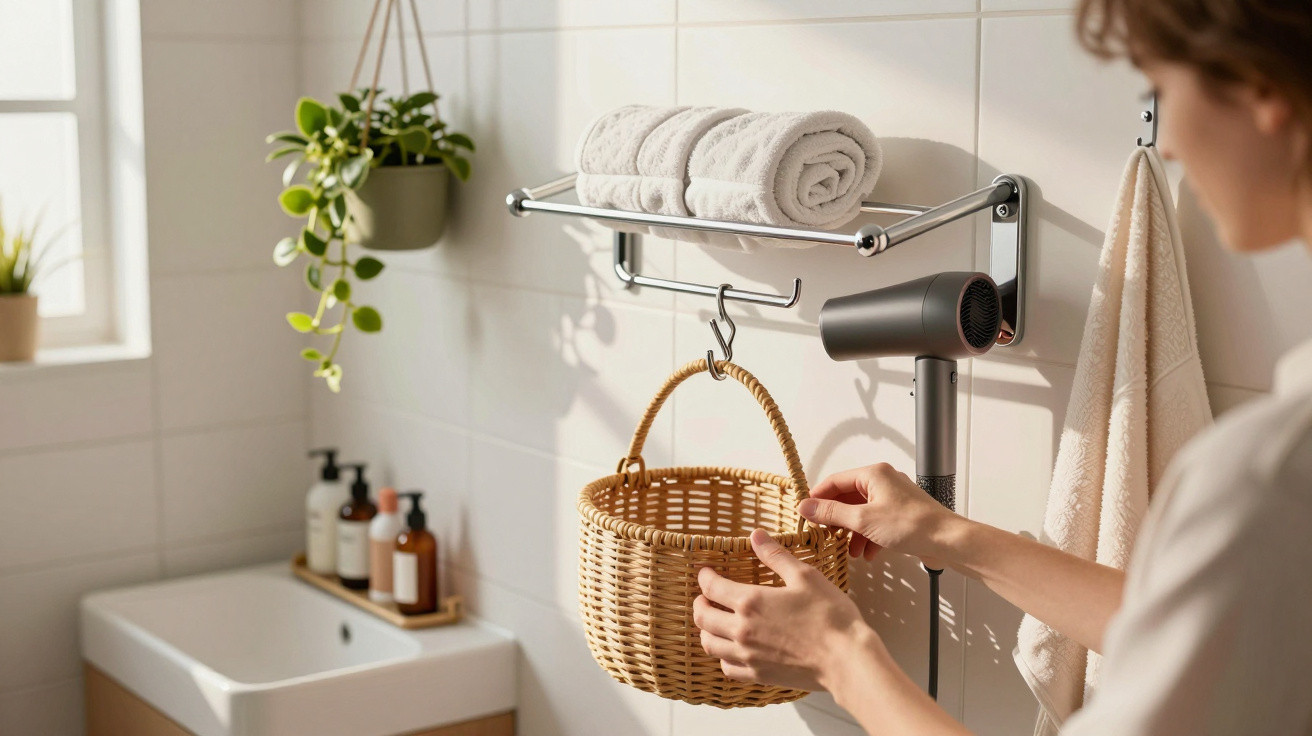
I watched a DIY professional called Lea enter that compact room, stop, and grin as though she had discovered unused floor space. She ran her hand over the towel rack, treating it less like a fixture than a pivot point for a more efficient routine. “We’re going to ask this thing to work harder,” she said, knocking on the wall as though it might respond. Rather than arriving with a replacement vanity or some miraculous storage tower, she had S-hooks, a tape measure and the unhurried confidence that seems to put clutter in its place. After measuring the rack twice, she slipped a clip ring over the rail and fastened a washcloth to it. That one small snap shifted the mood of the room. Baskets followed, then another rail, followed by a swing-arm solution that moved like a choreographed routine. It made something click for me as well: a towel rack can do more than one job.
Why your towel rack is concealing extra space
In most small bathrooms, a broad rail performs just one task: supporting a folded towel draped over it. That bar is ready for a bigger role. The space beneath, above and alongside it is where the opportunity lies. Lea calls it “stack[ing] the air”, using otherwise empty inches to create several levels of function. Tiny bathrooms don’t forgive wasted inches. Once a towel rack becomes a central support, everyday essentials can be hung, clipped and contained without making the room feel crowded.
In a 48-square-foot flat bathroom, we identified the unused areas: the rear of the door, one side of the vanity and the 8 inches beneath a standard rail. Using low-profile stand-offs, Lea fitted a slim second bar 5 inches below the first. She then placed four S-hooks on the upper rail for loofahs and added a fabric caddy for hairbrushes. The difference was not especially striking in photographs, but it was obvious in daily use. Towels dried more quickly because they were no longer heaped together, while the caddy stayed where it belonged. Yes, the back of the door counts as a wall.
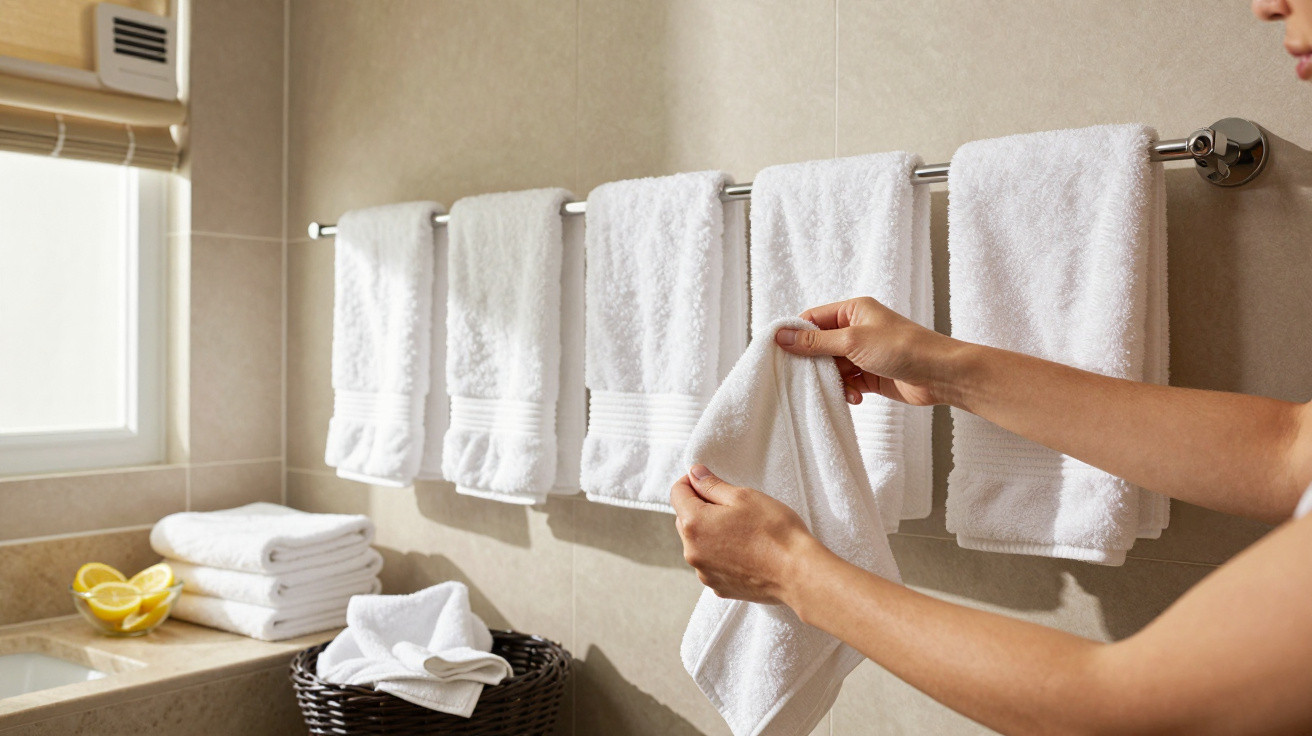
The principle is straightforward: a single horizontal rail offers one line of use. Two rails-or one rail combined with hooks-provide levels. More levels mean more capacity. Swing arms introduce movement, helping air circulate and fabrics dry. Lea leaves 4–6 inches between rails to prevent towels being squashed together, and chooses shallow baskets that will not catch you as you walk past. Metal rails work well with magnets and clip rings, while wooden versions suit straps and looped organisers. It comes down to friction: sufficient grip to secure items, without anything catching. The result is neater, but above all, quicker to use.
How to make a basic towel rack a multitasking station
Begin with the towel rack you already own. Add S-hooks for washcloths, bath mitts or even a razor cup with a loop. Curtain rings with clips can turn the rail into a compact display for smaller necessities. Where there is enough room, fit a second, shallower rail 4–6 inches below the existing one with slim stand-offs; use that lower rail as the “wet zone” for hand towels and reserve the upper one as the “dry zone”. A swing-arm rack near your main bar creates a drying tree that folds flat when you’re done. Used together, they operate much like a compact washing line.
A slim fabric caddy suspended from two hooks can hold hair ties, cotton pads and a travel hairdryer. On adhesive mounts, keep the load below 6–8 pounds. If drilling through tiles feels daunting, fix hardware along grout lines or choose a rail with humidity-rated micro-suction backers. Put racks where your hands naturally reach: by the basin for hand towels, behind the door for bath sheets and next to the shower for dressing gowns. Let’s be honest: nobody actually does that every day.
Most of us have experienced the moment when a towel lands in the sink and we promise to sort things out on Saturday. That is the bit that makes Lea smile.
“A towel rack isn’t a decoration. It’s a handle for your morning,” she says. “Give it three jobs: dry, hold, and catch. Everything else is luxury.”
- Put S-hooks or clip rings on your current rail to create immediate extra capacity.
- Install a second shallow rail 4–6 inches below the first for a two-tier arrangement.
- Replace one rail with a four-arm swing rack for improved airflow without added bulk.
- Suspend a slim basket for brushes and spare toilet rolls-keep it below 3 inches deep.
- Turn the rear of the door into storage with a vertical ladder rack for stacked bath sheets.
Towel rack mistakes to avoid and time-saving professional tips
Overloading a towel rack is the quickest way to make a small bathroom seem even more cramped. Avoid using it as a coat stand. Limit each rail to two towels, or each moving arm to one. Leave a gap around every item so it can dry properly. Dampness is unforgiving; it takes over when fabrics are touching. A simple label-face, hands, body-shows everyone at home where each item belongs without needing an explanation. Set up a single hook for “the towel in play” and the rest stops migrating to the floor.
Concern about damaging tiles is understandable. Making pilot holes in grout reduces the strain, while painter’s tape prevents drill bits from slipping. If you rent or simply do not want to drill, select rails made for removable adhesive; first clean the wall with alcohol, then allow the full curing period before adding weight. In humid rooms, opt for stainless steel or powder-coated aluminium. Timber brings warmth, but it needs ventilation. Choose shallow baskets to avoid bumping into them at 7 a.m. Compact bathrooms benefit from restraint-and reliable fixings.
Lea’s guiding principle is reassuringly realistic. She laughs and gives a shrug.
“Build for the life you live on Tuesday morning, not the Pinterest version. If it takes two hands or thirty seconds, you won’t use it.”
- Recommended rail height: 48 inches from the floor for adults, 36–40 inches for children.
- Space between stacked rails: 4–6 inches for airflow, 8 for bath sheets.
- Maximum basket depth beside a walkway: 3 inches.
- Weight guidance: 6–8 pounds for adhesive rails, 15–20 with suitable anchors.
- Quick additions: S-hooks, clip rings, narrow caddies and magnetic cups for metal rails.
What happens when your towel rack does more
You no longer need to search. The hand towel sits exactly where your hand reaches. A washcloth can dry without competing for room. The brush that once sat on the windowsill is now close at hand and no longer falls into the basin. A two-rail or swing-arm arrangement removes the anxiety of damp towels, quietly reducing the size of the laundry pile. Your morning becomes a smooth sequence instead of a search for essentials. The room appears more spacious, although its walls have not shifted.
There is a certain ease when every object has a purpose. Better still, an improved rack can reflect your own style rather than resembling a showroom display. Pick black hooks, brass rings or understated steel-it is your choice. Adjust the arrangement as the seasons change. Hang sunscreen in summer and store a hair bonnet in winter. In a very small bathroom, the towel rack is not merely an accessory. It is the control centre, right there in plain sight. Make one adjustment this week and see what it frees up.
| Key point | Detail | Benefit for the reader |
|---|---|---|
| Stacked rails | Position two rails 4–6 inches apart to separate “wet” and “dry” zones | Quicker drying, fewer piles of towels and a cleaner appearance |
| Swing-arm rack | Folding arms provide airflow and sit flat when not needed | High drying capacity without permanently using space |
| Hook and caddy combination | S-hooks and a shallow hanging basket fitted to the same rail | Keeps small essentials nearby and clears clutter from the counter |










Comments
No comments yet. Be the first to comment!
Leave a Comment