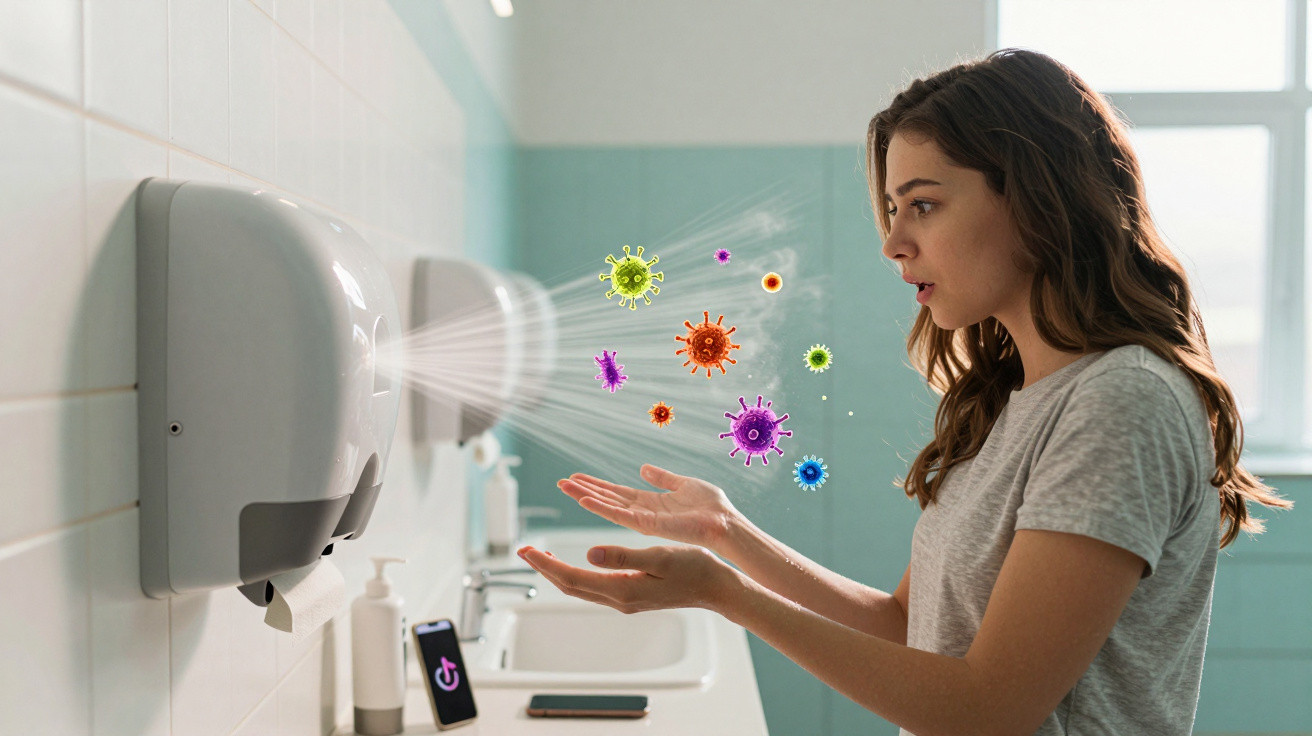
Hand dryers may appear harmless in public toilets, but a simple laboratory experiment reveals what they can blow on to freshly washed hands.
Many people choose electric hand dryers for convenience or environmental reasons. No paper, no waste and a quick blast of warm air: it sounds clean and modern. However, a viral experiment by a scientist suggests that the pleasant airflow may conceal a hygiene issue far more unpleasant than most people realise.
The TikTok experiment that unsettled millions
The scientist, known online as “Devon Science”, wanted a clear answer: how many germs reach the skin when someone holds their hands beneath a public hand dryer? Her approach was straightforward, almost like a school experiment, yet the results looked like something from a microbiologist’s horror film.
She used two Petri dishes containing growth medium. One was positioned directly beneath an operating hand dryer in a public toilet, while the other remained in clean laboratory air as a control. Both dishes were left to incubate overnight.
The following day, the difference was striking. The control dish was virtually empty. The dish placed in the toilet, by contrast, contained a thick layer of yellow, black and white spots. Each individual colony represented a group of bacteria or fungi propelled on to the dish by the airflow.
“The hand dryer did not behave like a hygienic appliance, but like a germ launcher aimed directly at hands and faces.”
Which germs are present in hand dryer air
An analysis of the colonies revealed a mixture that nobody would want to find in a hygiene appliance. It included common problematic germs associated with public toilets.
- Staphylococcus aureus: bacteria that can cause abscesses, wound infections and, in rare cases, pneumonia.
- Escherichia coli (E. coli): a typical gut bacterium linked to faeces which, if transmitted incorrectly, can lead to diarrhoea, urinary tract infections or more serious illnesses.
- Fungal spores: the black dots indicated mould or yeast fungi, which can irritate the airways and worsen allergies, particularly in people with asthma or weakened immune systems.
The experiment indicates that a hand dryer does more than dry hands. At the same time, it distributes bacteria and fungal particles that were previously present somewhere in the toilet, whether on walls, floors or within the appliance itself.
How hand dryers spread germs at high speed
The key reason lies in their design. Hand dryers draw in air from the room, accelerate it using a powerful fan and direct it in a concentrated stream at hands and forearms. There is nothing inherently hygienic about that air.
- Extreme air speed: modern jet hand dryers can reach several hundred kilometres per hour. This can pull tiny water droplets, skin flakes and toilet aerosols from the surrounding air into the stream, along with any germs attached to them.
- Internal dirt reservoir: in another test, the researcher swabbed the inside of a dryer with a cotton bud. The bud turned dark, suggesting accumulated dirt and bacterial deposits. When the appliance is switched on again, some of these deposits may be propelled back into the air.
This creates a cycle: using the toilet introduces germs into the room’s air; the dryer draws them in and allows them to build up; then, during the next use, it blows them out again at face height towards users.
Why washed hands become “contaminated” again
After washing, the skin may be clean but it is still damp. That moisture makes it more receptive to airborne germs, as micro-organisms adhere more easily to wet skin than dry skin.
Anyone holding their hands in the airflow for 20 to 30 seconds gives germs time to settle into every fold of skin. As a result, some of the benefit of careful handwashing can be lost.
What do studies say about paper versus air?
Separate from social-media experiments, specialist studies have examined for years whether paper towels are more hygienic than warm-air or jet dryers. Many studies reach a broadly similar conclusion.
| Method | Germ spread around the room | Germs on hands |
|---|---|---|
| Paper towel | Low: germs largely remain in the towel | Often fewer germs after drying |
| Warm-air dryer | Medium to high: the airflow stirs up germs in the room | Hands may be contaminated again |
| Jet hand dryer | High: substantial aerosol generation and wide dispersal | Hands sometimes show considerably more germs than after using paper |
For this reason, many hygiene specialists favour paper towels in hospitals and care homes, particularly in sensitive areas.
HEPA filters and UV light: solution or window dressing?
Manufacturers have responded in recent years with technical upgrades. Two terms appear repeatedly: HEPA filters and UV sterilisation.
- HEPA filters: these are intended to remove up to 99.97% of particles above a particular size from the air. In theory, this reduces the number of germs reaching hands. In practice, much depends on maintenance and filter replacement, as dirty filters become less effective.
- UV light inside the appliance: ultraviolet radiation can kill bacteria and fungi. For this to work, however, air must be exposed for long enough and with sufficient intensity. Whether this happens consistently in compact dryer housings is questionable and varies by model.
There is another issue: many older buildings still have conventional models with no additional filtration at all. Anyone using toilets at a railway station, motorway service area or pub is more likely to encounter an ageing standard appliance than a high-tech version.
What you can do in a public toilet
Despite the risks, avoiding public toilets entirely is not realistic. A few straightforward habits can, however, reduce your personal risk.
Practical tips for travellers, commuters and parents
- Choose paper over air where possible – If both paper towels and a dryer are available, use the paper. Germs go into the bin rather than the air.
- Alternative option: shake your hands – If a dryer is the only choice, shake excess water off over the basin, then roughly dry the rest on your trousers or with a tissue.
- Use sanitising gel – A small bottle in a backpack or handbag can help reduce the number of germs after using the toilet, especially while travelling.
- Keep your face away – If using a dryer cannot be avoided, stand with your head and body slightly to one side so less air blows directly into your face.
- Handle door handles carefully – Many germs ultimately end up on handles. Holding a paper towel between your hand and the handle, or using a quick elbow push, can help.
Where the problem is especially critical
For a healthy adult, contact with typical toilet germs is unlikely to cause harm in many cases. The situation becomes more concerning when people with existing vulnerabilities are involved.
Groups at greater risk include:
- patients with open wounds or recent operations
- people with severely weakened immune systems
- premature babies and very young children
- residents of care homes and homes for older people
In these settings, even smaller numbers of problematic germs can have consequences. It is therefore unsurprising that the debate over hand dryers is gaining momentum again in many hospitals.
Why we often underestimate germs in everyday life
People do not notice germs: they rarely smell, cannot be seen and do not hurt at first. We rely heavily on appearance. A gleaming white toilet looks clean even when the air is full of micro-organisms. An old, slightly crumpled paper towel may look “grubby”, yet it is often the more hygienic option.
There is also a psychological factor: technology creates a sense of security. An electric appliance with a sensor, LED light and powerful fan appears more modern than a basic paper-towel dispenser. Many people automatically interpret this as “more advanced”, and therefore “cleaner”.
This is precisely the point highlighted by the Devon Science experiment. It makes the invisible visible and demonstrates that high-tech does not automatically mean more hygienic. For operators of restaurants, motorway service areas or offices, this raises an uncomfortable question: are they ultimately cutting costs in the wrong place by removing paper towels?
For everyday life, one simple principle remains useful: wash properly first, then dry properly. Anyone who does not rely blindly on a hot stream of air reduces their own risk while also protecting people with less resistance to infection.

Comments
No comments yet. Be the first to comment!
Leave a Comment