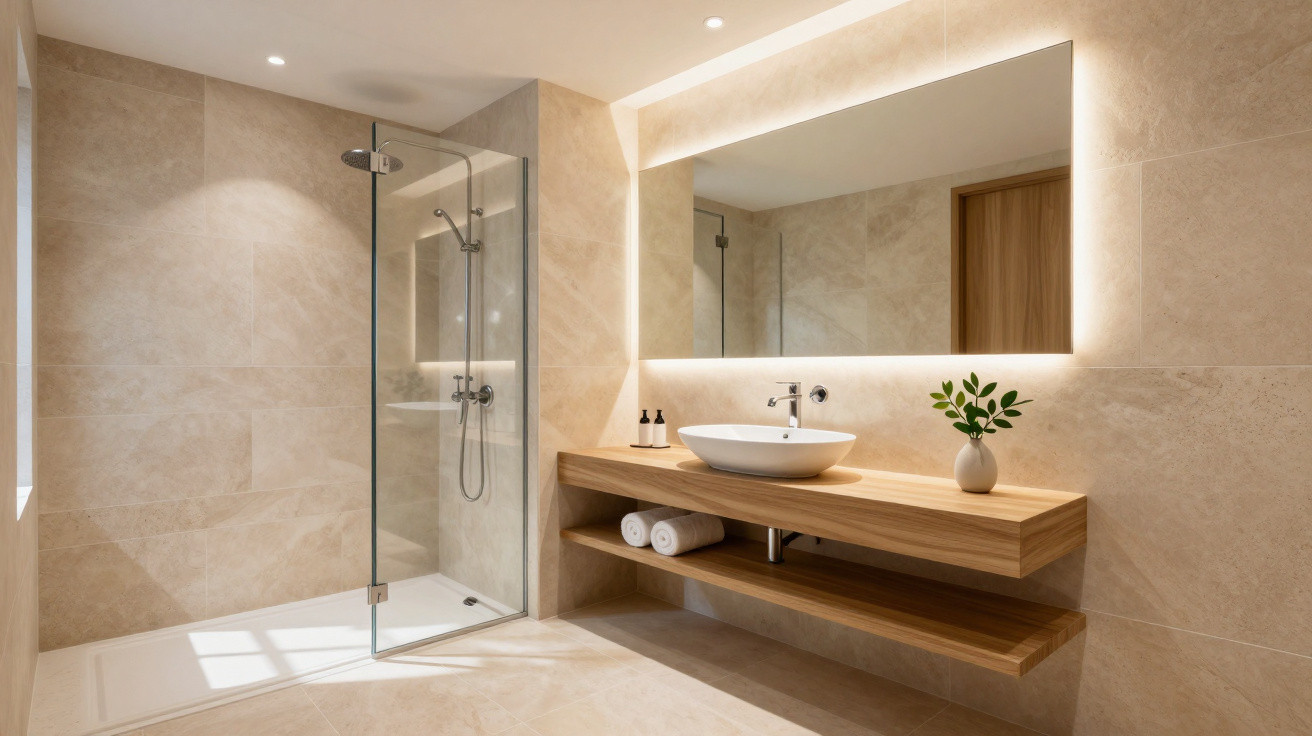
Sarah looked around her cramped bathroom and felt the same familiar disappointment. It was not merely small: it felt claustrophobic, inexpensive and almost as though it ought to apologise for taking up space. Each morning, she had to edge past the vanity unit, avoid the shower door and see herself in a mirror that appeared to make the room smaller still. The miniature metro tiles covering the walls formed a distracting pattern, making the space feel even tighter. She would browse the beautiful bathroom transformations on Instagram and wonder how others created spa-like retreats in rooms scarcely larger than her own. Then, while hurrying to get ready for work one Tuesday morning, she realised the truth: size is not everything.
The Psychology Behind Spacious Design
Step into a high-end hotel bathroom and one thing becomes obvious straight away. It may not occupy a huge floor area, but it still feels generous and impressive. Luxury is not about having a bigger room; it is about creating the illusion of space and making use of every available visual technique.
Interior designers have understood this for decades. A recent American Institute of Architects study found that homeowners regularly judge rooms with fewer visual interruptions to be larger than they really are. One designer I spoke to described turning a 3.7 m² bathroom in Manhattan into a space clients called “surprisingly roomy”. Her key tool was not removing any walls.
The effect comes from knowing how the brain interprets visual information. Dense patterns, several focal points and severe lighting can overload the senses. The eye moves rapidly around the room, so it seems cramped and disorderly. In contrast, uncluttered lines, carefully placed reflections and continuous surfaces allow the eye to travel smoothly through the space.
The Three-Element Transformation Strategy
Begin with mirrors, but set aside what you assume about positioning a bathroom mirror. Rather than fitting one small mirror in the middle above the basin, think about running a mirror across a complete wall. It immediately doubles the perceived space, adding depth where there was none.
Most of us, if we are honest, put a mirror where the previous owner fixed one and leave it at that. Doing so overlooks the greatest chance to transform the room. Many people fear a large mirror will reveal “too much”, yet it does the reverse: it introduces a sense of scale that can make the bathroom feel like a luxury suite.
“The goal isn’t to add more light fixtures, but to layer the light you have,” explains interior designer Maria Chen, who specializes in small space transformations. “Think of lighting like makeup – you need different types for different effects.”
Key lighting features include:
- Warm ambient light from ceiling fittings
- Task lighting positioned on either side of mirrors, rather than above them
- Accent lighting behind wall-hung vanity units
- Improved natural light through considered mirror placement
Why Large Format Tiles Change Everything
Imagine two otherwise identical bathrooms: one finished in 5 × 5 cm mosaic tiles and the other in 30 × 60 cm porcelain tiles. The smaller mosaic tiles make the room look busy and broken up, with hundreds of grout lines adding visual noise. By comparison, the large format tile option creates continuous, uninterrupted surfaces that fool the eye into seeing more space than is actually there.
This is not simply a design concept; it is optical science in practice. When Sarah eventually refurbished her bathroom with these ideas in mind, visitors repeatedly asked whether she had enlarged the room. She had not altered one structural feature. The difference came from recognising how materials work with light and sightlines.
We have all entered rooms that simply “feel right” without being able to say precisely why. Often, it is because someone has understood these essential principles and used them with care. A small bathroom no longer needs to apologise for its proportions. The most striking transformations can sometimes result from the simplest change in perspective.
| Key point | Detail | Value for the reader |
|---|---|---|
| Strategic Mirror Placement | Full-wall mirrors rather than small, centred mirrors | Immediately doubles perceived space and light |
| Layered Lighting Design | A combination of ambient, task and accent lighting | Adds depth and removes harsh shadows |
| Large Format Tiles | 30 × 60 cm tiles instead of small mosaics | Minimises visual clutter and creates flow |














Comments
No comments yet. Be the first to comment!
Leave a Comment