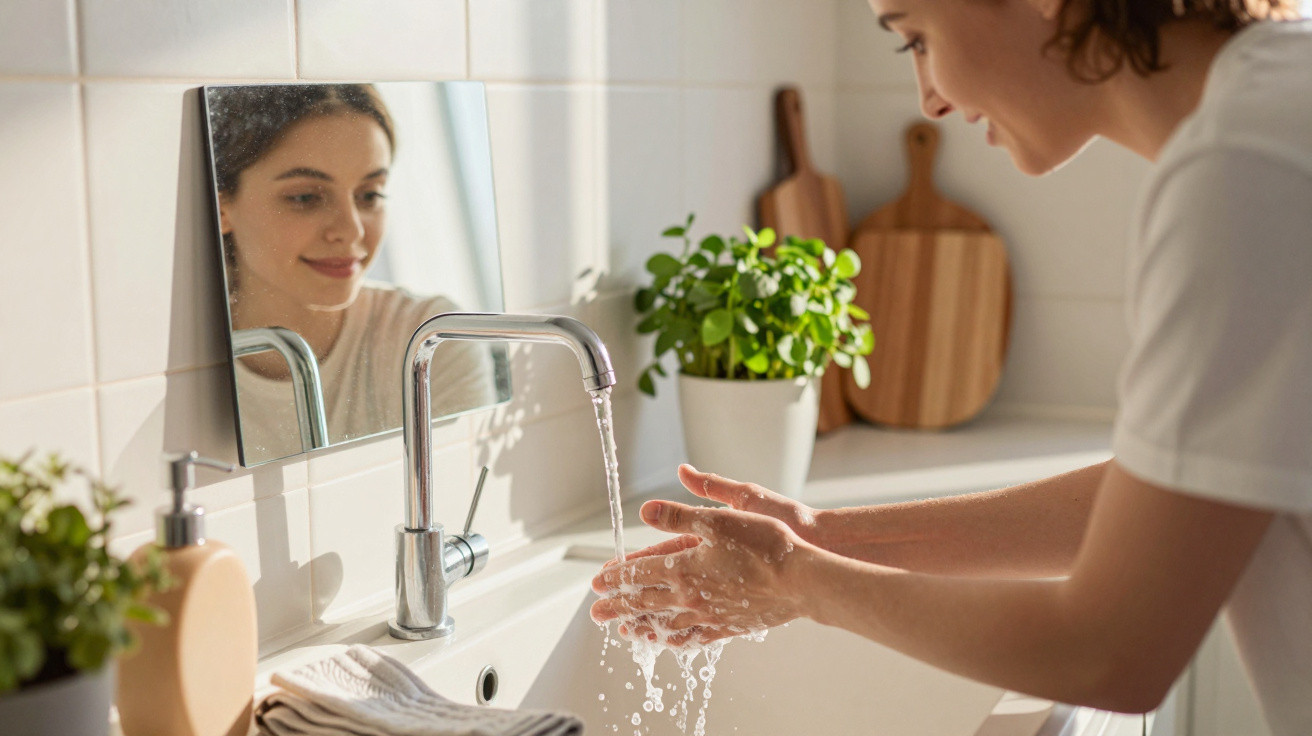
The first time I came across the mirror trick, I was in a friend’s cramped city kitchen, waiting for the kettle to come to the boil. She had tucked a small oval mirror between a plant and the washing-up liquid, directly behind the sink. Initially, I assumed it was simply decorative. Then, while working soap between my fingers, I caught sight of my own eyes. I saw myself hurrying, overlooking my thumbs and neglecting my nails. It felt faintly awkward, as though somebody was watching. That “someone” was me. I took more time and washed my hands properly. I have not really forgotten that sensation. One inexpensive mirror had quietly improved an entirely everyday routine.
The unusual effect of watching yourself wash your hands
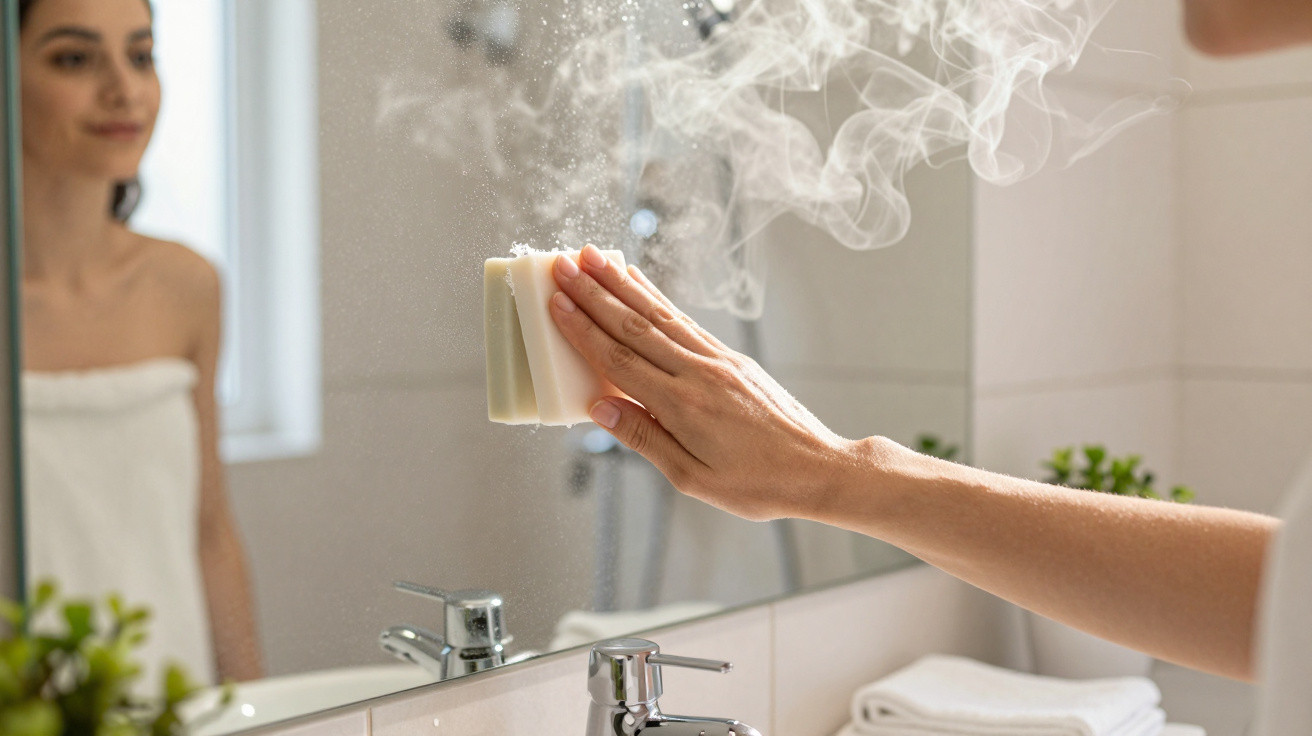
When you lean over the kitchen sink, your hands are unlikely to be on your mind. You run the tap, reach for soap, rub briskly, rinse and finish. It is such an automatic sequence that your brain scarcely registers it. Imagine that same moment, except your face is visible in a small mirror positioned behind the tap. Suddenly, you are not merely two hands beneath running water. You are a complete person looking back at yourself: your expression, your hurried movements and the areas you overlook. The process takes on a different quality-more intentional, almost like a tiny performance.
During a field study in shared bathrooms, one public health researcher called this “indirect self-observation”. People who could see their reflection near a hygiene station washed for longer and more carefully. A comparable response has been observed in supermarkets that place little mirrors above salad bars: customers take smaller servings and act more tidily. A mirror does not instruct you what to do. It just prompts you to pay attention to yourself. Once you do, your own expectations subtly become higher.
Psychologists refer to this as the self-awareness effect. As soon as you recognise that you are being watched-even by your reflection-your behaviour is more likely to match your values. If cleanliness matters to you, you may scrub more completely. If you see yourself rushing as though you are about to miss a train, you might feel a slight pang and ease off. This is much like the extra care many of us take when typing while our screen is shared on a video call. A kitchen mirror can turn a thoughtless splash of water into a brief, deliberate choice.
Setting up a “clean-hands” mirror behind your kitchen sink
There is no need for an elaborate fitting. Even a cheap, lightweight mirror roughly the size of your hand can alter the experience. Set it at eye level immediately behind, or just above, the tap, where your face will naturally appear as you bend forwards. You could rest it against the splashback, attach it using removable strips or suspend it from a small hook. What matters is seeing your eyes rather than only your chin. That brief moment of eye contact was what changed my own routine in my friend’s kitchen.
Making the mirror purely decorative is a frequent error. Your brain will tune it out if it is too high, too low, or obscured by draining racks and bottles. We all know how easily a helpful item can fade into the background of a home. Choose a straightforward mirror that is easy to wipe, and avoid cluttering the space around it. If sponges and brushes tend to accumulate, move them a little to one side so plastic and foam do not conceal your face. Small changes like these preserve the self-awareness prompt.
Some behavioral scientists talk about “nudges” that aren’t preachy yet change what we do. A mirror behind the kitchen sink is exactly that kind of nudge: silent, gentle, and surprisingly effective for something that costs less than a takeout lunch.
- Choose a small, unframed mirror that can be cleaned easily.
- Position it so that your eyes naturally meet your reflection as you wash.
- Keep the area around the sink as free from clutter as is reasonably possible.
- Use the mirror alongside a liquid soap that you genuinely enjoy using.
- Try different angles until you feel just a little more “seen”.
How a kitchen sink mirror changes your routine
After the mirror has been installed, the change may seem strangely understated but still tangible. Without consciously counting, you may wash for 20 seconds rather than 5. You could spot more lather, take greater care beneath your nails and concentrate more on rinsing your wrists. There is a slight emotional element too: you feel a little more responsible to yourself. To be honest, nobody does this with every single handwash, every day. Yet when you are tired or distracted, your reflection offers a quiet prompt about the standard you want to maintain-for yourself and for those you prepare food for.
| Key point | Detail | Value for the reader |
|---|---|---|
| Indirect self-observation boosts care | Seeing your face while washing increases self-awareness and effort | Encourages more thorough hand washing without extra willpower |
| Placement matters more than price | Small, well-positioned mirror beats expensive but poorly placed decor | Low-cost, practical setup that works in tiny or cluttered kitchens |
| Habit change feels almost automatic | The mirror nudges behaviour instead of demanding discipline | Helps you protect your household’s health with minimal friction |
FAQ:
- Question 1 Does a mirror behind the sink really change how well people wash?
- Question 2 What size mirror works best in a small kitchen?
- Question 3 Will guests actually notice and wash more carefully too?
- Question 4 Where exactly should I place the mirror for maximum effect?
- Question 5 Can this trick help kids or is it mainly for adults?




Comments
No comments yet. Be the first to comment!
Leave a Comment