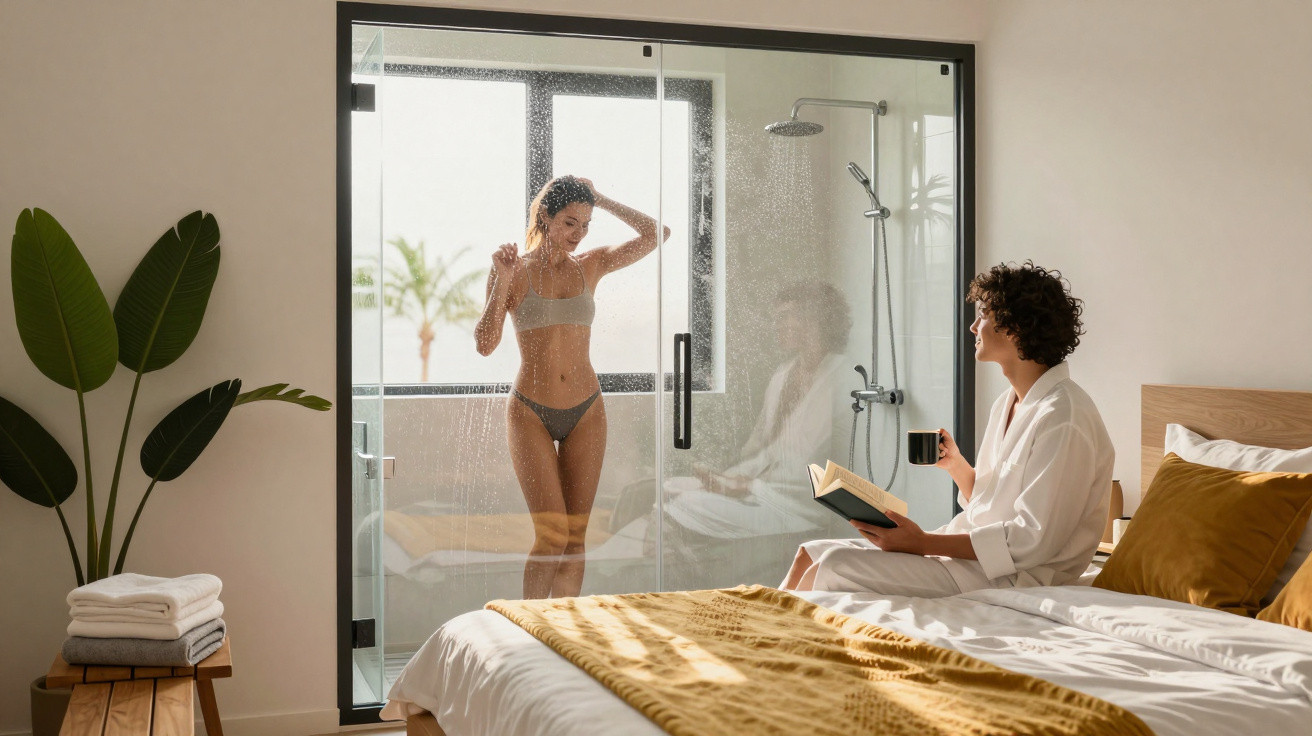
The first time Emma showed her parents the new “bathroom”, they could only stare.
The shower was positioned in the centre of the main bedroom, lit by a soft circle of light and set behind a low marble plinth. There was no wall and no curtain: only glass, with the bed three metres away. Her mother murmured something about “losing all sense of boundaries”. Her father wanted to know what had happened to the proper bathroom. Emma laughed, her partner appeared uncomfortable, and the architect wore the smile of someone who saw this reaction every week.
Online, the responses were even more polarised: “So sexy!” appeared alongside “absolutely horrifying”. What was once the home’s most secluded room has become a display space.
And many couples are discovering, rather painfully, what that entails.
From taboo to statement piece: why showers are moving into bedrooms
In upscale hotels, placing a glass-walled shower beside the bed began as a slightly provocative flourish. It suggested intimacy and gave guests the impression of staying in a stylish, design-led suite in Berlin or Bali.
That same concept is now finding its way into conventional homes. Architects are drawing up open showers directly beside headboards, influencers are posting “shower-with-a-view” room tours, and estate agents increasingly sell “spa suites” rather than bathrooms.
What was formerly tucked away behind a door is becoming the focal point of the room. It is a form of domestic theatre, with water, steam and skin taking the place of the traditional vanity mirror and towel rail.
Browse interior-design feeds and the same image appears again and again: a king-size bed with lightly rumpled linen, plus either a freestanding bath or a glass enclosure with a rainfall showerhead only a few steps away.
Interior designers in Paris and Milan say that up to 30% of new master suites they currently design include an open or semi-open shower arrangement. In São Paulo and LA, luxury schemes are being marketed with renderings that erase any firm divide between the sleeping area and washing area.
The reasoning is usually identical: more daylight, a greater sense of space, and couples who have “nothing to hide”. That is, until one person in the relationship realises how much they valued having a door.
Part of the reason is straightforward: homes are changing. Urban flats are getting smaller, property prices are rising sharply, and every square metre needs to do more work.
Taking down walls can save both room and money, but it also transforms the atmosphere of a home. Designers tend to talk about “wellness flows” and “rituals”, rather than showers and basins. The bathroom becomes a spa area, the bedroom turns into a lounge, and the spaces blend into one grown-up playground.
There is also a powerful element of design pride involved. A shower placed openly in the room announces: we’re modern, we’re open, we’re not like our parents.
It photographs brilliantly for Instagram. Day-to-day life with it can be another matter entirely.
How to live with an open shower without hating your partner
If the idea appeals to you, begin with a practical question: when do I actually shower? Is it in the morning, late at night, or while somebody else is lying in bed reading or doomscrolling?
Then plan for real life rather than an idealised version of it. A glass box in the middle of the room may evoke a boutique hotel, but a semi-open arrangement is often more workable at home: half-height partitions, textured glazing, or a shower positioned slightly away from the bed.
Consider the route through the room. When you get out of bed and walk to the shower, where will wet feet land? Where will the towel go? And where will shampoo bottles be stored, so that the room does not resemble a supermarket shelf?
Romance has its place. Slipping on a wet floor at 6:45 a.m. does not.
The usual error is not choosing the wrong glass or tiles. It is failing to discuss boundaries at all.
One Berlin architect described a couple who both insisted they were “totally cool” with an open shower when they approved the plans. Within six months of moving in, they were arguing every day because one partner began to feel exposed, especially on sleepy weekday mornings before coffee.
Discuss the unglamorous everyday realities: shaving, period days and stomach bugs. Be frank with yourself: do I want my partner to see all of that, every time?
Let’s be honest: nobody really does this every day as they do in shower-gel adverts, smiling beneath a perfect stream of water. Real life is untidy, and the design must accommodate that too.
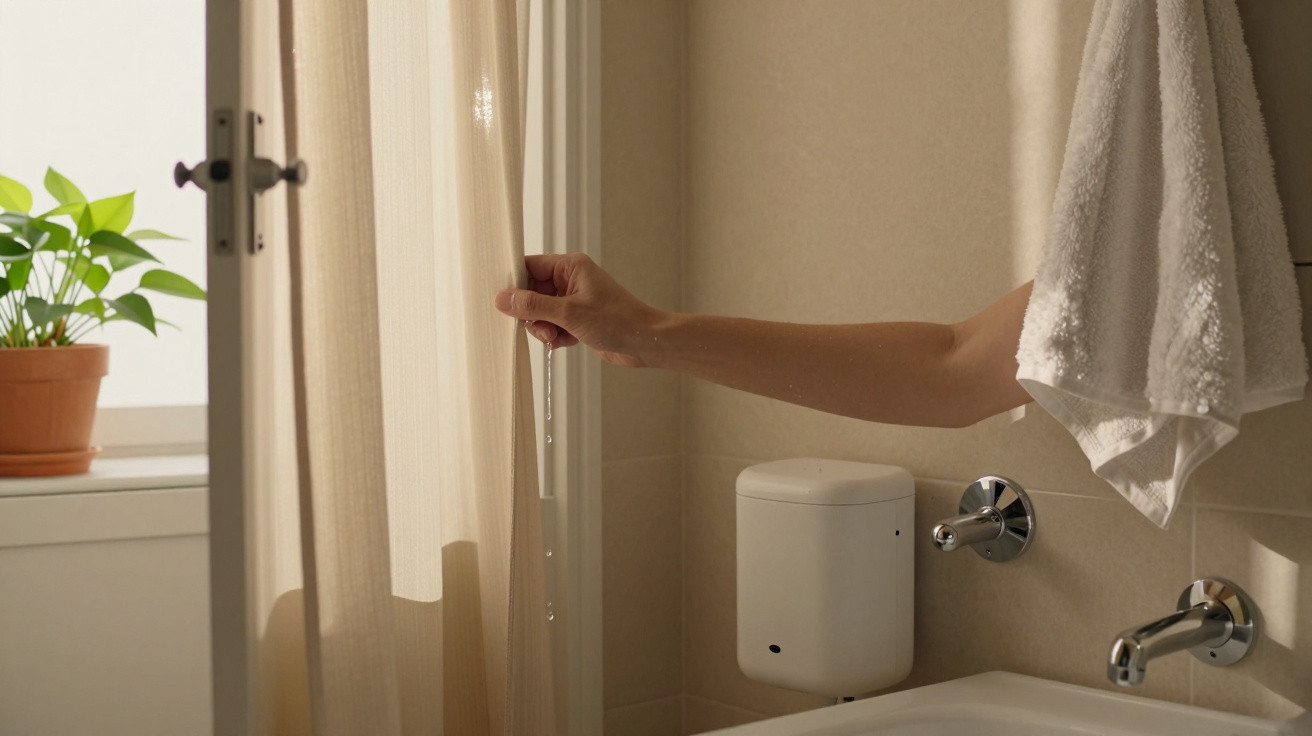
Designers who specialise in these schemes recommend including small privacy “escape valves”. This might mean a ceiling-mounted curtain track that can be drawn in seconds, or a sliding fluted-glass screen that obscures the body without removing the light.
As one London interior architect told me:
“The best open showers are actually 70% open and 30% cheat. That 30% saves relationships.”
A few uncomplicated details can make a major difference:
- Raise the shower floor slightly to stop water travelling beneath the bed.
- Fit dimmable warm lighting so a midnight shower does not illuminate the entire bedroom.
- Select textured or tinted glass if one person is shy but still likes the concept.
- Conceal drainage and pipework to retain a “spa” feel rather than a changing-room atmosphere.
- Include a separate toilet nearby that can be completely closed off. This is non-negotiable.
The new intimacy test hiding in plain sight
Open bedroom showers are more than a passing interior trend. They create a quiet, daily test of what intimacy between two people actually involves.
Some couples say the arrangement has brought them closer together. One can shower while the other gets dressed, they can talk, and it can feel as though there is no backstage any more: everything is shared.
Others say they feel watched rather than understood. What was intended to be sensual becomes a faint but persistent source of tension: one person prefers the lights on, while the other wants shadow.
At a deeper level, this layout raises a question that is rarely voiced: where does my body end, and where does my private self begin?
Most of us have locked the bathroom door not because somebody was about to enter, but because the world felt overwhelming and we needed three minutes alone. Remove that door and something subtly changes.
In households with children, an open shower in the parents’ bedroom becomes symbolic. It signals that this is the adult area, where the rules differ and bodies are not concealed in quite the same way. That may feel liberating, but it can also seem performative, as though adulthood now requires a glass enclosure to demonstrate itself.
Visiting friends will have opinions, whether or not they express them. Some will enthuse about the hotel-like atmosphere; others will go home and gratefully check the locks on their own bathroom doors.
Perhaps the most interesting question is what follows. After several years with a shower in the centre of the bedroom, returning to a tiled cubicle at the end of a corridor may feel unexpectedly old-fashioned.
That does not mean walls are about to vanish from every home. Plenty of people still want the quiet dignity of shutting a door on steam and toothbrushes.
What is changing is the discussion itself. Bathrooms were once considered purely functional, but they are becoming emotional territory where architecture and intimacy meet in full view.
People will continue debating open showers for years. The more revealing story lies in what those debates show about the ways we live together, and what we still wish to keep solely for ourselves.
| Key point | Detail | Why it matters to the reader |
|---|---|---|
| Open shower = design statement | It brings the washing area into the visual centre of the bedroom | Helps you judge whether the trend suits your lifestyle or merely your Instagram feed |
| Privacy needs vary | Couples respond very differently once they live without a bathroom door | Encourages honest conversations before spending money on costly renovations |
| Hybrid solutions work best | Partial walls, curtains, textured glass and a separate toilet area | Explains how to achieve the “spa suite” atmosphere without everyday discomfort |

Comments
No comments yet. Be the first to comment!
Leave a Comment