Every morning, millions of litres of clean, hot water pour from showerheads directly into the drain. One British inventor posed an awkward question: what if that water never needed to leave in the first place?
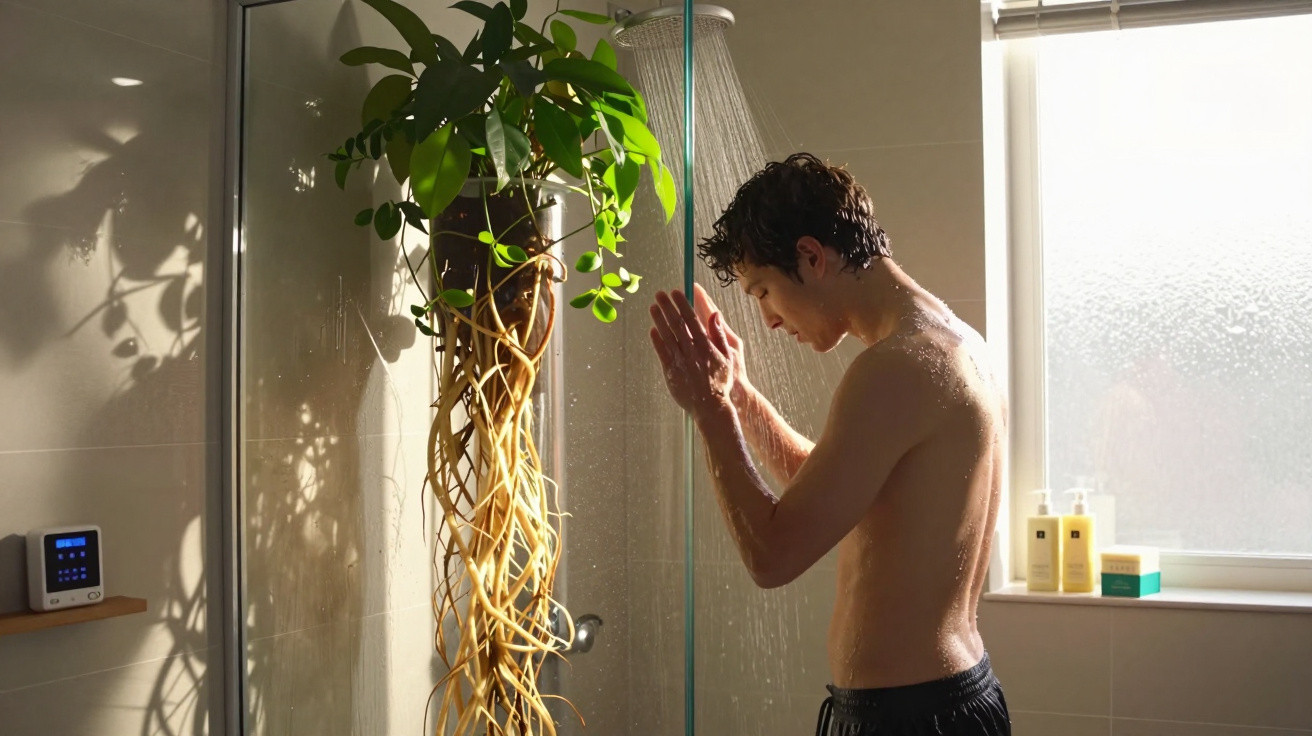
It is the greenery that catches your eye. A circle of shiny leaves winds up a narrow column beside the glass, while a soft trickle murmurs behind the panel like a stream in the woods. In a peaceful Bristol terrace, the inventor presses a switch no bigger than a thumb and the system stirs into life: a quiet pump, a transparent reservoir and fine roots moving as though waking from sleep. We all know the moment: the mirror steams up, litres spiral away, and you think that this cannot make sense. Here, the water waits, circulates and comes back through a living filter that resembles a houseplant more than a piece of equipment. He smiles at this modest household act in a large, water-hungry world. The shower looks alive.
A living shower that makes water work twice
Put simply, the shower collects used water, purifies it through plant roots and microbe-rich material, then recirculates it warm, clear and safe for the remainder of your wash. Seeing it in operation is unexpectedly soothing. There is no drain roaring away and no churn of guilt. Instead, a consistent loop runs through glowing clear channels, while roots form a delicate framework for unseen tiny workers. As steam passes the leaves, the British inventor explains it quietly, and the entire arrangement feels like bathing in a tiny greenhouse. Its appeal is that it does not feel aggressively futuristic.
In initial tests across two rented flats, he recorded the figures in a worn notebook: a typical UK shower uses around 60 to 70 litres. His loop worked comfortably with roughly 10 to 15 litres, plus small fresh-water additions to maintain quality. Ana, a nurse who tested it, shaved before a Sunday shift and sent a message later that day: “Weird detail, but my hot water didn’t dip when my partner hopped in after me.” By retaining heat, the loop reduced energy bills as well as water consumption. This was not a laboratory exercise, but ordinary people at 7 a.m.-tired, running late and getting on with it.
Behind the glass, familiar ecology is being put to work in plumbing. The roots offer an enormous surface on which biofilms-colonies of helpful microbes-can break down soap, skin oils and shampoo residue. Fine mesh traps hair, a gravel-and-charcoal layer refines the water, aeration allows the biology to breathe, and a final disinfection step using UV or heat eliminates pathogens before water returns to the showerhead. The plant is not a magic drinking straw; it supports microbial chemistry that performs well with suitable oxygen, temperature and contact time. Yes, plants can keep up. With a reliable rhythm, they carry out this quiet task more effectively than many cartridges.
From “nice idea” to an everyday ritual
If you imagine a bathroom jungle, do not worry. The domestic model is more like a neat wall-mounted column paired with a shallow base resembling an ordinary shower tray. Its sequence is straightforward: step inside; a pre-filter removes hair; the pump moves water into the root-zone module; it circulates for five to eight minutes while you wash; a small UV unit activates as a safeguard; and the system introduces a slight top-up of fresh hot water to preserve a smooth temperature. The pattern is intuitive: wet, pause, loop, rinse. Water service becomes a heartbeat, not a one-way sprint.
A few choices help the system run well. Plant-friendly soaps, with gentler surfactants and fewer strong fragrances, allow the biofilm to thrive. Avoid bleach-based tray cleaners; vinegar and a soft cloth will keep surfaces bright without destroying the microbes. There is also an initial settling period, because the root zone takes a week or two to establish its balance, rather like a sourdough starter. Realistically, no one wants to think about that every day. The system therefore uses simple indicator lights: green means all is well, amber means the mesh needs rinsing, and red says “empty and refresh.” It is designed around everyday life.
When people ask whether the plants “drink the dirt”, the inventor laughs. His reply is thoughtful rather than flippant:
“Water should do two jobs before it leaves the home: wash you, then grow something. The roots host the real workforce.”
- Select hardy plants: peace lily, spider plant and dwarf papyrus all cope well with indoor humidity.
- Replace the pre-filter each week; rinsing it in the sink takes 30 seconds.
- When guests are visiting, use “fresh mode” for a conventional one-way shower whenever needed.
- Lightly trim the roots once each season so that water can pass through them freely.
What happens when a shower becomes a small ecosystem
This is less a story about a gadget than one about changing habits. When you can see bathwater looping in front of you, the cycle becomes tangible rather than something imagined at a distant reservoir. Children point to the roots and start asking questions. Visitors look puzzled at first, then emerge smiling as if they have done something gently rebellious. You begin to match your shampooing to the pump’s soft hum, and may find yourself taking shorter rinses without meaning to. The inventor believes city pipes would become somewhat less pressured if thousands of bathrooms cut their peak flows in half. He also thinks mornings might feel easier. Nothing heroic-just sensible. A shower that keeps its promise: clean skin, clear mind, less waste.
| Key point | Detail | Why it matters to the reader |
|---|---|---|
| Water savings up to ~80% | The looped cycle uses 10–15 L rather than 60–70 L per shower | Lower bills and reduced pressure during droughts |
| Heat retained in the loop | Recirculation means minimal reheating is needed | Comfortable showers and lower energy spending |
| Plant-root biofiltration | Roots and microbes break down soaps; UV provides the final treatment | Clear water you can trust, with a living design |





Comments
No comments yet. Be the first to comment!
Leave a Comment