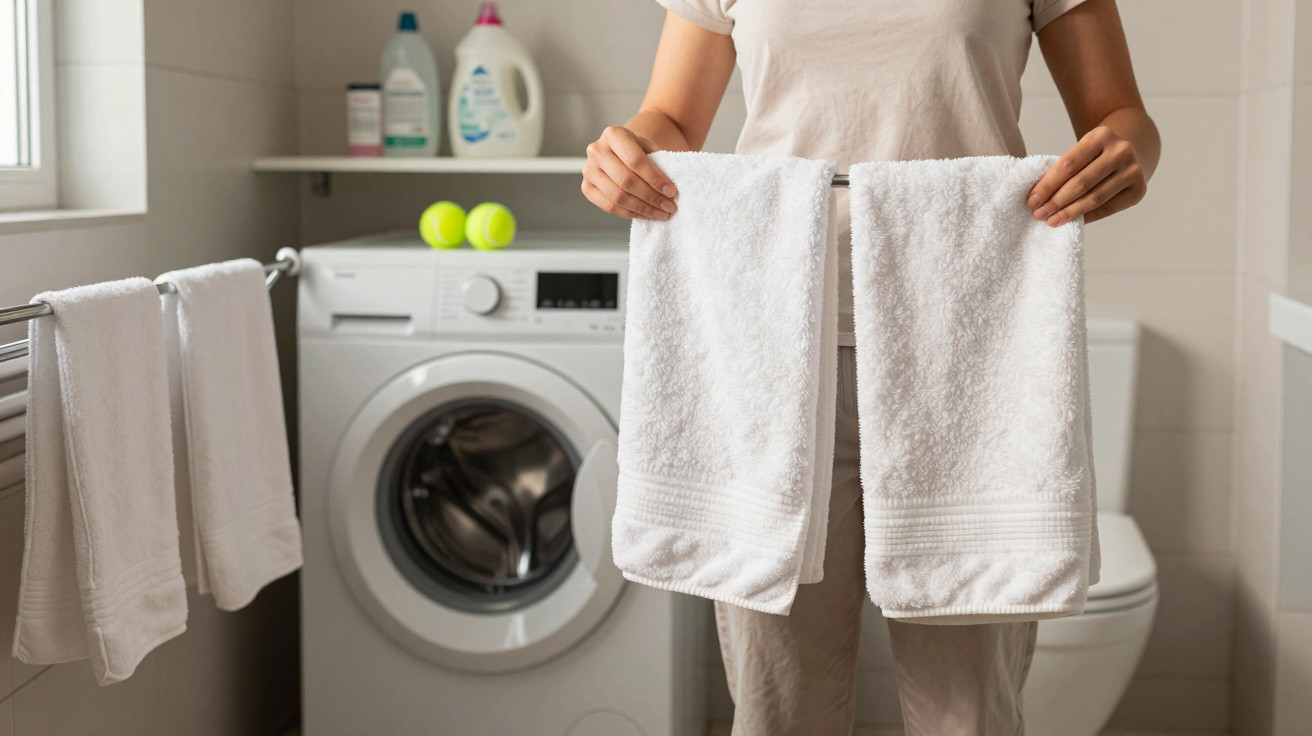
The towel looked immaculate on the shop shelf.
It was thick and cloud-soft, exactly the sort you want to press your face into. Two months later, it hangs sadly in your bathroom: limp, rough around the edges and somehow disappointing. You wash it repeatedly, pour in extra fabric softener and increase the spin speed. Yet each wash leaves it flatter and stiffer, feeling more like something from a gym changing room than a boutique hotel.
Then you stay at an ordinary hotel, where the towels feel like an embrace. They are springy, highly absorbent and almost make a sound as you unfold them. There is no luxury brand on the label. It is simply cotton… plus knowledge that hotels seem to have and most of us do not.
Why do our towels deteriorate so quickly when hotel towels withstand years of daily washing and still recover their bounce? The explanation begins with an uncomfortable fact about that pleasantly scented fabric softener.
Why towels lose their fluff and hotels avoid fabric softener
In almost any British bathroom, you can often work out the laundry habits just by handling a towel. When it feels velvety yet does a poor job of drying, fabric softener is usually responsible. Behind the appealing fragrances and “soft touch” claims is a straightforward process: softener leaves a fine, waxy coating on the fibres. Initially, the towel feels wonderfully soft. After several dozen washes, though, the loops become weighed down and covered, lying flat rather than standing proud.
Hotels understand this, which is why most commercial laundries do not use softener on towels or bathrobes at all. It may make linen smell pleasant, but it also leaves it slippery. For a hotel, a towel that dries poorly creates more guest complaints, additional rewashing and more energy use in tumble dryers. Their alternative is hot water, strong but carefully measured detergent, thorough rinsing and a controlled drying process. There are no elaborate products involved: just a system.
Consider a straightforward three-star hotel in Manchester or Brighton. Its housekeeping team may process hundreds of towels every day. They endure demanding conditions, including high temperatures, industrial spin cycles and rapid turnaround times. Nevertheless, the towels guests receive often feel thicker than those washed exclusively in domestic machines. Commercial laundries depend on physical action rather than cosmetic treatments. Vigorous agitation raises the fibres, heavy-duty dryers “snap” them back into shape, and anything that blocks the cotton is avoided. Fluffiness is not created by miracle products; it comes from allowing the loops to breathe.
At home, we commonly do precisely the reverse. We pack the drum too tightly, use excessive detergent and then add a fragranced liquid that quietly undermines absorbency. The towel may last, but it ages badly. Fibres break, loops become matted, limescale collects in hard-water regions and the material turns cardboard-stiff. It is easy to blame poor quality, when the real culprit is sitting on the washing-machine shelf, scented “Summer Meadow”.
The hotel-style no-softener method for home towels
The secret of avoiding fabric softener may sound unexciting. Here is what hotels actually do, adapted into a practical home routine. Start by removing softener from every towel wash, completely. Instead, wash towels on a warm cycle - normally 40–60°C is sufficient - using an ordinary amount of detergent rather than an oversized scoop. Modern detergents are concentrated: extra powder does not mean cleaner laundry, only more residue lodged in the fibres.
Around once a month, give towels a reset wash. Run one cycle with a cup of white vinegar in the fabric-softener drawer, with no softener or other additions. Vinegar helps dissolve accumulated detergent and limescale, particularly in hard-water areas. Your towels will not smell like a chip shop, as the odour vanishes during drying. This “strip wash” is about as close as you can get to a professional fresh start at home.
Drying is where the hotel effect really takes place. Even a brief tumble-dry lifts the loops and restores that buoyant texture. If you would rather air-dry, you can still follow the same principle: do not peg towels from the middle, where they fold over and dry into a stiff, drooping line. Hang them fully open, shake them firmly before and after drying, and do not leave them sitting on a radiator. Cotton benefits from movement and dislikes stagnation.
We all have small laundry habits at home that gradually damage towels. We overload the machine until they can barely move. We wash them alongside jeans or zipped hoodies that rub against and flatten the loops. We choose quick-wash programmes that fail to rinse detergent away properly. On a busy weekday, it is tempting to put everything in together and hope for the best. Let’s be honest: nobody really follows the ideal rules every day.
Hotels keep towels separate for good reason: they need the loops to move freely rather than be compressed against heavy clothing. Try doing a towel-only load once every week or fortnight. Use less detergent than you think is necessary, and leave out the softener. If air-dried towels feel scratchy, put them in the tumble dryer for ten minutes with a couple of clean tennis balls or wool dryer balls. The bounce is not imaginary; the fibres are literally being “massaged” back into shape.
Sometimes, giving up the scent is the greatest challenge. Fabric softener has taught us to link cleanliness with a powerful fragrance that lingers. Hotel towels rarely smell strongly scented. They smell like… very little. That is intentional. Fresh, neutral cotton dries more quickly and lasts longer. Your nose may miss the perfume initially, but your skin and your towels will not.
“We never use fabric softener on towels,” a hotel laundry manager in Leeds told me. “It makes them feel nice for two or three washes, then guests start complaining they’re not drying properly. We’d rather have a towel that works than a towel that just smells good.”
- Use no softener on towels – it coats fibres and destroys absorbency.
- Wash warm, not excessively hot – 40–60°C keeps towels clean without damaging the cotton.
- Give them room – lighter loads and plenty of movement produce fluffier loops.
- Reset monthly – a vinegar wash removes residue and restores genuine softness.
- Finish with movement – a short tumble-dry or a vigorous shake can dramatically improve the feel.
Rethinking soft towels: what matters most
Once you begin to notice these details, the entire towel experience shifts. Some of the “softest” towels in shops can feel oddly silky, almost plastic-like. Microfibre and polycotton blends may feel smooth, but they do not perform like genuine hotel cotton. A quality towel has a little weight and is covered in small, visible loops that you can feel. It might not resemble a teddy bear on its first day, but it becomes more lively with every correctly handled wash.
There is an emotional aspect to towels that we rarely acknowledge, too. After a tiring evening, wrapping yourself in a thick, fluffy towel after a shower can feel like evidence that somebody, somewhere, considered your comfort. On a grey British morning, while standing on a tiled floor, that small moment matters more than the advertising copy on a bottle of “Aloe & Silk Softness”. We have all had the moment when a towel feels like sandpaper, and it somehow makes the day feel 10% worse.
The encouraging news is that you do not need a hotel budget or industrial equipment to change the outcome. You only need a modest change in mindset: move from asking, “How good does this smell?” to asking, “How well does this work, again and again?” Share that approach with your family or flatmates, and everyone will soon understand why there is no softener in a towel wash and why the machine should not be filled to the brim. Gradually, towel by towel, your bathroom can feel a little more like a hotel and a little less like a laundrette.
| Key point | Detail | Benefit for the reader |
|---|---|---|
| Avoid fabric softener | Oily agents coat fibres and reduce absorbency | Find genuine, lasting softness rather than merely the effect of the “first few washes” |
| Wash more intelligently | 40–60°C cycles, minimal detergent and full rinses | Keep towels clean, fluffy and more durable over time |
| Take inspiration from hotels | No softener, plenty of movement and controlled drying | Recreate the “hotel towel” feel at home without spending more |



Comments
No comments yet. Be the first to comment!
Leave a Comment