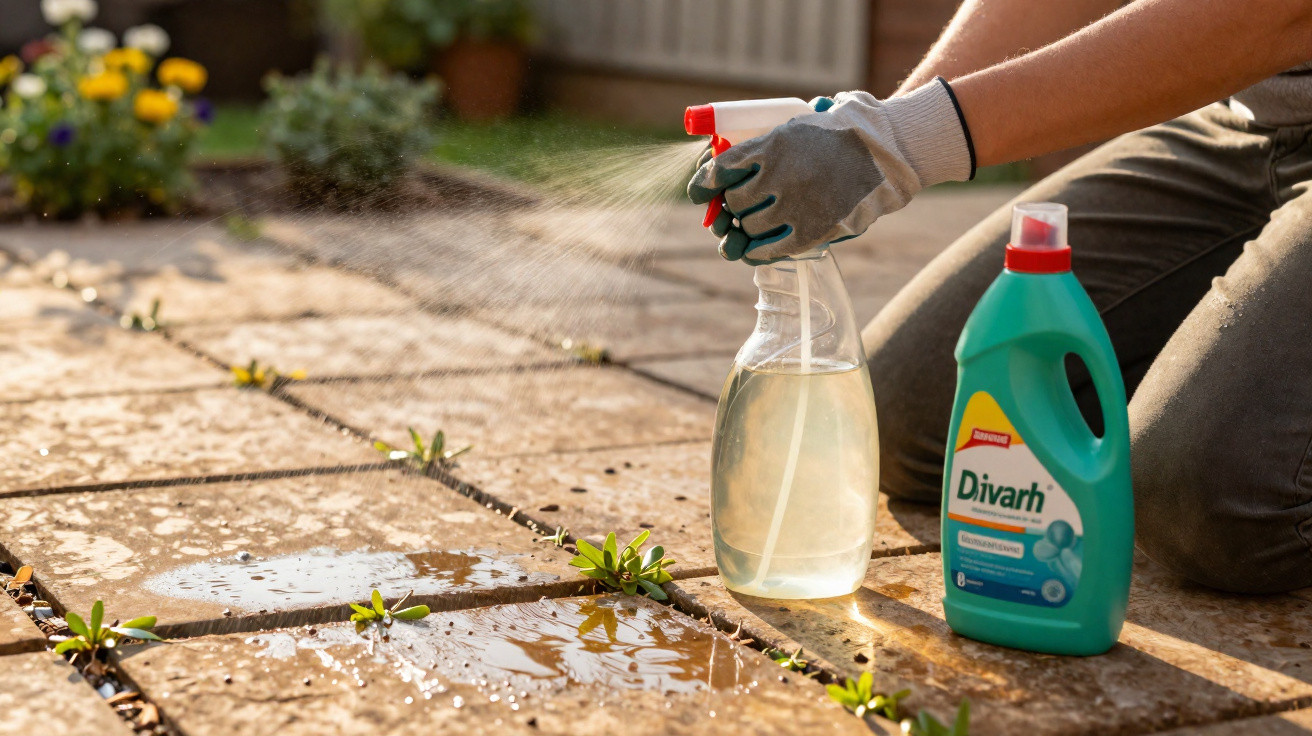
Many keen gardeners instinctively reach for the bottle of vinegar from the kitchen. Although the result can look impressive, it usually does not last for long. An unassuming household product can deliver noticeably better results and make removing weeds from paving joints and paths considerably easier.
Why ordinary household vinegar barely solves a weed problem
Household vinegar mainly works on the surface. Its acid attacks leaves and young shoots, causing them to discolour and wilt. At first glance, the area can appear “clean”.
Beneath the paving, however, the situation is different: the roots generally survive this treatment with little real damage. Shielded in the soil, they remain viable and start growing again after a few days or weeks. The joints soon turn green again.
For isolated, very young seedlings, vinegar may be enough in the short term. Once an area is more densely covered, though, it reaches clear limits. Anyone wanting to keep a patio clear permanently would need to spray every few weeks – a repetitive task that few people genuinely want to keep up.
Vinegar mainly burns the visible parts of a plant – the real issue, the root, usually remains active in the soil.
This is where many gardeners turn to an extra ingredient that almost everyone already has by the kitchen sink.
Washing-up liquid: the hidden star of natural weed control
Washing-up liquid behaves very differently from vinegar in the garden. It contains substances known as surfactants. These break through the fine waxy layer that protects the surface of many plants. As a result, water and other ingredients adhere more effectively and penetrate further.
When diluted washing-up liquid is applied directly to foliage, the plant loses its natural “raincoat”. The leaves dry out more readily, substantially weakening the upper parts of the plant. Adding vinegar can intensify this effect.
Washing-up liquid is not a conventional poison, but an “enhancer”: it makes household remedies such as vinegar much more effective on plant surfaces.
For this reason, many hobby gardeners use a straightforward mixture aimed precisely at problem areas such as pavement joints, driveways, gravel strips alongside the house and gaps in patios.
Basic recipe: washing-up liquid mix for weeds in paving joints
Common kitchen ingredients can be used to make a basic recipe that can be adjusted as needed. The starting mixture is as follows:
- 1 tablespoon of washing-up liquid
- 1 litre of water
- optional: 1 cup of household vinegar
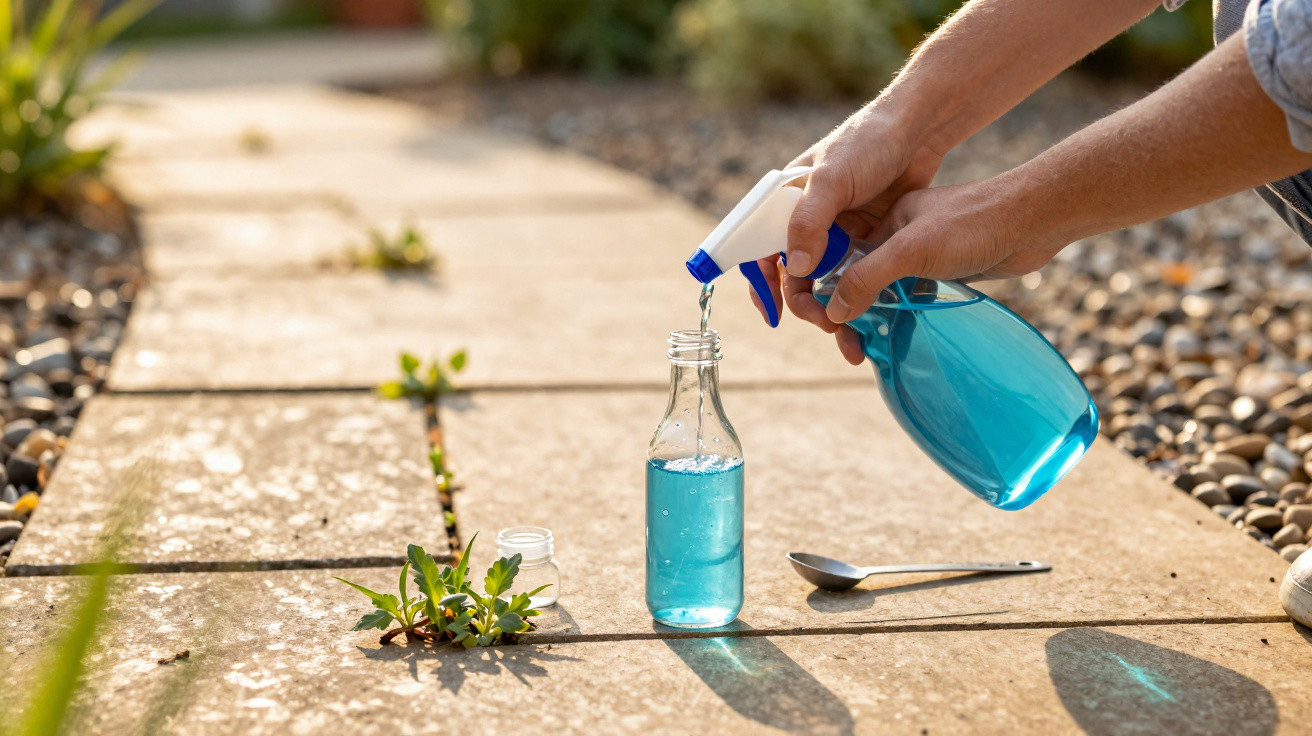
Put all the ingredients into a watering can with a rose attachment or a spray bottle. Shake thoroughly until the mixture is evenly combined, then apply it specifically to the unwanted plants.
For small joints with young growth, the mild version containing only water and washing-up liquid is often sufficient. The surfactant film coats leaves and shoots, the plants lose moisture and collapse.
Stronger mixes for persistent problem areas
Those tackling very dense mats of growth or grasses that have been established along paths for a long time often use more powerful combinations. Three strengths have become common:
- Gentle mix: 1 litre of water + 1 tablespoon of eco-friendly washing-up liquid – for young seedlings in joints.
- Medium strength: 1 litre of household vinegar + 2 teaspoons of washing-up liquid – for matted paving joints and older plants.
- Radical version: 1 litre of household vinegar + 40 g of salt + 10 ml of washing-up liquid – use only on surfaces where nothing is intended to grow permanently.
The final version is intended for very particular situations, such as old yard entrances, steps or narrow edging stones alongside walls. Where absolutely no greenery is wanted, this salt, vinegar and washing-up liquid mixture can be highly effective.
The stronger the mix, the more consistently it should be confined to bare stone surfaces – otherwise the soil can suffer for years.
How gardeners apply the washing-up liquid mix properly
To achieve the greatest possible effect, both the timing and method of application matter. A number of practical rules have proved useful:
- Spray only in dry weather: rain quickly washes the mixture away.
- Choose sunny days: heat and sunshine increase the drying-out effect on plants.
- Work close to the plant: hold the spray nozzle just above the leaves so very little drips onto the ground.
- Use little, but precisely: do not “flood” the area; direct the liquid straight onto leaves and stems.
- Wait for still conditions: this prevents droplets from landing accidentally on lawns or herbaceous plants.
Anyone with only a watering can can carefully run the mixture along the joints beside the line of plants. A spray bottle often makes it easier to target individual clumps of grass accurately.
Important limits and risks for garden soil
Washing-up liquid remains a cleaning product. In soil, it can alter its structure, including the ground's ability to absorb and retain water. In beds or vegetable-growing areas, this could have long-term consequences for earthworms, micro-organisms and plants.
Salt has an even greater impact. Soil quality deteriorates, nutrients become unbalanced, and many plants respond with impaired growth or die. This change persists for a long time because salt leaches away only very slowly.
A simple rule therefore applies:
Washing-up liquid and salt mixtures belong only on stone surfaces, paving joints and gravel paths – never in vegetable beds, lawns or herbaceous borders.
Those wishing to work carefully can shield neighbouring areas with cardboard or old boards while spraying. This keeps droplets out of places where the soil needs to remain alive.
Alternative methods: a kitchen mix is not always necessary
Mechanical approaches are entirely adequate for many surfaces. Examples include:
- Joint scrapers with a narrow, sharp blade for tight gaps
- Joint brushes with metal or plastic bristles for cobbled paving
- Hot-air or infrared tools that briefly heat weeds intensely
These tools work without any chemicals. They do require physical effort, but they fully protect the soil and surrounding area. They are often the better choice, particularly near beds or play areas.
Where the washing-up liquid trick is most effective
Used correctly, the washing-up liquid mix is best suited to clearly defined mineral surfaces: garage driveways, paved courtyards, stone stairways, narrow strips along the house wall or gravel beds that are deliberately meant to remain free of wild growth.
Treating these areas two or three times a year significantly reduces growth. Between treatments, a quick pass with a joint scraper is usually enough to remove any isolated latecomers.
What terms such as “surfactants” mean
Surfactants are molecules with two “sides”: one is attracted to water, while the other binds to fats or waxes. In washing-up water, they lift greasy films from plates; on plant surfaces, they disrupt the protective wax layer. This accounts for their enhancing effect in weed-control recipes.
Eco-friendly washing-up liquids often use plant-based raw materials as the basis for these surfactants and avoid certain additives. They break down more quickly in soil, reducing the risk to the environment and groundwater, but they are not completely harmless.
Practical example: what a seasonal plan could look like
A typical yearly routine could look like this:
- Spring: Check the joints for the first time, use a mild water-and-washing-up-liquid mix, and treat only heavily overgrown joints with a little vinegar.
- Summer: On a hot, dry day, spray targeted areas again where mats of growth have reappeared. Use a joint scraper for individual plants.
- Autumn: Carry out a final round on particularly affected surfaces. Remove larger mats before they spread seeds over winter.
This keeps use of the household mixture limited, leaves stone surfaces looking well maintained and keeps the soil in neighbouring areas alive. Combining the washing-up liquid trick with a little manual work can keep paths and patios clean over the long term – without resorting to overly aggressive products.







Comments
No comments yet. Be the first to comment!
Leave a Comment