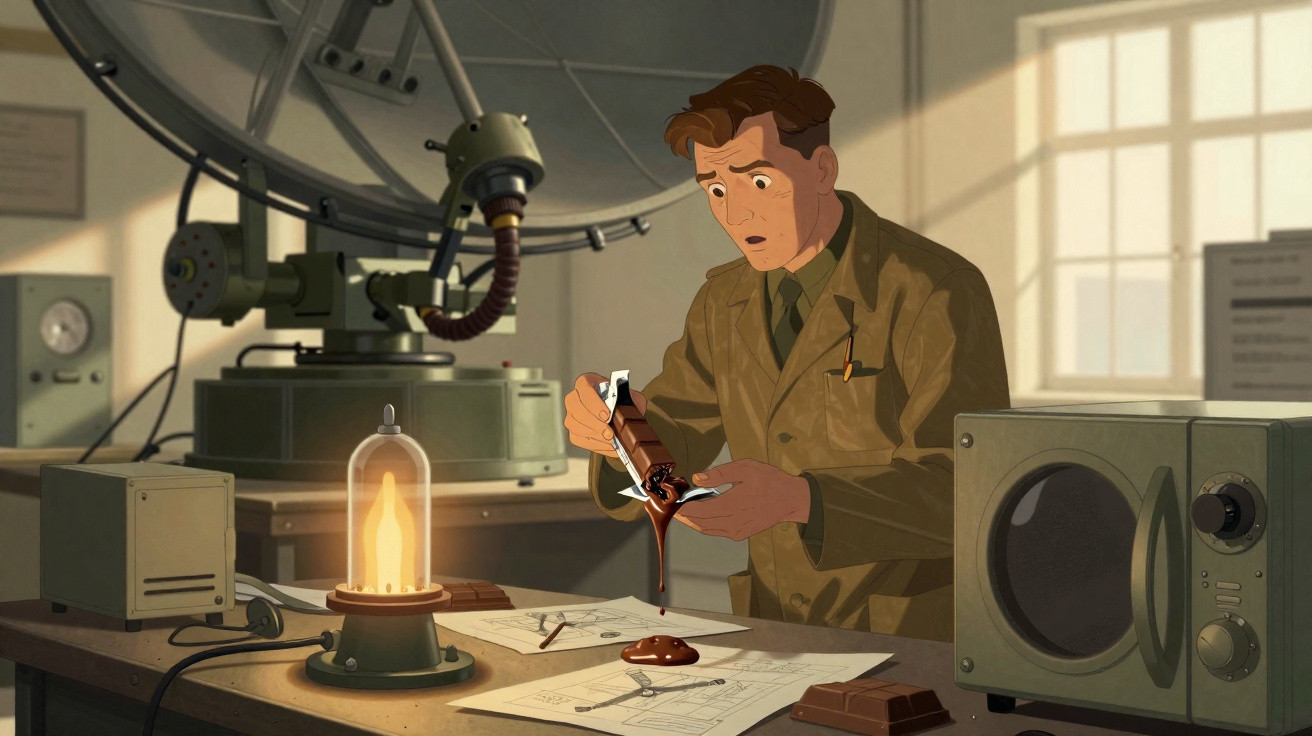
The invention of the microwave came about by chance during the Second World War, when an engineer found that a chocolate bar in his pocket had melted as he worked with radar equipment.
How did the invention of the microwave come about?
The story began in 1945, when American engineer Percy Spencer, a radar specialist, was testing a magnetron, a component used to produce microwaves in military systems.
During his work, he realised that the chocolate bar he had kept in his pocket had melted completely. This observation piqued the researcher's curiosity and prompted a series of experiments.
Why did the chocolate melt so quickly?
Spencer determined that the microwaves produced by the magnetron were transferring energy to food, heating it from the inside out far more quickly than conventional methods.
To test his theory, he carried out further trials using various foods. The experiments that helped demonstrate the discovery included:
- Maize kernels, which popped to make popcorn.
- An egg, which heated rapidly and eventually exploded.
- Other foods, which showed accelerated heating.
When was the first microwave oven launched?
Following the successful tests, the company Spencer worked for patented the technology. Not long afterwards, the first commercial microwave oven was introduced.
The original machine bore little resemblance to modern models: it weighed around 340 kilograms, stood approximately 1.80 metres tall and cost several thousand dollars. It was used mainly by restaurants and commercial establishments.
How did the microwave reach homes?
As the electronics industry progressed, the appliances became smaller, more efficient and considerably less expensive. Over the following decades, the household appliance found its way into millions of kitchens around the world.
Today, the microwave is used in homes, businesses and offices, providing a convenient way to reheat meals, make quick recipes and save time in everyday life.
Why did this accidental discovery change history?
The invention of the microwave is regarded as one of the greatest examples of serendipity, in which an important discovery occurs unexpectedly while another piece of research is under way.
The episode demonstrates how one melted chocolate bar led to the development of a technology that changed eating habits and remains part of the daily routine of billions of people.
The microwave continues to evolve today
Even decades after its creation, the appliance continues to gain new technologies, including intelligent sensors, automatic functions and improved energy efficiency, making it even more convenient to use.
Percy Spencer's remarkable experience remains one of the best-known cases in the history of science, showing that major inventions can arise from seemingly ordinary observations.
















Comments
No comments yet. Be the first to comment!
Leave a Comment