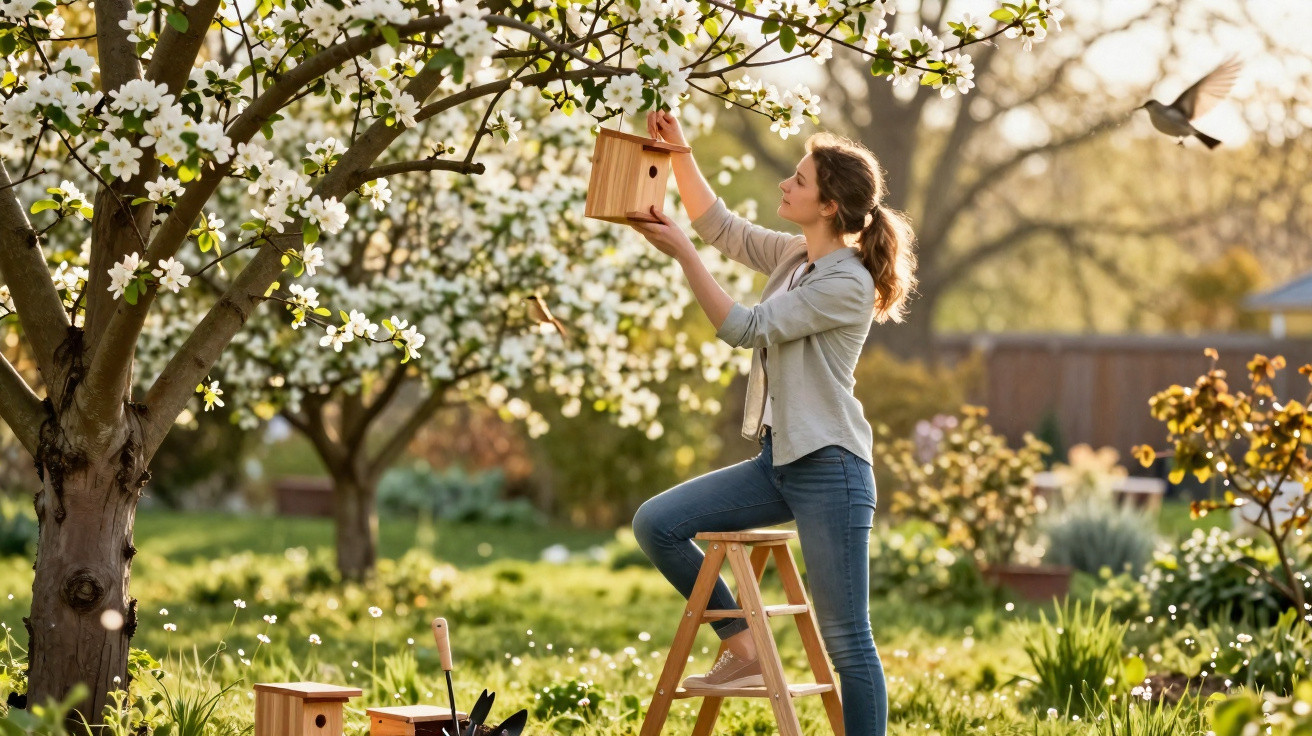
Many people wonder why, despite birdsong, things seem to be getting quieter. Experts are sounding the alarm: familiar town and village birds such as tits, sparrows and swallows are losing their nesting sites. A simple wooden box in the right place can achieve more than you might expect – turning a “tidy” garden back into a lively piece of nature.
Why garden birds urgently need new nesting sites
In many places, house façades now look smooth and immaculate: insulated, rendered and sealed. While this brings greater comfort for people, it creates a problem for birds. In the past, they could find cracks, spaces beneath roof tiles, gaps in brickwork or open barns. Tits, house sparrows, swifts, swallows and other species built their nests there.
Modern renovation work removes precisely these access points. Doors and windows are fitted more tightly, stables and storage buildings are made airtight, and roofs are sealed with membranes. What may seem sensible for hygiene deprives many species of their last breeding places.
Many familiar urban birds are now declining sharply because nesting opportunities on buildings and in gardens are lacking.
Studies from France show that common urban species are declining almost as quickly as birds living in agricultural landscapes. The same trend can be seen across German-speaking countries. To keep populations stable, suitable features must be restored: safe breeding sites, cover, food and short distances between them.
What tits really need in your garden in spring
Tits are adaptable, but they are not miracle workers. A lawn maintained by a robotic mower or a closely clipped “designer garden” offers them very little. A family of tits needs four essential elements:
- Good roosting and nesting places: tree cavities, old fruit trees, nest boxes and hollows in buildings.
- Enough insects: caterpillars, spiders and larvae – without them, the chicks starve.
- Cover: hedges, shrubs, perennials and piles of twigs protect against cats, magpies and sparrowhawks.
- Short journeys: food sources need to be close to the nest, otherwise feeding becomes too demanding.
Anyone with only a perfectly trimmed thuja hedge and a closely mown lawn is unlikely to see tits move in, even with an attractive nest box. The birds carefully assess whether the surroundings can support raising their young.
Nest boxes as replacement cavities: a lifeline for sparrows, tits and more
In the wild, tits often breed in woodpecker holes or openings in decaying branches. Such old trees are becoming increasingly scarce in built-up areas. Nest boxes can replace these cavities – provided they are chosen and installed correctly.
Building-nesting birds such as sparrows, swallows and swifts would normally use cracks in walls, roof beams or open barns. Since these features are disappearing rapidly, suitable nesting places can be retrofitted with specialist boxes and built-in nest units on façades and beneath eaves.
A well-planned nest box helps recreate lost habitats and stabilise bird populations in residential areas over the long term.
Choosing the right nest box: size, entrance hole and location
Not all nest boxes are alike. Different species require different dimensions and entrance-hole sizes. Here is a brief overview:
| Species group | Entrance hole Ø (approx.) | Typical occupant |
|---|---|---|
| Small cavity nester | 26–28 mm | Blue tit, marsh tit, coal tit |
| Medium cavity nester | 32–34 mm | Great tit, house sparrow |
| Large cavity nester | 35 mm and more | Starling, sometimes sparrow |
| Open-fronted box | open front | Robin, spotted flycatcher, black redstart |
Organisations such as regional nature conservation groups advise seeking guidance beforehand rather than putting up boxes at random. Not every species suits every box, and not every box is appropriate for every house.
The best place in the garden: how to hang nest boxes correctly
Many nest boxes remain empty because they have been positioned badly. A few straightforward rules can greatly improve the chances of success:
- Orientation: East or south-east is best, so the box does not become too hot and rain cannot blow straight in.
- Height: Usually 2–3 metres for tits and sparrows, and somewhat higher for starlings.
- Protection: Avoid constant sunlight and intense midday heat against a wall.
- Clear approach: Nothing should be growing densely in front of the entrance hole, so cats and martens cannot lie in wait.
- Peace and quiet: Do not place it directly beside the patio, trampoline or barbecue area.
On buildings, eaves, gable areas and sheltered façades are suitable locations. In trees, branches should not provide cats with a “climbing aid” – a smooth trunk is an advantage.
I’ve modernised – what now?
Even if you have already renovated or insulated your property, there are still ways to retrofit nesting features. Many houses can accommodate:
- Nesting bricks integrated into the insulation during the next minor building project.
- External nest boxes fitted beneath roof edges.
- Adapted internal spaces, such as lofts or barns, so they offer nesting opportunities again without compromising hygiene standards.
It is important that birds cannot get into cavities where they may later be trapped or disturbed during building work. If in doubt, seek support from a local nature conservation group.
More than bird protection: the benefits of nest boxes in the garden
At first glance, nest boxes can seem like nothing more than a “hobby for bird enthusiasts”. In fact, they bring tangible benefits – including for people who simply value peace and order in their garden.
- Natural pest control: During the chick-rearing period, a family of tits feeds thousands of caterpillars and insect larvae to its young.
- More life, more to watch: Children and adults can see for themselves how quiet calls turn into loud begging cries before the fledglings finally leave the nest.
- Better pollination: Where more insects and birds are active, fruit trees and berry bushes benefit too.
- Stable biodiversity: Small changes in private gardens create a network of mini nature reserves across entire towns and villages.
A single nest box does not create a rainforest, but many gardens together can change the outlook for entire bird populations.
How to turn your garden into a genuine bird paradise
Nest boxes alone are rarely enough. Anyone who truly wants to make their garden bird-friendly should take small steps rather than start major projects. Even a few simple measures can make a substantial difference:
- Mow one section of lawn less often and allow wildflowers to grow.
- Plant a dense hedge of native shrubs, such as dog rose, elder and blackthorn.
- Leave some perennial stems and leaf piles in place over winter instead of clearing everything away “neatly”.
- Provide a shallow bird bath with fresh water and clean it regularly.
Tits make intensive use of these structures: they find caterpillars in fruit trees, retreat into the hedge, drink from the dish and disappear into the nest box with food. Anyone who has watched this happen will think twice before carrying out any further shaping cuts.
Risks and mistakes to avoid
Some well-meant measures can cause harm. Common pitfalls include:
- Cheap decorative boxes: Thin timber, incorrect dimensions and oversized entrance holes mean these models are generally useful only as garden ornaments.
- No cleaning: Nest boxes should be roughly cleaned once a year, in autumn or winter, otherwise parasites can build up.
- Poor positioning: Directly above the barbecue or beside a garden swing, stress is inevitable.
- Feeding only fatty food during the breeding season: While raising chicks, tits mainly need insects; nuts and seeds are only of limited help.
Keeping these points in mind significantly improves the likelihood of successful breeding. Often, it is enough to check briefly once or twice a year and make small adjustments.
How a nest box becomes a small conservation project
Perhaps the greatest effect is not seen in the first spring, but after several years: birds often return to proven breeding sites. Once a garden or house is considered safe, an established bird community gradually develops.
Every additional box, hedge and preserved crack in a wall strengthens this small network. Then, when you wake up with the window open on an April or May morning, it quickly becomes clear that this is not only about bird protection, but also about quality of life – right outside your own front door.










Comments
No comments yet. Be the first to comment!
Leave a Comment