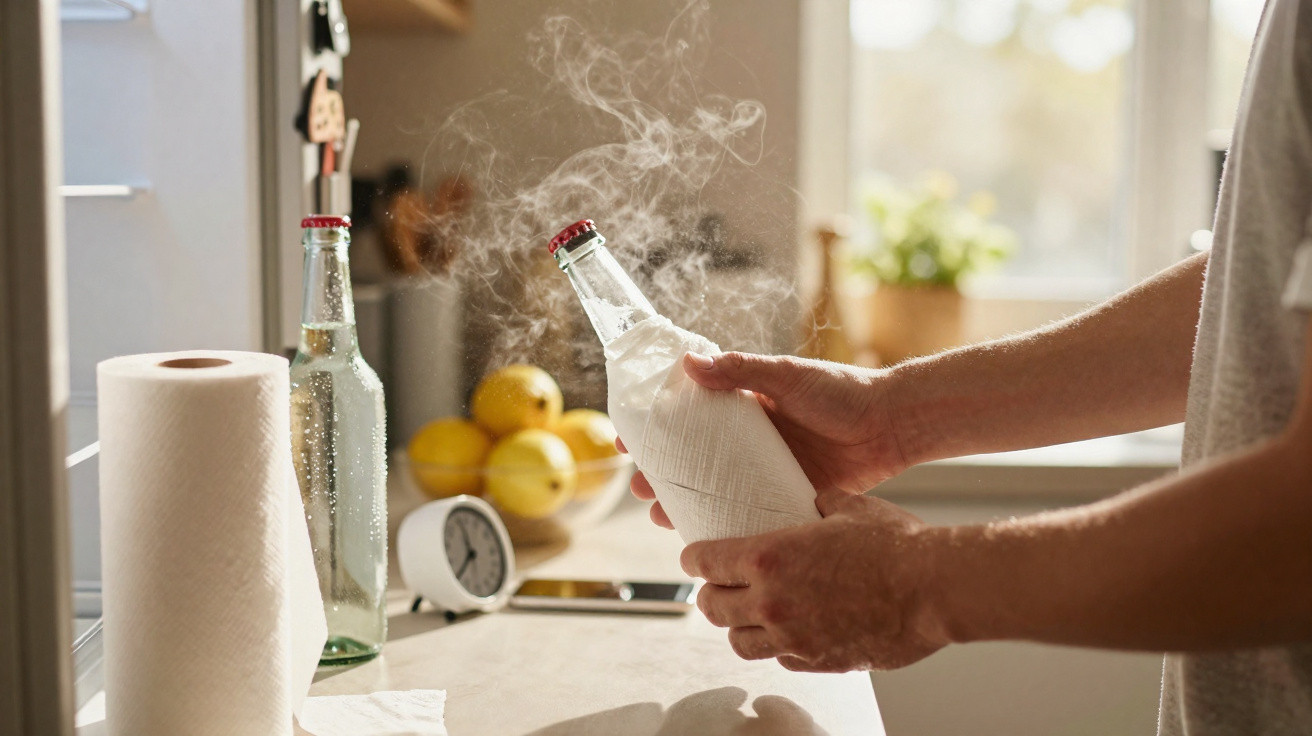
Have you ever got home with a warm bottle or can and needed it chilled in minutes? The wet paper towel trick-wrapping the drink and putting it in the freezer-has attracted millions of views on social media, with claims that it will make everything ice-cold in 15 minutes. However, the physics makes the story rather less straightforward.
The science behind the wet paper towel trick is genuine
The principle behind this method is not made up. Evaporation cools things down; it is the same process that makes us sweat in hot weather. As the water in the paper towel evaporates, it takes thermal energy from the bottle’s surface with it, speeding up cooling. That is also why wrapping a can in a damp cloth and placing it near a fan works so well on a summer day.
The catch is that this process requires something an ordinary domestic freezer rarely provides: active air circulation. Without airflow, the water in the towel does not evaporate-it freezes. Rather than helping the drink cool more quickly, the wet paper then becomes an insulating layer around it, producing the opposite of the intended result.
- Freezer without ventilation: the wet paper freezes before it can evaporate, forming an insulating shell that slows cooling rather than speeding it up.
- Frost-free freezer with a fan: the trick genuinely works because the airflow enables evaporation, allowing the drink to cool faster.
- Damp cloth + an external fan: this is the most effective combination for rapidly chilling a drink outside the freezer, particularly during summer heat.
- A can cools more effectively than a bottle: aluminium conducts cold far better than glass, so the trick produces more noticeable results with cans than with bottles.
- Salt in the water used for the paper: salt lowers water’s freezing point, keeping it liquid for longer in the freezer and improving thermal contact.
The experiment that cooled expectations of the viral claim
Researchers tested the method by placing two identical containers of water in a standard domestic freezer: one was wrapped in a damp paper towel, while the other was left uncovered. The outcome contradicted what the videos suggest: the container with the wet paper took longer to cool than the uncovered control. The reason is simple: the paper introduces an additional layer through which heat must pass before it can escape.
With glass bottles, the benefit is smaller still. Glass is inherently a poor thermal conductor, so any added layer around it-even a damp one-makes the insulation worse. Tests suggest that using wet paper towels on glass bottles in a freezer without air circulation cuts chilling time by only 18%, well below the 40% widely claimed online.
When the wet paper towel trick actually works
Researcher Greg Blonder examined the issue in detail and identified the circumstances in which the method genuinely succeeds. When he tested a bottle wrapped in a damp cloth inside a commercial freezer with a powerful fan, it cooled considerably faster than an uncovered bottle. The difference is that active airflow allows the water to keep evaporating, genuinely drawing heat away from the drink’s surface.
The method that really works when you are desperate
Ice, water and salt: the most efficient combination for chilling in minutes
For anyone who needs a cold drink within minutes and does not have a commercial freezer, the most effective approach is an ice bath containing salt and water. Dissolved salt lowers the freezing point of the mixture, which sits at around -10°C to -15°C-far colder than ice alone. Submerging a can or bottle in this mixture for just 5 to 10 minutes is enough to bring it to the ideal drinking temperature.
The reasoning is straightforward: liquid transfers heat much more efficiently than air. A can in an ordinary freezer may take 1h30 to chill, whereas the same can in a bucket of ice, salt and water is ready in under 10 minutes. It is the difference between waiting for the summer to pass and enjoying the barbecue now.
Away from the freezer, the damp paper towel method also makes sense when paired with a switched-on fan. Wrap the can in a wet cloth and place it in front of the airflow; evaporation can then happen properly, bringing the temperature down. It is the same principle as perspiration in the human body, applied to a drink instead.
A mistake that can ruin the drink completely
Whichever method you choose, one basic precaution bears repeating: never leave bottles or cans in the freezer for longer than 30 to 40 minutes. Water in drinks expands as it freezes. In glass bottles, internal pressure can lead to cracks or even an explosion. With aluminium cans, the base can distort and carbon dioxide escapes, leaving the drink flat. Setting a timer on your phone solves the issue with a single tap.
The viral trick is not entirely false, but neither is it the universal solution portrayed in videos. Context is everything: in a domestic freezer without ventilation, a wet paper towel hinders more than it helps. With circulating air or an ice-and-salt bath, physics works in your favour. Understanding the mechanism is what separates someone who waits an hour from someone raising a glass in ten minutes.
The adjustment that improves either method
To get the most from paper towels in a frost-free freezer, there is one simple modification: add salt to the water used to wet the paper. Once salt has dissolved, the water’s freezing point falls below zero, keeping the paper liquid for longer inside the freezer and improving its thermal contact with the container. It is a small detail that makes a genuine difference to the end result.
Ultimately, the trick shows how a sound scientific principle can be applied incorrectly. Evaporation does provide real cooling; a domestic freezer without ventilation is simply not the right setting for it.
This is the sort of tip that could save plenty of barbecues. Share it with anyone who always turns up at the last minute with a warm drink.








Comments
No comments yet. Be the first to comment!
Leave a Comment