A simple kitchen staple can finally put an end to it.
Keeping a patio or driveway free from weeds can quickly become a Sisyphean task. You pull, scrape and swear – only for everything to sprout again a few weeks later. Many people now turn to household vinegar as a “natural weedkiller”. Yet disappointment usually follows quickly: the plants appear to be gone, but stubbornly return. The real favourite among many amateur gardeners has long been sitting in the kitchen cupboard – and it is not vinegar, but something quite different.
Why ordinary household vinegar fails against persistent weeds
At first, vinegar sounds like the ideal answer: inexpensive, free from synthetic chemicals and quick to use. Its acid scorches the parts of the plant above ground; leaves and young shoots discolour, wilt and appear dead. At a glance, the joint or edge looks freshly cleaned.
Below the surface, however, the situation is different. In many cases, the roots remain largely unaffected. With grasses, plantain, dandelions and other deep-rooted plants in particular, the real “engine” of the plant lies deeper in the ground. Vinegar barely reaches it, especially when it is sprayed on only once and at the surface.
“Vinegar mainly destroys what is visible – the unseen root reserves survive and grow again.”
This may be enough for isolated, very young seedlings in paving joints. In areas that are already heavily overgrown, treatments would need to be repeated continually. That takes time, tests patience and soon becomes frustrating. This is exactly when many gardeners look for a more powerful option that is still based on household products.
The secret favourite: washing-up liquid as a weed helper
This is where a product intended for plates, pans and glasses comes in: washing-up liquid. This everyday item contains substances known as surfactants, which dissolve grease and help water spread more effectively.
They have a similar effect on plant leaves. The leaf surface has a thin, waxy coating that makes water bead off. Surfactants attack precisely this protective layer. Water and other added substances adhere more effectively and can enter the plant tissue more easily.
When used on its own, washing-up liquid gradually removes moisture from the leaves, causing the plant to dry out from the top down. However, it becomes particularly interesting when combined with vinegar.
Washing-up liquid and vinegar: why the mixture is so popular
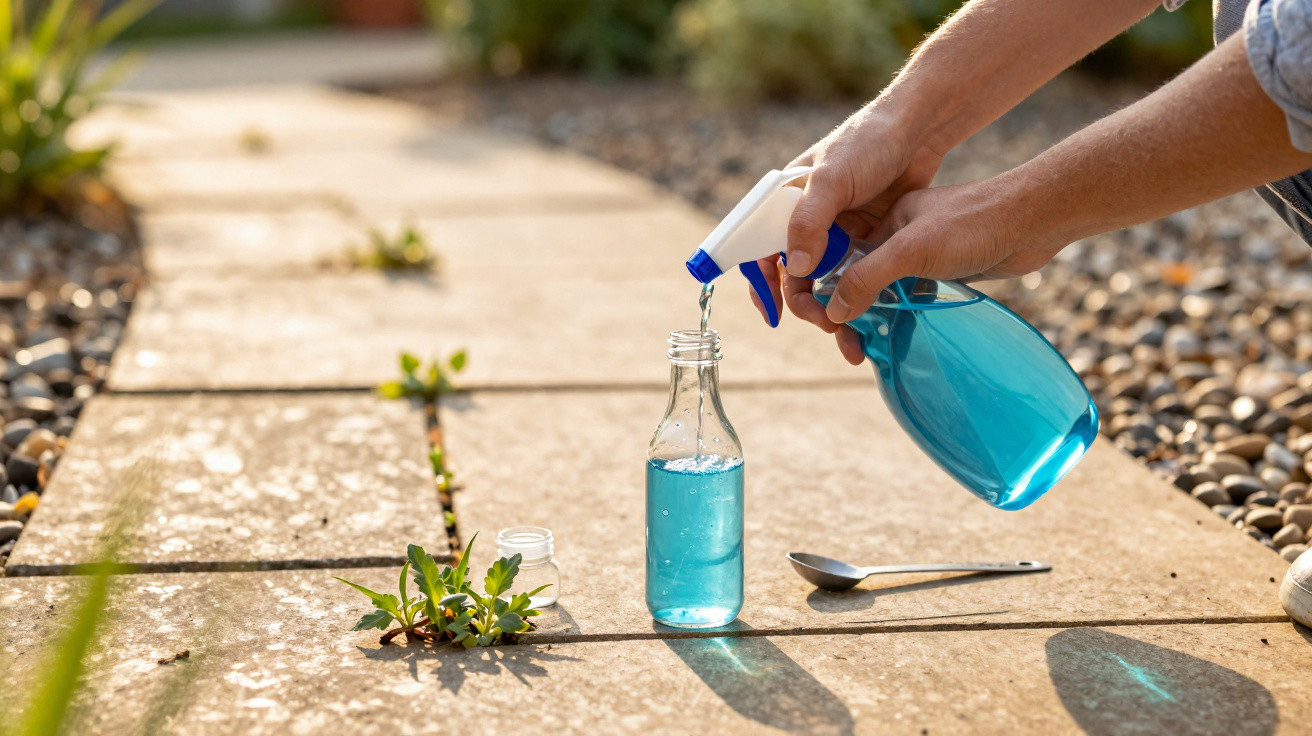
Many amateur gardeners use a straightforward mixture from the kitchen and cleaning cupboard to target paving joints and gravel paths. It relies on three ingredients: water, washing-up liquid and, if required, household vinegar.
“Washing-up liquid acts like a ‘door opener’: it breaks through the leaf’s protection so vinegar and water can penetrate further into the plant.”
Two unremarkable kitchen products can therefore become a much more effective aid against persistent weeds on paved surfaces or gravel paths. Plants dry out faster, the treatment lasts longer and it does not need to be repeated as often.
Basic recipe for weed-ridden joints and paths
For most everyday situations, a mild solution is sufficient. It is gentler on the surface and is not intended to replace the “chemical hammer”. The following ingredients have proved useful:
- 1 litre of water
- 1 tablespoon of washing-up liquid
- optional: 1 cup of household vinegar
Preparation is simple: pour everything into a watering can or, preferably, a spray bottle, then shake briefly until the washing-up liquid has dispersed. Next, spray or pour it directly onto the unwanted plants.
When and where the mixture works best
The best time to apply it is on warm, dry days in direct sunshine. Sunlight intensifies the drying effect. Within a few hours, the leaves often look noticeably damaged; after several days, brown, dried-up remains can be seen.
The mixture is particularly suited to:
- joints between patio slabs
- block-paved driveways
- gravel paths and chipping-covered areas
- kerb edges and the borders of steps
This method is unsuitable for flower beds, lawns or vegetable gardens. There, the mixture harms cultivated plants just as much as weeds.
Stronger options: when growth is already out of control
Anyone dealing with densely overgrown joints or neglected gravel areas sometimes opts for more concentrated mixtures. The stronger the dose, the greater the effect – but also the potential impact on soil and tiny organisms.
Three levels are especially common among amateur gardeners:
- Gentle version: 1 litre of water, 1 tablespoon of eco-friendly washing-up liquid. For fresh seedlings and lightly overgrown joints.
- Medium version: 1 litre of household vinegar, 2 teaspoons of washing-up liquid. For denser plant growth on patios and paths.
- Radical version: 1 litre of household vinegar, 40 g of salt, 10 ml of washing-up liquid. Only for areas where nothing should grow permanently, such as beneath wheelie bins or along difficult-to-reach edges.
As the concentration increases, so does the risk of placing a lasting burden on the soil. Salt in particular can effectively make the ground barren and prevent a healthy soil structure from developing there again.
Important garden precautions: where the mixture does not belong
Although washing-up liquid and vinegar may seem harmless in the kitchen cupboard, they behave differently once they reach the soil. Surfactants can alter soil structure, slow water absorption and disrupt tiny organisms. Salt makes this effect considerably worse.
“Anyone using washing-up liquid and vinegar should consider the whole area, not only the visible weeds.”
For this reason, several basic rules apply:
- never apply it directly in vegetable beds or among perennials
- avoid lawns, including their edges
- use it wherever possible only on paving, slabs and gravel areas
- apply it only in targeted spots, not week after week
- do not dispose of leftover quantities in beds
If there are children or pets in the household, treated areas should be allowed to dry before anyone walks over them again.
Alternatives: other proven ways to tackle weeds on paths
The washing-up liquid and vinegar mixture is practical, but it is not the only choice. Mechanical methods are often more sustainable, even if they require more effort. Joint scrapers, specialist wire brushes or gas burners, used carefully, remove growth without introducing extra substances into the soil.
For gravel areas, sturdy weed membranes beneath the layer of chippings can help. They prevent new plants from pushing upwards from the soil. On patios, keeping the gaps as narrow and well-pointed as possible can limit the problem from the outset.
Legal considerations
Many local authorities have clear rules about which products may be used on sealed surfaces. The reason is that anything applied to driveways and paths can be washed by rain into drains or the ground. In some cases, even homemade remedies fall under these rules when they are used in the same way as a herbicide.
Checking local requirements or asking the council can prevent trouble. Those who want to remain on the safe side should favour mechanical methods and use washing-up liquid and vinegar mixtures sparingly, and only where rainwater does not run directly into drains.
Practical tips for less work with joints and gravel paths
Fewer weeds depend not only on the right mixture, but also on sensible prevention. Any gap where dust, soil and seeds collect will eventually become a problem area.
- Sweep joints regularly so that no layer of humus can form.
- When laying slabs, ensure the base is clean and sufficiently compacted.
- Use jointing mortar or specialist jointing materials that allow less plant growth.
- Rake gravel areas from time to time to disturb young plants at an early stage.
Keeping these points in mind means reaching for the spray bottle far less often – whether it contains vinegar, washing-up liquid or other household remedies. Ultimately, this saves time and money while also protecting the soil around the home.







Comments
No comments yet. Be the first to comment!
Leave a Comment