Kitchen appliances can date quickly, yet trends have a habit of coming full circle.
At the moment, nostalgia is making a quiet comeback.
After years in which glossy black air fryers ruled kitchen worktops, another kind of appliance is drawing attention: a substantial, retro-inspired fryer that could have appeared in a 1970s catalogue but fits neatly into 2025 cooking routines.
Why the classic air fryer now seems slightly dated
For a time, air fryers appeared to be the future of home cooking in a box. They offered crisp chips, succulent chicken and roasted vegetables while using 70 to 90 percent less added fat than deep frying. Manufacturers continued to add features, including Wi-Fi operation, recipe apps, 360-degree hot-air circulation, automatic temperature regulation, dual baskets, viewing windows and odour filters. The promise was clear: one appliance could take the place of an oven.
That push for increasingly sophisticated performance has had an unexpected consequence. Today, most air fryers have much the same appearance: large black or stainless-steel units with shiny touchscreens and blue LED displays. They occupy a considerable amount of room and, in many kitchens, have stopped feeling distinctive. Instead, they simply hum away with programmes that are seldom used.
In 2025, the problem is rarely “can it cook?” but “do I want this thing on my counter every day?”
Meanwhile, tastes in home interiors changed. Rather than choosing only minimalist appliances designed to disappear into the background, people began favouring items with personality. Colourful refrigerators, curved kettles and chrome detailing – the familiar SMEG effect became mainstream. Social media hastened the movement, as kitchen appliances now feature in Instagram stories almost as often as they do at the dining table.
Another shift is that many people cooking at home now favour a single adaptable appliance over several gadgets with just one purpose. A conventional air fryer that merely fries and reheats struggles to compete with compact ovens capable of baking, roasting, grilling and dehydrating. As a result, the high-tech black box that seemed state-of-the-art in 2020 can look rather old-fashioned in 2025.
The retro air fryer revival: why 1973 has returned to the worktop
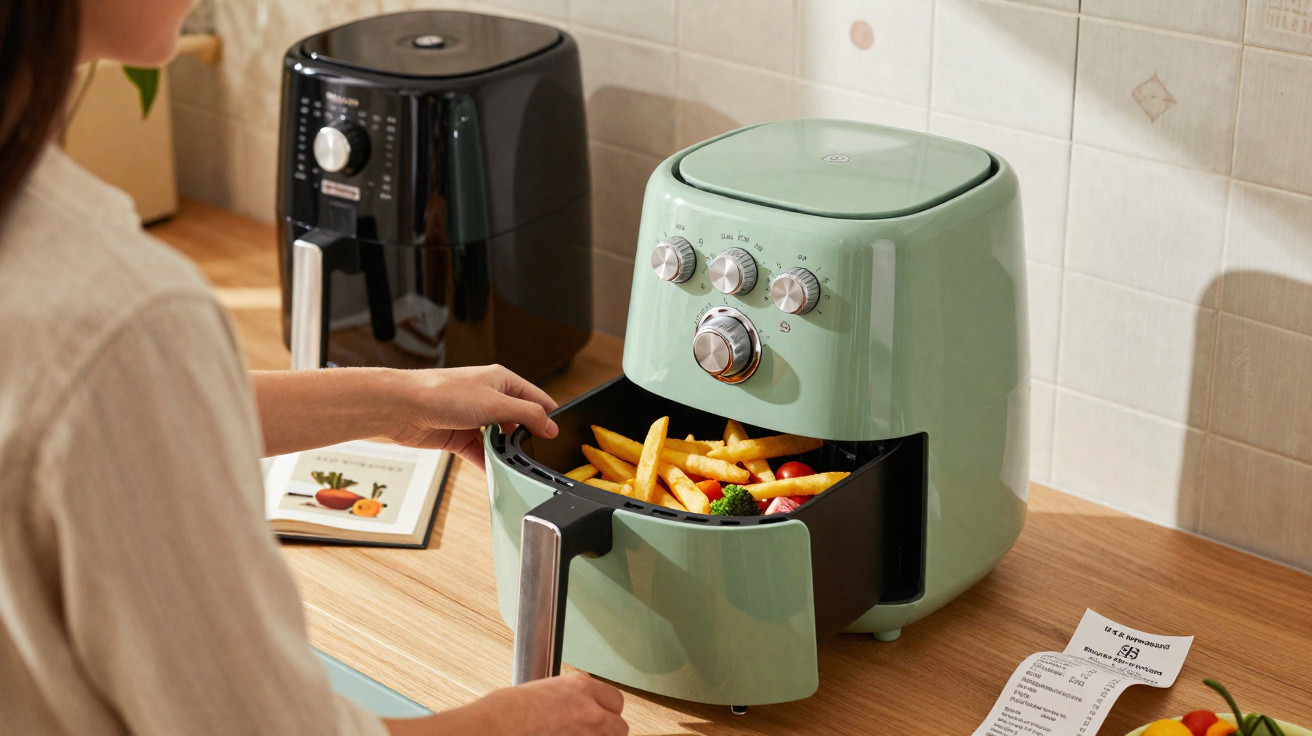
This is the opening for the retro-style air fryer. It draws on 1950s and 1970s design cues – rounded forms, substantial knobs and muted colours – while retaining the rapid hot-air cooking that made air fryers popular. Rather than attempting to blend into the background, it is designed to resemble a decorative object.
In place of sharp angles, there are curved edges; instead of concealed sliders, there are large, almost whimsical dials. Its colours seem lifted from vintage cookbooks: aqua blue, cherry red, pastel yellow, cream white and deep bottle green. Chrome accents and enamel-style surfaces add to the period character.
It looks like your grandmother’s fryer, but behaves like a 2025 multi-cooker with fans and precise thermostats inside.
Underneath the nostalgic casing, the technology remains up to date. Heating elements work alongside forced hot air to brown food evenly. Most versions provide adjustable temperatures across a broad range, as well as timers that switch the appliance off automatically. Features including cool-touch handles, overheating protection and automatic shut-off make everyday cooking straightforward and reassuring.
Lidl Silvercrest Retro 1973 air fryer drawing attention
Europe’s most discussed example at present comes from a retailer more commonly associated with affordable groceries than design statements: Lidl. Sold under its Silvercrest brand, the Lidl Silvercrest Retro 1973 is a large 8.7-litre hot-air fryer costing 59.99 €.
The model embraces nostalgia without apology. A prominent “1973” marking sits on top, resembling a date badge from a past era. Available in black, red or cream white, it can either make a statement or complement traditional kitchen shades. At the front, futuristic glass displays are replaced by rounded drawers and plainly styled, old-fashioned controls.
Lidl’s Retro 1973 under 60 € offers double baskets, family capacity and that “found in a vintage shop” look in one package.
Its twin-drawer arrangement provides two 4.35-litre cooking areas. The Sync-Finish and Sync-Cook functions allow two different foods to finish at once or duplicate the same settings in each basket. For a busy household, this lets chips and chicken cook together without one portion cooling down while the other finishes.
At this price point, app-based operation and elaborate smart-home functions are not included. What it offers instead is something many people now value more: an appliance that works well, can remain on the worktop without resembling a miniature server rack, and is unlikely to seem obsolete after a year of smartphone launches.
What to consider before choosing a retro air fryer in 2025
A retro appearance may catch the eye, but choosing one requires more thought than simply deciding whether its colour suits your tiles. Several factors make a meaningful difference to everyday cooking.
Capacity and cooking habits
- One person or a couple: A compact 3 to 4-litre basket will generally manage snacks and uncomplicated evening meals without taking over the entire worktop.
- Family cooking: Look for 5 to 7 litres, or choose a dual-zone version if you regularly prepare mains and side dishes together.
- Batch cooking: Models of 8 litres and above are better suited to weekly meal preparation, whole chickens or trays of roasted vegetables.
Dual-zone appliances, such as Lidl’s Retro 1973, suit cooks who want versatility: vegetables can roast on one side while leftovers warm through on the other, or sweet food can be kept apart from savoury dishes. One large basket is less complicated and is often quicker to clean.
Controls: dials or touch panels
Most retro-inspired fryers use physical controls, and this is more than a styling decision. Large dials are easy to use with greasy fingers, can be read from across the room and are unlikely to stop working because of a software fault. Some manufacturers do, however, combine analogue-looking knobs with subtle digital timers to maintain precise control.
When comparing appliances, consider the following:
- The temperature range in degrees rather than vague options such as “high” or “medium”.
- Clearly labelled programmes for everyday foods if preset settings appeal to you.
- Fan noise, particularly if you live in an open-plan flat.
Cleaning and upkeep
Whether it is retro or not, an air fryer succeeds or fails according to how willing you are to clean it regularly. Baskets with non-stick finishes and detachable internal trays make a substantial difference. Dishwasher-safe components can save time, although it is worth checking that high-temperature dishwasher programmes will not harm the coating over time.
A quick clean after each session keeps odours away and preserves that glossy retro finish people actually want to show off.
The essential maintenance routine is straightforward:
- Clean the basket and drawer after use with warm, soapy water and a soft sponge.
- Once cool, wipe the interior chamber using a damp cloth.
- For persistent grease, apply a gentle bicarbonate of soda paste without scratching the finish.
- Inspect the vents and power cable regularly for blockages and signs of wear.
How retro air fryers influence cooking habits
Appearance genuinely affects behaviour. When an appliance is attractive and kept on the worktop, people are generally more inclined to use it. Retro air fryers benefit from this effect, encouraging experimentation with quick roasted chickpeas, cinnamon apple slices, marinated tofu, toasted nuts and small traybake-style meals for one.
For students and renters with restricted kitchen space, a large retro fryer can function almost as a small oven combined with a grill. It heats up more quickly than a conventional oven, making it practical for weekday meals. For parents, the clear icons and straightforward dials may also help teenagers feel more confident about using it safely.
| Feature | Standard air fryer | Retro-style fryer |
|---|---|---|
| Design focus | Minimal, technology-led | Decorative, nostalgic |
| Controls | Touchscreens, digital menus | Large dials, simple buttons |
| Worktop appeal | Often put away | Usually left on display |
| Perceived “newness” in 2025 | Feels familiar, almost generic | Feels different, visually fresh |
Why affordable models such as Lidl’s matter to the trend
Premium design-led appliances are available, but they commonly cost £150-plus. Lidl’s Retro 1973 costs under 60 €, bringing this aesthetic into a far more mainstream price bracket. That affects how widely the look is adopted.
Someone who would not risk £200 on a statement fryer may be happy to try one costing less than €60. If it proves appealing, it remains visible in the kitchen, begins appearing in photographs and influences friends’ buying decisions. Budget retailers can act as amplifiers for design trends that previously belonged to niche brands.
There is a psychological aspect as well. Spending less on a boldly styled appliance reduces the worry that a kitchen will soon look unfashionable. If tastes change again, the financial loss feels less significant, while the practical benefit for daily cooking remains genuine in the meantime.
Retro styling, modern health priorities
Behind the nostalgic design, the health message that drove the air-fryer boom remains unchanged. People still want crisp food without filling a pan with oil, and retro models retain that appeal. They rely on the same rapid hot-air method and offer the same reduction in added fat compared with deep frying.
A more noticeable and appealing appliance can also help support modest changes in routine. Replacing frozen breaded foods with homemade seasoned potatoes or marinated vegetables is easier when preheating takes only a few minutes and cleaning is fast. An air fryer cannot transform a diet by itself, but it can reduce the obstacles to making better choices.
For households keeping an eye on energy bills, these appliances generally use less electricity than heating a full-size oven for small quantities of food. Across months of quick evening meals, the difference can build up. Whether retro or otherwise, checking the wattage and preheating time offers a clearer idea of running costs.
What could follow the 1973 trend
The popularity of models such as Lidl’s suggests a future in which more cooking appliances put a “personality costume” around broadly similar internal technology. It is easy to imagine toasters inspired by 1990s hi-fis, rice cookers styled like 1960s radios or coffee machines resembling analogue laboratory equipment.
For buyers, the danger is choosing purely for appearance and ending up with weak heating elements, ineffective airflow or poor-quality coatings. A sensible approach combines emotion with specifications: examine litre capacity, temperature range, warranty and user-serviceable parts before choosing that appealing 1970s cream casing. When those factors are in place, the retro badge on the worktop becomes more than a fashion statement; it becomes a dependable everyday appliance that happens to look as if it travelled through time from 1973.














Comments
No comments yet. Be the first to comment!
Leave a Comment