A simple trick can change that.
After pizza nights, roasts and baked dishes, stubborn layers of grease and burnt-on sauce collect on oven racks. Yet these grids are surprisingly rarely included in a deep clean, as they are bulky and barely fit in either the sink or dishwasher. A straightforward household method shows how burnt-on oven racks can be cleaned thoroughly with almost no scrubbing, using ingredients found in nearly every kitchen.
Why oven racks become magnets for dirt
Oven racks usually sit directly above the heat. Dripping fat, cheese residue and marinades burn onto them particularly firmly. Each baking session adds another layer, eventually creating a dark, sticky crust.
When cleaning, many households focus on the oven door and baking trays. The rack stays inside, “because it will only get dirty again anyway”. There is also a very practical issue: the bars are narrow, the gaps are even narrower, and the rack is larger than any standard sink.
Oven racks are among the most heavily used parts of an oven – and among the most neglected.
Anyone who has tried cleaning one in the sink will know the result: water splashes everywhere, part of the rack sticks out of the basin, and some areas remain untouched. Although harsh oven cleaners work quickly, they can irritate hands and airways and may also damage the metal.
The unexpected helper: why the bathroom becomes a cleaning station
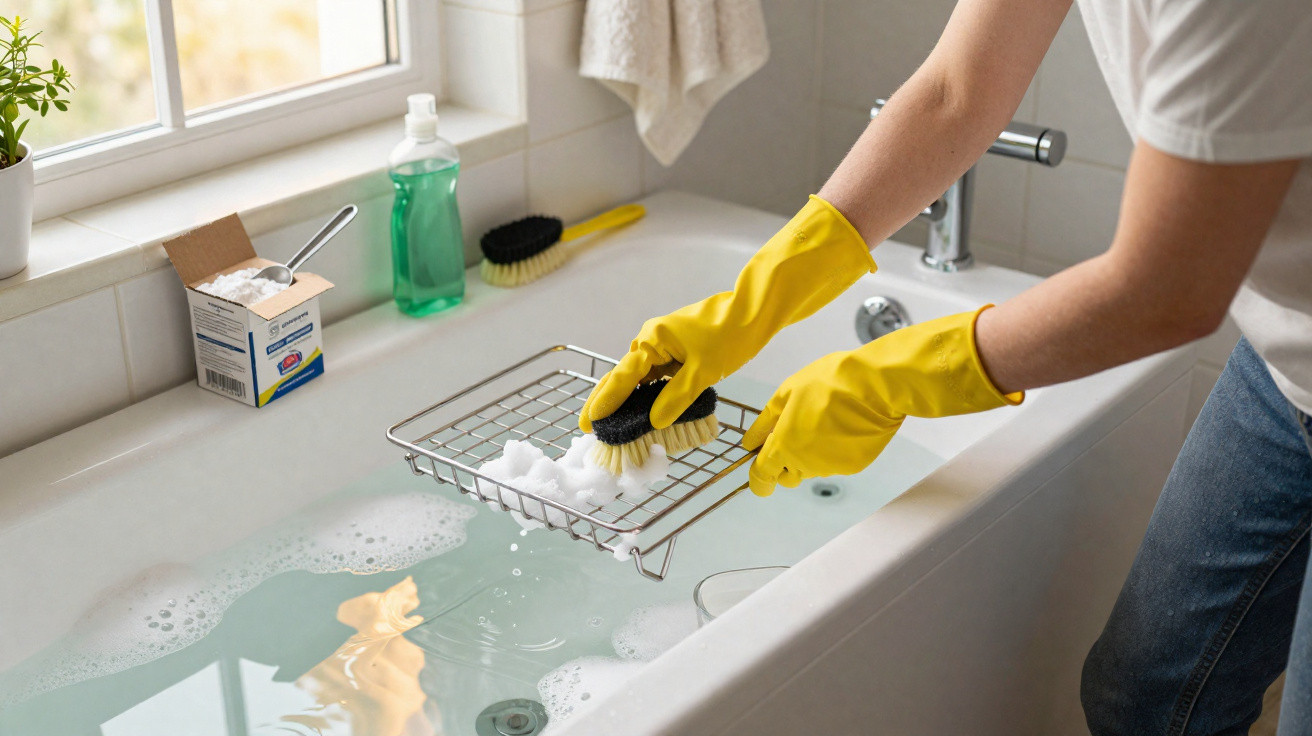
The answer is often just one door away, in the bathroom. A bathtub provides what neither a sink nor a bucket can offer: enough room to submerge the entire rack.
A little preparation helps to protect both the bath and its enamel surface:
- place a thick, old towel across the bottom of the bath
- lay the racks flat on it, ensuring they do not rub against the bath
- seal the plughole securely so that no water drains away
The towel trick does more than prevent scratches on the bath surface: it also softens the noise when the metal grids are lowered into the water or lifted out again.
Which ingredients really work on burnt-on residue?
The cleaning solution itself requires just three simple components:
- very hot water
- bicarbonate of soda (sodium bicarbonate, often sold as “soda” or “baking soda”)
- a grease-cutting washing-up liquid
These three elements work particularly well together:
| Component | Effect |
|---|---|
| Hot water | Softens crusted residue and opens up the grease layer |
| Bicarbonate of soda | Is mildly alkaline and loosens grease and roasting residue |
| Washing-up liquid | Breaks fats and oils into small droplets that can be rinsed away |
A tried-and-tested ratio is around 150 grams of bicarbonate of soda to roughly 50 millilitres of washing-up liquid per bathtub. Naturally, the quantity can be adjusted to suit the size and number of racks.
Cleaning oven racks step by step
1. Prepare the bathtub
Put the towel on the bottom of the bath, position one or several racks side by side on top, and close the plughole. Ideally, the grids should lie as level as possible so that they are covered evenly later.
2. Fill with hot water
Fill the bath with very hot water until the metal grids are completely submerged. The hotter the water, the more effectively the burnt-on deposits will soften. Boiling water from a kettle can be added if the tap water does not get hot enough.
3. Add the cleaning mixture
Scatter the bicarbonate of soda evenly over the water’s surface, then pour in the washing-up liquid. Briefly stir with your hand or an old washing-up brush until everything is well distributed. A little foam is perfectly fine – it shows that the ingredients are combining.
4. Leave to soak
At this point, the chemistry does the work. For lightly soiled racks, 30 to 45 minutes of soaking is often enough. Heavily burnt-on grease marks require more patience: several hours or a full night in the solution can loosen even firmly attached layers.
The longer the rack sits in the warm soda bath, the less muscle power is needed at the end.
5. Finish lightly, rinse and dry
Once soaked, the loosened residue can usually be wiped away with a soft washing-up brush or a non-scratch sponge. Wire brushes and steel wool are unnecessary and may harm the surface.
Finally, rinse everything thoroughly with clean water until no soap residue remains visible. Dry the racks with a tea towel or allow them to air-dry before returning them to the oven. This helps to prevent water marks and rust.
Why this method works so well in everyday life
The appeal of this bathtub technique lies in the balance between effort and results: the hands-on work consists of only a few simple steps, while the soaking bath handles the rest. Your hands are not exposed to harsh sprays, and the air remains free from aggressive fumes.
At the same time, the gentle mixture protects the metal’s protective coating. Vigorous scrubbing on a dry rack creates microscopic scratches where grease can settle again later. Soaking first and then wiping lightly helps to avoid exactly that.
Making oven-rack cleaning part of the kitchen routine
Anyone who cleans their racks only once a year has to tackle thick, stubborn deposits every time. A different approach makes more sense: after especially greasy meals, such as roast goose, lasagne or cheese-topped dishes, put the rack in the bath at the next opportunity.
Many households combine the task with laundry or a weekend bathroom clean that was already planned. The soaking continues in the background while other jobs are taken care of.
- After every substantial oven meal, wipe off large bits of residue straight away with kitchen roll.
- Plan a soda bath at least every few weeks.
- Do not wait when visible build-up appears; deal with it early.
Where else the method can be used
This trick is not limited to oven racks. Other bulky metal parts also benefit from a bath of bicarbonate of soda and washing-up liquid, including:
- barbecue grills from charcoal or gas barbecues
- telescopic rails inside the oven
- oven shelves in fan ovens with multiple levels
For enamelled parts or aluminium, it is worth checking the manufacturer’s instructions first. Strongly alkaline cleaners can sometimes attack these surfaces. In most cases, a shorter soaking time with less bicarbonate of soda is sufficient for such items.
What to consider with alternatives and household remedies
Some people swear by vinegar, citric acid or baking powder. Acidic cleaners are excellent at removing limescale, but they are often less effective against grease and protein crusts than an alkaline mixture of bicarbonate of soda and washing-up liquid. The commonly mentioned canned oven-cleaning foam is also strongly alkaline, but it contains significantly more aggressive ingredients.
Those with sensitive skin can wear thin household gloves when handling the bicarbonate of soda solution. Compared with specialist cleaners, the solution is notably mild, but prolonged contact can dry out the skin.
For households with children or pets, the rule is simple: never leave the filled bath unattended, and rinse it thoroughly afterwards so that no residue ends up on sensitive paws or hands.
A cleaner oven, better baking results
A well-maintained rack is not just about appearance. Old grease layers start to smell at high temperatures and can affect the flavour of fresh food. Dark baked-on deposits conduct heat differently from bare metal, which can produce uneven baking results.
Making oven-rack cleaning with simple household ingredients a regular habit brings two benefits: the oven looks well cared for and delivers more consistent results, whether you are cooking a Sunday chicken or making a quick frozen pizza after work. With the bathtub method, this can be done without much effort or an aggressive chemical cocktail – just hot water, bicarbonate of soda, washing-up liquid and a little planning.






Comments
No comments yet. Be the first to comment!
Leave a Comment