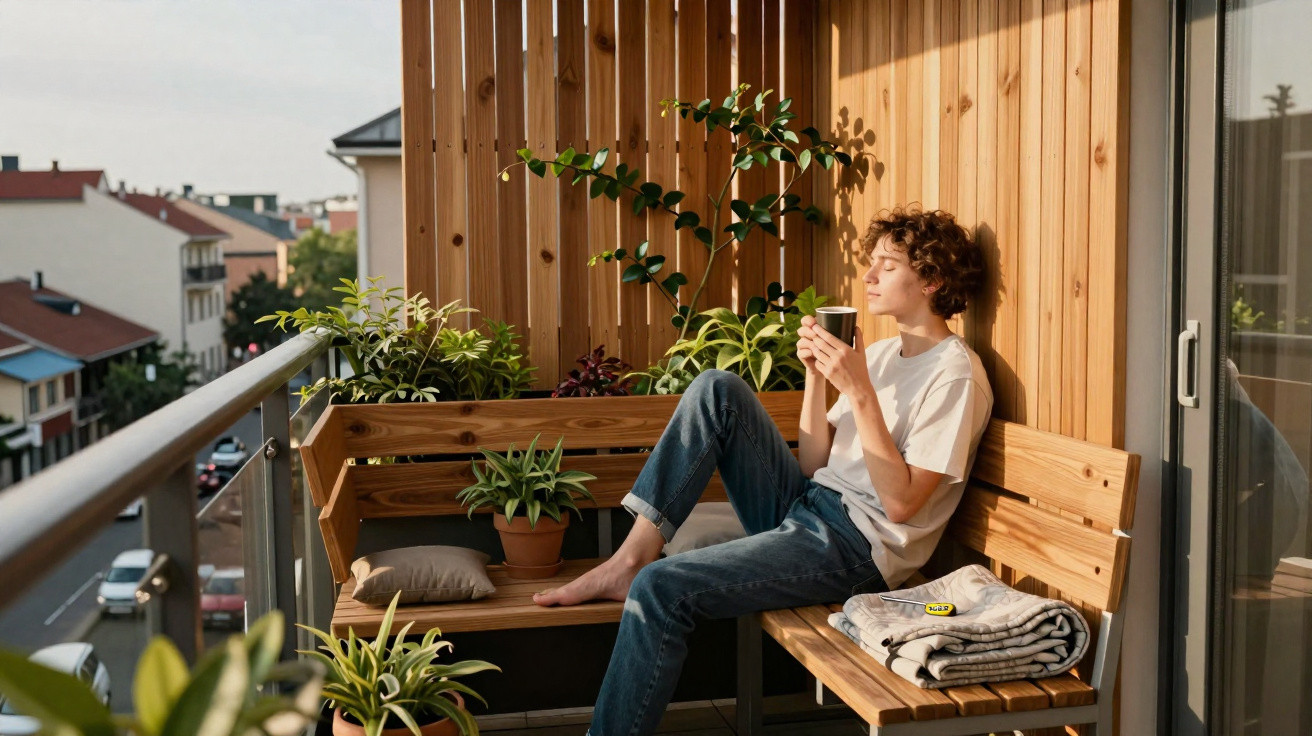
Living in the city brings a familiar problem: step outside with a coffee or an after-work beer and it can immediately feel as though you are being watched. Windows open, someone leans over their balcony railing, and curious eyes follow every move. Eventually, many people give up in frustration and barely use their outdoor space. IKEA offers a clever answer: a solution that combines a privacy screen, seating and storage, without drilling or major alterations.
Why privacy is so hard to achieve on balconies and in small gardens
Urban residents often live closer together than they would like. A neighbour diagonally opposite may have a direct view of the balcony, wheelie bins in the courtyard are something you would rather not look at yourself, and there always seems to be somebody at a window. Traditional options such as tall hedges, permanent fencing or brick walls often fail for the following reasons:
- Lack of space: every centimetre matters on a narrow balcony.
- Rules set by landlords or property management: drilling, wall plugs and fixed privacy screens are often prohibited.
- High cost and effort: a permanent screen can quickly become expensive and may require tradespeople.
- Slow-growing alternatives: hedges and climbing plants can take years to provide genuinely dense coverage.
As a result, many people want something that works straight away, does not need permanent fixing and can be moved again whenever required. That is exactly what a piece from IKEA’s NÄMMARÖ range provides, and it is currently attracting plenty of attention on social media and online forums.
The NÄMMARÖ privacy screen: the idea behind the 3-in-1 design
At its centre is a freestanding privacy screen made from solid acacia wood. Its wooden slats are positioned to shield against inquisitive glances while still allowing air and daylight through. Rather than making the area feel dark or boxed in, it creates a light timber structure that helps divide the space into zones.
The standalone privacy screen measures around 140 centimetres high and approximately 80 centimetres wide. With a footprint of about 50 centimetres, it remains stable without taking up excessive room. This is crucial for compact balconies: position the screen by the railing, sit behind it on a chair, and you are noticeably better shielded from people looking up from the street or flats below.
The principle: a movable feature that interrupts sightlines without turning the outdoor area into a concrete enclosure – ideal for tight urban settings.
Acacia wood works well outdoors because it is comparatively hard and weather-resistant. With some maintenance – wiping it down with soapy water and re-oiling or staining it once or twice a year – the furniture should remain attractive for a long time.
Privacy screen, bench and storage in one piece of furniture
The extended version is particularly appealing for small spaces: one module brings together a privacy screen, bench and built-in storage. Its approximate dimensions are 80 × 68 × 140 centimetres. The top serves as seating, small items can be tucked away inside, and the timber backing provides screening.
The storage compartment is suitable, for example, for:
- Seat cushions and pads
- Throws for cooler evenings
- Small gardening tools or a watering can
- Children’s toys for the courtyard
According to market observations, the basic privacy screen costs around €75. The complete unit with bench and storage is generally priced at roughly €170 to €220, depending on promotions. For city dwellers aiming to turn just a few square metres into a usable retreat, this represents a relatively manageable investment.
How difficult is it to assemble?
Assembly follows a similar process to other IKEA furniture: screws, wooden components and illustrated instructions. Many buyers say it can be put together alone if you allow enough time. Having a second person available when lifting it upright is useful to prevent it from tipping over. No specialist tools are needed; an ordinary screwdriver or cordless drill driver will do.
Anyone who has assembled a simple IKEA shelving unit before should be able to manage this module – the key is simply to take your time and read the instructions carefully.
How the NÄMMARÖ module changes everyday life on a balcony or in a tiny garden
Its main benefit is mobility. The screen is not screwed to either the wall or the floor, so it can be repositioned to suit the situation, for example:
- In the morning, as a windbreak while drinking coffee
- At midday, as shade in strong sunshine
- In the evening, to block glare from car headlights or street lamps
- At weekends, as a divider between a children’s play area and a dining space
In tight courtyards, it can create a clearly defined corner where you feel as comfortably settled as you would in the living room, rather than as though you are on display. Sit on the bench, lean against the timber slats, and views from the second or third floor are considerably softened.
Styling ideas: from a wooden screen to a green oasis
The slats make an excellent base for light vertical planting. If drilling into walls is not permitted, simply use S-hooks or hanging plant holders. This quickly creates miniature “green walls”:
- Herb pots with rosemary, thyme or mint
- Small trailing plants such as devil’s ivy, for sheltered balconies
- Ornamental grasses in narrow pots to add some height
- Planter boxes with strawberries or chillies for snack lovers
This vertical approach is especially popular in cities, where ground space is scarce. Plants enhance the screening effect, soften noise slightly and create visual separation. Add larger containers of bamboo or grasses in front, and you can easily gain an extra 30 to 50 centimetres of visual cover above the 140 centimetres of timber.
Examples for different outdoor spaces
Narrow balcony: Place the module parallel to the railing, with the bench facing inwards. The timber surface blocks views from below and opposite. A slim table and two chairs can fit behind it.
Tiny back-courtyard garden: The furniture separates the eating area from the sun-lounger zone. On its “back side”, wheelie bins or the outdoor unit of an air-conditioning system can be hidden away. This makes the garden look tidier and less technical.
Ground-floor terrace: Two modules arranged in an L-shape form a kind of timber nook. This corner can be used for reading, making phone calls or working without feeling observed. Cushions go into the storage compartment in the evening, leaving everything neatly put away within easy reach.
Two modules can quickly create a small “room outdoors”, which can be used differently depending on the occasion – from a reading nook to a children’s area.
How much privacy does it really provide?
The privacy screen is most effective against side-on and diagonal views, as well as inquisitive looks from closer range. One module alone will usually not be enough to block a direct view from far above. In these situations, a combination of the following helps:
- The wooden module as a base
- Tall grasses or bamboo in containers
- An awning or shade sail
Placing the modules slightly offset can break up sightlines effectively. It is worth testing the view yourself from a neighbour’s balcony, if your relationship allows it. This makes it easier to see which angle exposes you most and to arrange the furniture accordingly.
Care, safety and long-term use tips
Wooden furniture on a balcony or terrace will age if it is left in the rain. Acacia can withstand quite a lot, but benefits from protective oil or wood stain. Covering the furniture with a protective cover in winter, or storing it in a cellar, significantly extends its lifespan.
In exposed, windy locations, stability should be considered. Depending on the surface, it may make sense to weigh the bench down with cushions, plant pots or boxes. On roof terraces with strong winds, it is worth briefly checking that the module is secure and cannot slide.
Another detail that is easily overlooked: the storage compartment is tempting for all sorts of items, from decorations to tools. It is best not to use it for the long-term storage of highly moisture-sensitive belongings such as electronics or valuable books. Condensation can always form, even if the lid closes tightly.
Making more of a few square metres
Anyone who has hardly used their outdoor space because they feel watched often underestimates how much a better sense of enclosure can improve quality of life. A single item that combines seating, storage and privacy screening solves several everyday problems at once: less clutter, a stronger sense of retreat and more motivation to use the balcony properly.
The NÄMMARÖ privacy screen demonstrates how significant the effect of a well-designed piece of furniture can be. Add a few plants, string lights and comfortable cushions, and a previously neglected strip of balcony can quickly become a favourite spot – even in the middle of a densely built-up city.








Comments
No comments yet. Be the first to comment!
Leave a Comment