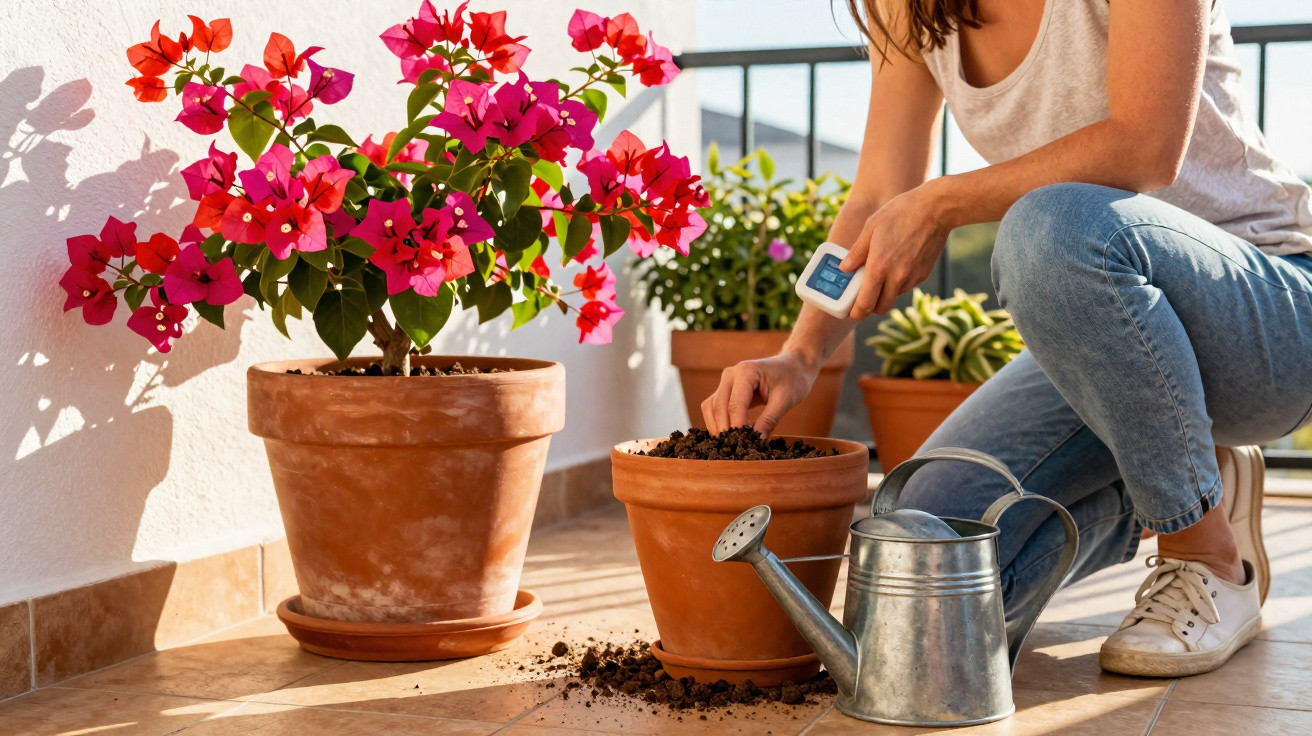
On a balcony, against a house wall or in a conservatory, this vividly coloured climber is often seen as a treasured reminder of the South. Yet in the UK it frequently produces plenty of foliage but no bracts - the colourful modified leaves that most people mistake for “flowers”. Gardeners know the main reason for this, along with a simple yet surprisingly effective technique that encourages flowering.
Why your Bougainvillea produces leaves rather than colour
If your Bougainvillea appears healthy, grows vigorously and carries dense foliage, that is initially a positive sign. When the colourful bracts fail to appear, however, the cause is usually not something exotic but a very ordinary issue.
The plant originates in relatively dry, sunny regions, where it receives:
- many hours of intense sunshine
- short, heavy downpours
- extended periods of dry soil in between
In UK gardens, the opposite can easily happen: partial shade, a constantly moist root ball and generous applications of all-purpose fertiliser. This leads to the familiar “growth mode”: long shoots and lush green leaves, but barely any flower buds.
Full sun, dry spells and lean soil are much closer to a Bougainvillea’s natural habitat than a well-meaning “spa pot” kept permanently wet.
Bougainvillea location and temperature: the foundation for flowers
Before any technique can work, the location needs to be right. Without sunshine, a Bougainvillea will not deliver its colourful display.
How much sun does the plant really need?
Bougainvillea is an unmistakable sun lover. To produce flowers, it needs:
- at least 6 hours of direct sunlight each day
- ideally, a warm and sheltered spot against a house wall
- a south-facing or south-west-facing aspect
During the growing season, it thrives at 20 to 30 degrees. When temperatures fall towards 5 degrees, it should be moved indoors or into winter storage. Around freezing point, many varieties can already be damaged.
The right pot and suitable growing medium
What happens below the surface matters just as much as the conditions above it. Bougainvillea does not tolerate heavy, wet compost; instead, it needs:
- loose, free-draining soil
- a pot with a large drainage hole
- no saucer that remains permanently full of water
A mixture of potting compost with coarse sand or fine expanded clay is ideal. This allows excess water to drain away quickly, keeps air around the roots and prevents them from rotting.
The biggest obstacles to flowers: excess water and fertiliser
A common scene on many patios goes like this: it is midsummer and the heat is intense. Worried about the plant, its owner reaches for the watering can every other day and adds all-purpose fertiliser each week. It may feel reassuring, but it is not helpful for Bougainvillea.
What follows is that the plant directs its energy into:
- long, soft shoots
- dense green foliage
- strong vegetative growth
The colourful bracts do not develop, and although the shrub looks vigorous, it appears “bare”. In botanical terms, too much water - and especially too much nitrogen - makes the plant prioritise growth over reproduction.
Plenty of water and lots of nitrogen keep Bougainvillea in an endless “leaf mode”. Anyone wanting flowers must challenge the plant slightly rather than overindulge it.
The gardeners’ trick: controlled dryness
The secret to abundant colour lies in deliberately alternating dry periods with thorough watering. Professionals refer to this as a form of “controlled thirst period”.
How the “thirst protocol” works in practice
- Establish the basics: provide plenty of sunshine, free-draining soil and no standing water in the saucer.
- Choose the right fertiliser: fertilise moderately during the season, ideally using a product containing more potassium than nitrogen. Stop feeding altogether from mid-September.
- Wait for a dry period: in summer, water only once the top 3 to 4 centimetres of compost feel clearly dry.
- Then water properly: when you do water, do so generously. The whole root ball should be thoroughly soaked.
- Empty the saucer: remove surplus water from the dish after around 30 minutes.
This sequence recreates natural conditions: brief, heavy rain followed by dry intervals. That contrast is precisely what signals to the plant that it should switch from producing growth to producing flowers.
How to tell when it is time to water
Many amateur gardeners rely on the calendar or the air temperature. With Bougainvillea, checking the compost is far more important.
- Finger test: push a finger into the compost. If the upper few centimetres feel dry, it is time to water.
- Watch the leaves: slightly limp leaves are an early warning sign. Do not wait until they turn brown or curl up.
- Adjust the watering interval: gaps between watering will be longer on cooler days and shorter during hot weather - let the soil decide, not the clock.
A short dry spell followed by a heavy “thunderstorm” from the watering can supports the formation of colourful bracts far more effectively than constant moisture.
Common mistakes that delay flowering
Even with a suitable location and adjusted watering, several pitfalls can postpone flowering for months.
Automatic watering and an oversized pot
A watering system that lightly moistens the pot every day removes exactly the dry intervals that benefit the plant. The result is once again the familiar focus on foliage instead of flowers.
An excessively large container is similarly problematic. In a very large pot, the Bougainvillea will invest substantial energy in developing roots before it becomes ready to flower at all. A fairly snug pot, though not one that is too small, encourages earlier flowering.
Pruning at the wrong time
Hard pruning at an unsuitable time can remove developing flower buds. A two-stage approach is better:
- lightly thin the plant immediately after a flowering period
- prune more firmly in late winter, before new growth begins
This keeps the plant in shape without sacrificing the basis for the next flowers.
Winter rest: why cool brightness encourages flowers
Overwintering has a greater influence on the following season than many people realise. Bougainvillea needs a clear “winter signal” if it is to flower strongly again the next year.
A bright, cool location at 10 to 15 degrees is ideal. Watering should be reduced considerably, leaving the pot almost dry. By contrast, in a consistently warm living room with central-heating air, the plant can easily lose its rhythm, produce soft growth and become weak.
Practical guidance: when to expect results
Anyone who has overwatered and overfed their plant for years should not expect miracles overnight. Once the watering routine, location and nutrient supply have been changed, the plant often needs several weeks before it gradually produces more flower buds.
A small notebook or a note on your smartphone can be useful. Record watering dates, fertiliser applications and the first signs of buds. This soon reveals which intervals and which care routine work particularly well for your own plant.
Background: what actually “flowers” on a Bougainvillea?
Strictly speaking, the striking colours are not flower petals but bracts - modified leaves surrounding the rather inconspicuous small flowers. Like the petals of roses or geraniums, they serve to attract pollinators.
So when people complain about missing “flowers”, they generally mean these very bracts. Their absence is a clear sign that the Bougainvillea is too comfortable in terms of available nutrients and water - it does not feel compelled to reproduce abundantly.
This is exactly where the technique used by experienced gardeners comes in: plenty of sunshine, relatively lean conditions and carefully applied dryness move the plant into the mode in which it reveals its true colour potential. Those willing to water less and fertilise more sparingly will usually be rewarded with significantly more colour in the end.





Comments
No comments yet. Be the first to comment!
Leave a Comment