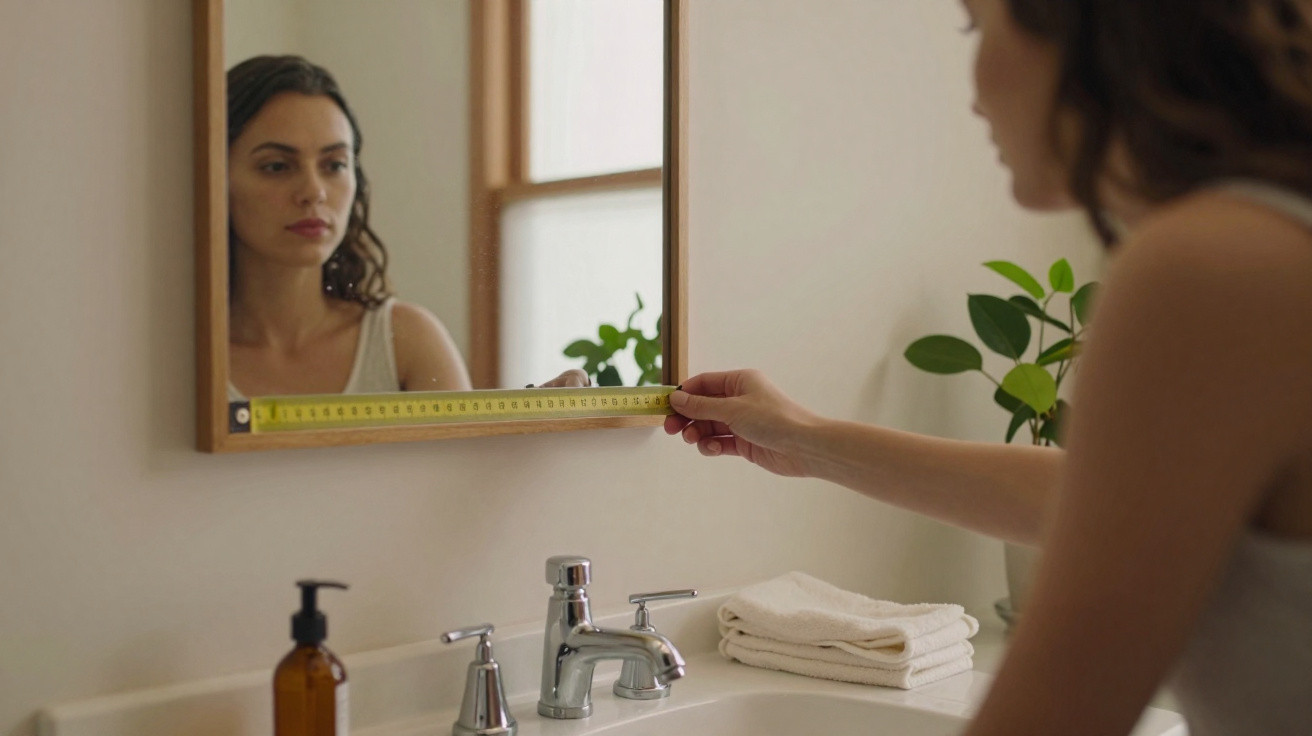
A small adjustment is precisely where many bathrooms go quietly wrong.
The woman in the mirror has not changed.
Yet the face staring back at her somehow has.
On one morning, she appears well rested: her complexion is smooth, her features look refined and her eyes are lively.
The day after, beneath the very same bathroom light, her face looks more severe, with under-eye shadows and small blemishes she did not notice the night before.
There has been no dramatic alteration.
Her routine, ceiling spotlight and make-up are all unchanged.
Only one thing has shifted: while repainting the wall, her partner lifted the mirror by a few centimetres.
Suddenly, the light fell differently across her face, creating more shade than brightness and making the room feel more “office bathroom at 7 pm” than “hotel spa at 9 am”.
She had not changed; the mirror height had.
How mirror height changes the appearance of your face
Visit ten bathrooms and you will probably spot the same arrangement.
The mirror is positioned wherever the builder installed it, typically centred between the basin and ceiling as an unchallenged, safe-looking choice.
Your face may land in the middle of the mirror - or it may not.
Shorter people tend to raise their heads and lean forwards.
Taller people often stoop, trying to find their reflection nearer the tap.
That uncomfortable movement has an effect on what you see.
Whenever you reposition your body, overhead lighting reaches your face from a different angle.
One angle can flatten your features, while another cuts deep shadows beneath your eyes and nose.
Many people put this down to being tired or getting older.
Quite often, though, the mirror is simply mounted a little too high.
Consider a compact flat bathroom with a single ceiling spotlight.
Its owner, a graphic designer in her thirties, told me she always felt “grey” while preparing for work.
Her photos at home seemed less flattering than her reflection in any lift or café window.
On paper, her lighting was sound: an LED bulb, an acceptable colour temperature and bright white walls.
What was missing was proper alignment between her face and the brightest part of that lighting.
The mirror’s bottom edge was 25 centimetres above the basin.
At 1.60 m tall, her eyes met the lower third of the glass, meaning she instinctively lifted her chin.
This placed her eye sockets in shade and made the lines between her nose and mouth appear stronger.
One weekend, she lowered the mirror by around 6–7 cm.
It was hardly a major change.
Yet the following morning, with the same lighting and routine, her reflection looked as though she had enjoyed two additional hours of sleep.
The explanation is straightforward physics.
Bathroom lighting is usually fitted above the mirror or in the ceiling.
This sends light downwards, which commonly creates shadows below the brows, nose and chin.
When a mirror is too high, you lift your chin to bring yourself into view.
In doing so, strong light strikes the upper part of your face and casts severe shadows below it.
With a lower mirror, your eyes sit nearer the glass’s vertical middle and your head can remain in a neutral position.
Light then falls more evenly across your features.
Shadows become gentler, skin texture appears more forgiving and colours look more true to life.
You have not installed a Hollywood mirror.
You have merely matched your real face to the geometry of your lighting.
The ideal bathroom mirror height
Interior designers may disagree on plenty, but there is broad agreement on one approximate bathroom rule.
Hang the mirror so that the average user’s eye line falls between roughly one third and halfway up the glass.
In many rooms, this places the mirror’s lower edge approximately 10–20 cm above the basin.
It should not sit tight against the tap or hover halfway up the wall; it needs to be low enough that you are not forced to strain your neck.
Begin with the people using it, rather than the tile layout.
Stand where you would naturally stand to wash your hands.
Keep your shoulders loose and look forwards.
Picture a horizontal line running from the middle of your eyes to the wall - that is where the mirror’s useful viewing area truly starts.
Position the glass so this line sits comfortably within it, rather than skimming along its bottom edge.
When putting up a mirror, many people make an ambitious attempt to accommodate everybody.
They place it high enough for the tallest household member, while assuming shorter people will “manage”.
The result is children on tiptoes, grandparents bending at awkward and potentially unsafe angles, and visitors wondering why the bathroom makes them resemble an extra in a crime series.
A more considerate method is available.
Measure the eye levels of the shortest and tallest regular users, take the average, and use that figure as your guide.
Where children are still growing, plan around the shortest adult or teenager and provide a small step stool for the next few years.
For shared bathrooms with double basins, some designers even suggest installing two mirrors: one a little lower and the other slightly higher.
Rather than looking odd, it appears intentional, while changing how each person encounters their own face each morning.
Behind these decisions is a simple emotional reality.
Where you place the mirror determines whether your everyday reflection feels compassionate or judgemental.
Bathroom lighting, psychology and the daily ritual
Once the mirror is at a suitable height, the lighting around it becomes much more noticeable.
You begin to see exactly where shadows sit, which side of your face appears softer and where make-up colours become inaccurate.
Professionals frequently refer to “cross-lighting” - the use of illumination from both sides of the face.
Wall sconces placed approximately at face level, one on either side of the mirror, can rebalance the light without requiring a complete refurbishment.
The aim is not to flood the bathroom with brightness.
Instead, surround your features with soft, balanced light: less from above and more from the front and sides.
The mirror then stops acting as a spotlight and becomes a neutral witness.
At a deeper level, shifting a mirror by a few centimetres can alter small emotions experienced every day.
If your first view each morning is a distorted, harshly illuminated version of yourself, your brain quietly records it as “I look bad today”.
Repeat that experience for a hundred mornings and it begins to linger.
We often overlook the extent to which a bathroom mirror shapes our perception of ourselves.
Adjusting mirror height is therefore more than a design alteration.
It is a way to reclaim control over what influences how you see yourself.
A lighting consultant I spoke to expressed it bluntly:
“If your mirror makes you raise your chin or bend your neck every day, it’s not just bad design. It’s a daily micro-aggression against your own face.”
Let us be honest: nobody spends hours thinking about their mirror unless it falls off the wall.
Even so, this pane of glass frames countless private moments - taking off make-up after a late night, examining a rash or practising a difficult conversation.
Practically speaking, improved lighting on your face reveals better detail: you can shave without missing areas, apply matching eyeliner to both eyes and direct skincare to the right places.
More quietly, it can mean fewer mornings spent asking why you look so “off” when you physically feel well.
- Lowering a mirror may reduce the appearance of eye bags and lines around the mouth under downward lighting.
- Bringing your eye line into alignment with the mirror’s centre helps you hold your face more naturally.
- Side lighting at face height nearly always outperforms one ceiling spotlight.
Reconsidering your reflection space
After noticing how mirror height affects your face, it becomes difficult to ignore.
You may find yourself mentally assessing every bathroom you enter - from a hotel with a flattering glow to a friend’s home where the mirror crops off foreheads.
Fortunately, this does not require a complete renovation.
Often, all it takes is removing a bracket, filling two holes, moving the mirror up or down by a hand’s width, and trying the result for a week.
Such a minor trial carries little risk but offers a great deal of feedback.
If, on an ordinary Tuesday, you find yourself thinking “I look like myself again”, you will know you have found something worthwhile.
Most of us have experienced a passing reflection in a shop window that felt unexpectedly kind.
The light was more favourable, your posture seemed better and your face looked more recognisably your own.
A bathroom mirror can provide that same gentle honesty each day.
It is not about flattery or filters, but a setup that does not alter your features before you have even eaten breakfast.
So, before choosing a fashionable new tap or an expensive scented candle, stop and consider where your mirror actually sits on the wall.
A few centimetres higher or lower can tell your face a very different story.
| Key point | Detail | Benefit for the reader |
|---|---|---|
| Mirror height | Position the eye line between the lower third and the middle of the mirror | A more natural reflection and less facial distortion |
| Type of light | Choose soft side lighting rather than a single ceiling spotlight | Fewer harsh shadows and more accurate make-up application and shaving |
| Adapting to users | Account for both the shortest and tallest regular user | Greater visual comfort for the whole family and a calmer morning routine |











Comments
No comments yet. Be the first to comment!
Leave a Comment