For years, I dashed around the garden with a watering can as the water bill climbed and blazing sunshine scorched my young plants. At the same time, caps from empty bottles were being thrown away without a thought. Then I realised that these small plastic or cork items could make tending my vegetable garden far less stressful.
How bottle caps became the vegetable garden’s secret weapon
The realisation came on an exceptionally dry spring day. The soil had turned hard, the seedlings were drooping, and slugs had once again chewed their way through my tender lettuces. While tidying up, I noticed a whole handful of bottle caps that had built up over several weeks.
It suddenly made perfect sense: plastic is waterproof and durable, while cork retains moisture and can mildly deter certain insects. Instead of ending up in the bin, these items work brilliantly as tiny water reservoirs and natural defensive barriers in a bed. Since then, I have never regarded a cap as rubbish.
Rubbish becomes a tool: with a few simple steps, every bottle can turn into a quiet helper against drought stress and slug damage.
Bottle drip irrigation: how the trick works
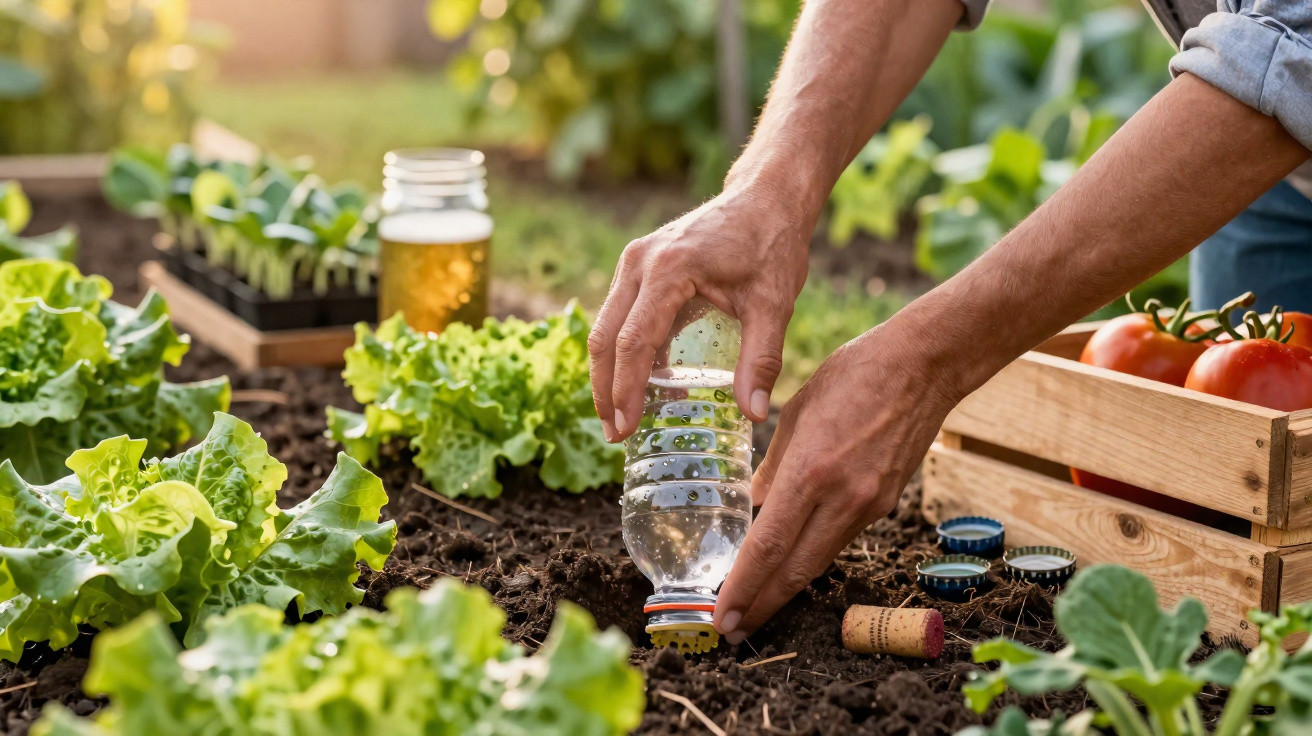
The principle could hardly be simpler: take an old plastic bottle, pierce its cap, and you have an improvised drip irrigation system that delivers water directly to the roots.
Materials needed for a homemade irrigation system
- Plastic bottle (0.5 litres for young plants, 1.5 litres for large vegetable plants)
- Matching cap
- Sewing needle or thin nail
- Lighter for heating the tip
- Craft knife or sharp knife
First, briefly heat the needle or nail with the lighter. Its warmed tip will pass through the plastic cap much more easily. Make one small hole in the centre, keeping it no larger than necessary.
You can quickly check the flow over the sink: roughly one drop every two to three seconds is suitable for most vegetable plants. Keep the hole especially small in heavy, compact soil; in free-draining soil, it can be enlarged slightly so that the bottle does not remain full indefinitely.
Finally, neatly cut off the base of the bottle. This makes it easy to refill the reservoir from above later, without having to pull the bottle back out of the soil.
Installing bottle caps in the bed correctly
When planting, make an additional small hole beside every tomato, courgette or pepper plant. Position the bottle neck cap-down, around 10 to 15 centimetres from the plant stem, and press it approximately 5 to 10 centimetres into the ground. Firm the surrounding soil well so water cannot escape sideways.
The practical results fit easily into everyday gardening:
- During spring, topping up once a week is generally enough.
- In hot summer spells, check the bottles about every three days.
- For seed trays or small pots, use mini bottles with even finer holes.
Watering takes place exactly where the plant needs it: at the root, rather than on the surface.
The foliage stays dry, helping to prevent fungal diseases, while the water seeps in slowly instead of evaporating unused. Particularly during summers with little rainfall, this noticeably cuts down watering work without plants suffering.
What cork stoppers can do in a vegetable bed
Plastic is ideal for the drip system, but cork offers different strengths. It is made up of tiny air-filled cells. Acting rather like a sponge, it holds water and gradually releases it once the soil begins to dry out.
Cork has another advantage: it contains substances whose smell can confuse some pests. Ants, aphids and small species of gnats in particular often avoid this texture. That can make a noticeable difference in the vegetable garden when vulnerable young plants need to establish themselves undisturbed.
Its low thermal conductivity provides an added benefit. Spread directly around a plant’s base, cork softens temperature extremes. The soil warms less intensely on hot days and does not cool as abruptly overnight. For tomatoes, peppers and cucumbers especially, which are sensitive to temperature changes, this may reduce stress.
Practical ways to use cork in the garden
- All-round slug barrier: Place slices or coarse pieces around plants to create a rough ring that many slugs avoid.
- Moisture store in pots: Put finely chopped pieces beneath the soil in window boxes and large containers.
- Mulching material: Crushed cork protects the soil surface from drying out and capping.
- Drainage layer: Use pieces of cork at the bottom of a pot instead of expanded clay, where they can absorb excess water.
With a little patience, an unremarkable piece of leftover cork becomes a flexible mini insurance policy against drought and heat stress.
How bottle caps deter slugs and prevent injuries
Beyond watering, these small helpers have another unexpectedly useful role in the everyday life of an amateur gardener. They can reduce slug damage while also lowering the risk of injuries in the bed.
Mini beer traps
Plastic caps can be made into small slug traps in moments. Press several caps flat into the soil and fill them with beer or sweet syrup. The scent attracts the animals, concentrating them in these spots and leaving young lettuces alone far more often.
Anyone wishing to keep the garden wildlife-friendly should use this approach sparingly and combine it with other measures, such as rough barriers and regular hand-picking in damp weather.
Safer supports for tomatoes and more
Thin canes and metal rods ending dangerously at eye level are an often overlooked garden hazard. Caps are useful here too: simply push them onto the upper ends of the supports and the job is done.
This makes the ends clearly visible and greatly reduces the chance of injury while bending down or working in the bed. It also makes lines of canes easier to spot, which is helpful, for example, in densely planted tomato beds.
How much can you really save, and what should you consider?
Anyone tending numerous vegetable beds needs enormous quantities of water in summer. Bottle-based drip irrigation substantially lowers consumption because almost no water is lost through evaporation at the surface. Light sandy soils benefit in particular, as they would normally retain water poorly.
It remains important to keep bottles and caps clean. Algae deposits and soil can block the tiny holes. A thorough annual clean, or replacing the components, is worthwhile. Plastic bottles that start to deteriorate should be replaced, as they become brittle and may splinter.
Where slug pressure is severe, a cork barrier alone will usually not be sufficient. In those situations, further measures can help, including copper tape on raised beds, encouraging natural predators and choosing robust varieties.
Why this simple bottle cap trick suits everyday life
Bottle caps accumulate continually in almost every household. Rather than putting them straight in the bin, you can build up a small garden supply with very little effort. Involving friends or neighbours quickly provides dozens of them, enough to equip entire rows of tomatoes and beds of lettuce.
Getting started costs virtually nothing and requires no specialist tools. A needle, a knife and a few old bottles are all that is needed to turn a thirsty vegetable garden into a considerably easier project to maintain.
Over time, everyone develops their own version: varying hole sizes, combinations of cork mulch and drip bottles, or particular mixes of cork pieces and soil for beds especially prone to heat stress. That is precisely the appeal: a supposedly disposable item becomes a personalised, clever system that saves water and makes the garden more manageable in day-to-day life.


Comments
No comments yet. Be the first to comment!
Leave a Comment