I scrubbed, rinsed and grumbled at a bottle of polish that advertised itself as “professional” but produced… meh. A neighbour then insisted that an everyday cupboard ingredient could return a sink to a mirror finish-the sort of gleam in which you can check your hair while the kettle boils. I laughed, tested it and watched the steel come alive as though it had been dormant for a year. It feels like cheating.
The quiet power of a humble powder
Stainless steel gradually loses its confidence, splash by splash. Hard water traces the spots where the day has left its mark. Soap film, a touch of oil and tiny micro-scratches all diffuse the light, leaving the surface looking dull rather than dazzling.
We have all seen a kitchen that is clean yet somehow looks “off”, without being able to say why. Often, it is the sink finish rather than the crumbs. A brilliantly bright bowl can alter the feel of the entire worktop, much like changing a warm light bulb for daylight.
The surprise is that this overlooked powder is not really a conventional cleaner. It is a lightweight polish that burnishes and absorbs instead of scouring. Buffed into dry stainless steel, its particles act like an ultra-fine eraser, removing residue and refining the micro-texture so light reflects clearly.
A 90-second ritual with flour
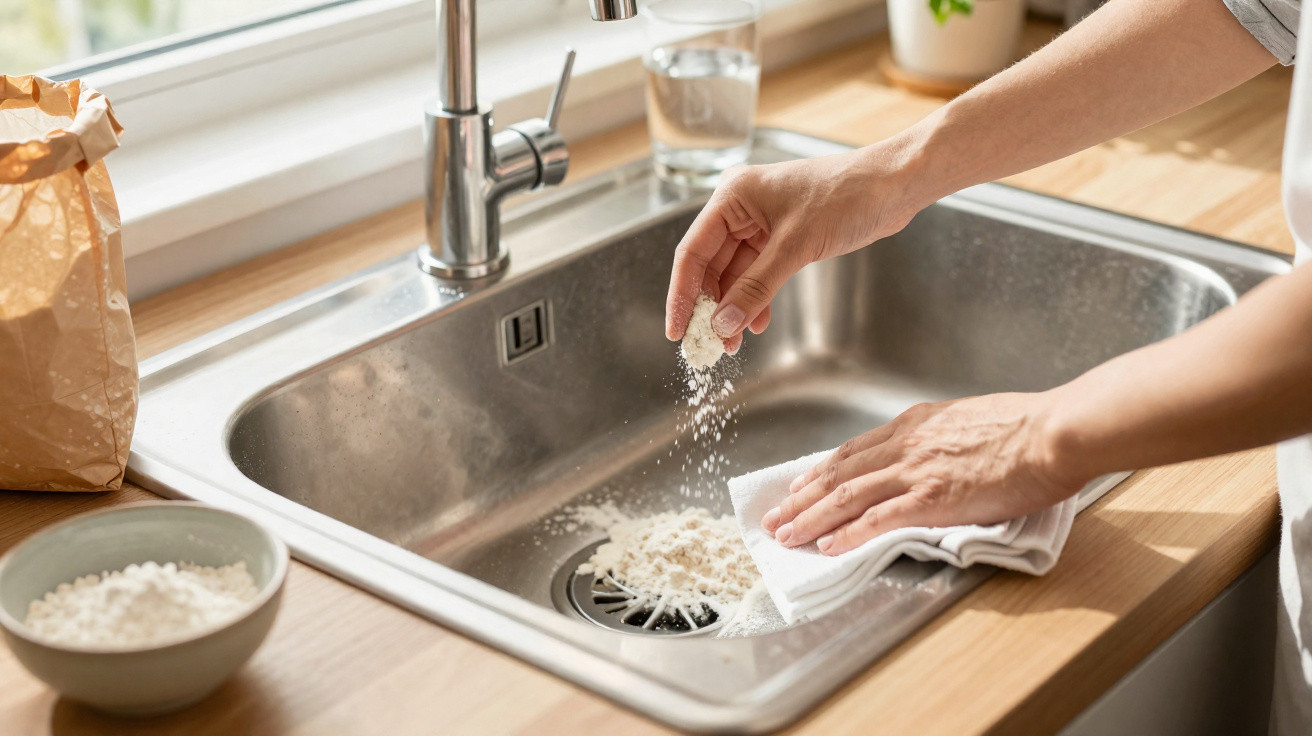
That powder is simply plain flour from the baking cupboard. First wash the sink with hot water and a drop of washing-up liquid, or a sprinkling of bicarbonate of soda, then dry it completely-including the edges, seams and the curve beneath the tap. Scatter one tablespoon of flour over the dry bowl, then gently work it in with a soft microfibre cloth using slow circles in the direction of the grain. Collect the powdery coating afterwards and remove it with a dry towel.
A little goes a long way. Apply only enough flour to lightly cover the surface, rather than piling it on. When the sink is even a little wet, flour clumps into a sticky paste, which is rather like trying to polish with porridge. Realistically, this is not an everyday job. Save it for before guests arrive, ahead of a viewing or whenever the kitchen needs to feel refreshed.
I picked up this method from a home stager who prepares five kitchens before lunchtime.
“Flour is the backstage pass-no smell, no film, and that crisp ‘snap’ of shine clients notice without knowing why.”
You only need to remember a short checklist:
- Begin with a clean, completely dry sink.
- Use a light scattering of flour, not a blizzard.
- Buff in easy circles, following the grain.
- Remove every trace of residue while dry, then give it one quick dry wipe.
- Do not let flour go down the drain-handle it as you would glitter.
Why this works-and when to use it
Flour’s smooth, talc-like particle size allows it to work as both a very gentle abrasive and an absorbent. It draws away oils and haze without etching the surface, then polishes by minimising the micro-roughness that makes stainless steel appear flat. Consider it a finishing step rather than the scrub itself.
The visual change can seem out of proportion to the effort, because reflectivity is not solely about being “clean”; it also depends on how consistently a surface reflects light. A freshly washed sink may still scatter light in countless directions. Buffed steel sends it back in one assured reflection, and the room suddenly appears more expensive.
There is a practical benefit as well. A tablespoon of flour costs pennies, has no fragrance to compete with your coffee and does not leave a silicone film that attracts fingerprints. It is suitable for the 304 and 316 stainless steel commonly used in household sinks, and works well on brushed finishes when you follow the grain.
Beyond the shine
Once you have seen that mirror-like effect emerge from your sink, it is difficult not to notice it. You begin to spot the difference before a dinner party, after a messy baking session or during that peaceful moment when the dishwasher is humming and the worktops are clear. You might also use it on the stainless steel base of a kettle, the smooth side of a toaster or the trim surrounding a built-in hob-always on dry surfaces, with a light touch and never near vents.
On some days, the routine takes three minutes; on others, thirty seconds-or it does not happen at all. This is not about perfection, but about a small success that changes the kitchen’s feeling from “used” to “ready”. It is a tidy reminder that shine does not require buying anything new. It means uncovering what is already there.
Cupboard solutions have a habit of doing exactly that. They wait quietly on the shelf and occasionally prove that they still have a role to play. Pass this on to the friend devoted to expensive sprays, then watch their expression when a handful of flour turns their sink into a mirror.
| Key point | Detail | Benefit for the reader |
|---|---|---|
| The “forgotten powder” | Plain flour, used dry as a final polish on stainless-steel sinks | Extremely cheap, fragrance-free and visually impressive |
| Why it works | Micro-fine particles absorb residue and burnish the surface without scratching | Mirror-like reflectivity with very little effort |
| How to use it | Clean and dry the sink, sprinkle over one tablespoon, buff with the grain and remove the residue | A quick routine before guests, photographs or a mood reset |









Comments
No comments yet. Be the first to comment!
Leave a Comment