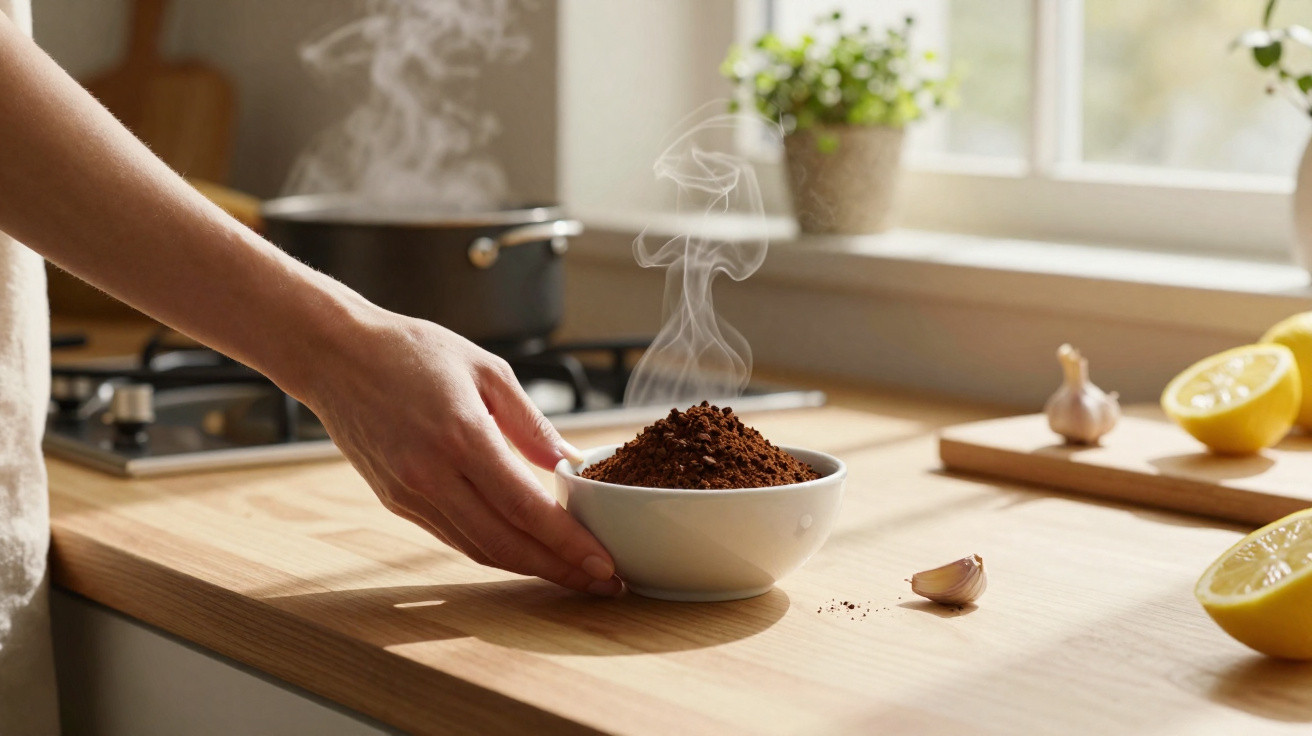
The moment you open the front door, the smell greets you. It is not the comforting hint of an evening meal, but the lingering mix of last night’s fish, fried onions and something unidentifiable from the bin. You have opened a window, sprayed a citrus air freshener and lit a candle that now smells like orange peel layered over rubbish. Still, nothing shifts. The kitchen air seems dense, as though it remembers everything.
Then you spot the little bowl on a friend’s worktop: dark, crumbly coffee grounds resting beside the sink. She shrugs and says, “Oh that? It just eats the smell.” A few hours later, you see what she means. The kitchen feels fresh again, with none of that artificial perfume hanging over it.
There is a reason that such a simple bowl can work.
Why kitchen odours linger - and how coffee grounds tackle them
Kitchen odours do not simply drift away on their own. They settle on almost every surface: curtains, wooden cupboards, tea towels and even that harmless-looking sponge. Grease particles hold onto smells and help them embed themselves in surfaces, particularly after cooking pungent foods such as fish, cabbage or garlic. You may not notice it immediately, but leave the house for an hour and you will smell it as soon as you return.
In the middle of this, coffee grounds work like miniature odour magnets. Scented sprays merely disguise a smell, whereas coffee targets its source. The bowl can sit quietly in place and get on with the job.
Think of the morning after hosting dinner, when you wake to the scent of “yesterday’s kitchen”. The food has gone and the dishes are clean, yet the odour still lingers like a guest who failed to take the hint. One reader said she began putting a shallow bowl of used grounds beside her bin after cooking fish once a week. Within two or three hours, the air seemed lighter and less heavy. It was not perfumed; it simply felt cleaner.
You can find a comparable approach behind the scenes in small restaurants and food trucks. During service, some owners leave bowls of coffee near the fryer or bin. It is no substitute for a thorough clean, but it can reduce the thick, greasy haze that clings to clothing.
The science involved is fairly simple. Coffee grounds contain porous organic material that acts rather like a natural sponge for odour molecules. Their tiny pores capture volatile compounds in the air, particularly sulphur-rich odours from foods such as fish or eggs. This process is called adsorption, with a “d”: the molecules stick to the coffee’s surface rather than being absorbed into it.
Coffee’s own aroma also plays a part. It is not only pleasant-smelling; it interacts with and masks certain disagreeable notes, making them seem less intense to your brain. Your nose can only process so many signals at once, and coffee is a very persuasive one. The room therefore feels fresher without the obvious sense that somebody has sprayed an air freshener.
How to use coffee grounds in a bowl for a fresher kitchen
The most effective approach is usually the easiest one to keep up: save used coffee grounds and put them to work again. Once you have made coffee, allow the grounds to cool slightly, then spread them loosely in a small bowl, ramekin or wide mug. The more surface area left exposed, the more effectively they can catch odours. Set the bowl close to where the smell originates: beside the bin, near the sink drain or on the worktop by the hob.
For particularly strong odours, use several small bowls rather than one large one. Put one by the bin, another near the hob and one on the windowsill. Treat them as small odour-absorbing stations.
There is one minor downside that is rarely mentioned: coffee grounds can spoil too. Left wet and forgotten in a warm kitchen, they may become mouldy, creating precisely the sort of new smell you do not want. Spread the grounds out in the bowl a little so that they dry more quickly. Replace them every one to three days, according to how much cooking you do and how humid your home is.
Realistically, nobody manages this every day without fail. Aim for “most of the time” instead. If the grounds smell sour or develop a fuzzy appearance, add them to the compost and start again with fresh ones. Dry grounds perform better, last longer and sit unobtrusively in the kitchen.
“Coffee grounds don’t erase a dirty kitchen,” laughs Camille, who runs a small catering business from her apartment. “They just give you some breathing space between reality and deep cleaning. I love that it’s low effort and low drama.”
- Best places for your bowl
Place it near the bin, next to the sink, close to the hob or by the fridge door. - Fresh versus used grounds
Used grounds are generally sufficient and are more environmentally friendly, although fresh grounds have a stronger scent and work more quickly. - How often to replace them
Change them every 1–3 days, or as soon as the coffee aroma has faded or the grounds become damp and clumped together. - An extra boost
For additional absorption, sprinkle a thin layer of coarse salt beneath the coffee in the bowl. - Which coffee works best
Dark roasts usually provide a more powerful aroma, although any ground coffee can help reduce kitchen odours.
More than a hack: a small ritual that changes a kitchen’s feel
Beyond the practical trick, there is something reassuring about this modest routine. You make coffee in the morning, transfer the grounds to a bowl and let the kitchen quietly refresh itself over the course of the day. There are no harsh sprays and no perfume strong enough to cause a headache, only a familiar aroma that gradually fades as it does its work. It is a household cycle that feels both traditional and sensible.
Most of us know that moment when the home looks clean but the air still smells of last night’s meal. A bowl of grounds will not solve burnt pans or an overflowing bin, but it can soften the situation enough to make the room feel liveable again. Suddenly, your kitchen does not merely look clean; it smells like a place where life happens without leaving too much behind.
Some people take the habit beyond the kitchen. They may keep a small bowl in a fridge corner, another in the shoe cupboard or one in the utility room after a damp week. Others stir the grounds into potting compost once they have finished absorbing odours, giving them one more purpose.
Perhaps that is the real appeal of this trick: it requires very little while quietly improving a room you use daily. You may first put coffee grounds in a bowl out of curiosity. You may continue because the air at home starts to feel easier to breathe, less cluttered and more your own.
| Key point | Detail | Value for the reader |
|---|---|---|
| Simple odour neutraliser | A shallow bowl of used coffee grounds captures and masks persistent kitchen smells | A quick, inexpensive way to freshen the room after cooking |
| Best method of use | Spread cooled grounds in wide bowls, position them near odour sources and replace every 1–3 days | Maximum effectiveness with almost no additional effort |
| Environmentally friendly habit | Reuses an everyday waste product that can later be composted or added to plants | Cuts waste while making the home more comfortable |









Comments
No comments yet. Be the first to comment!
Leave a Comment