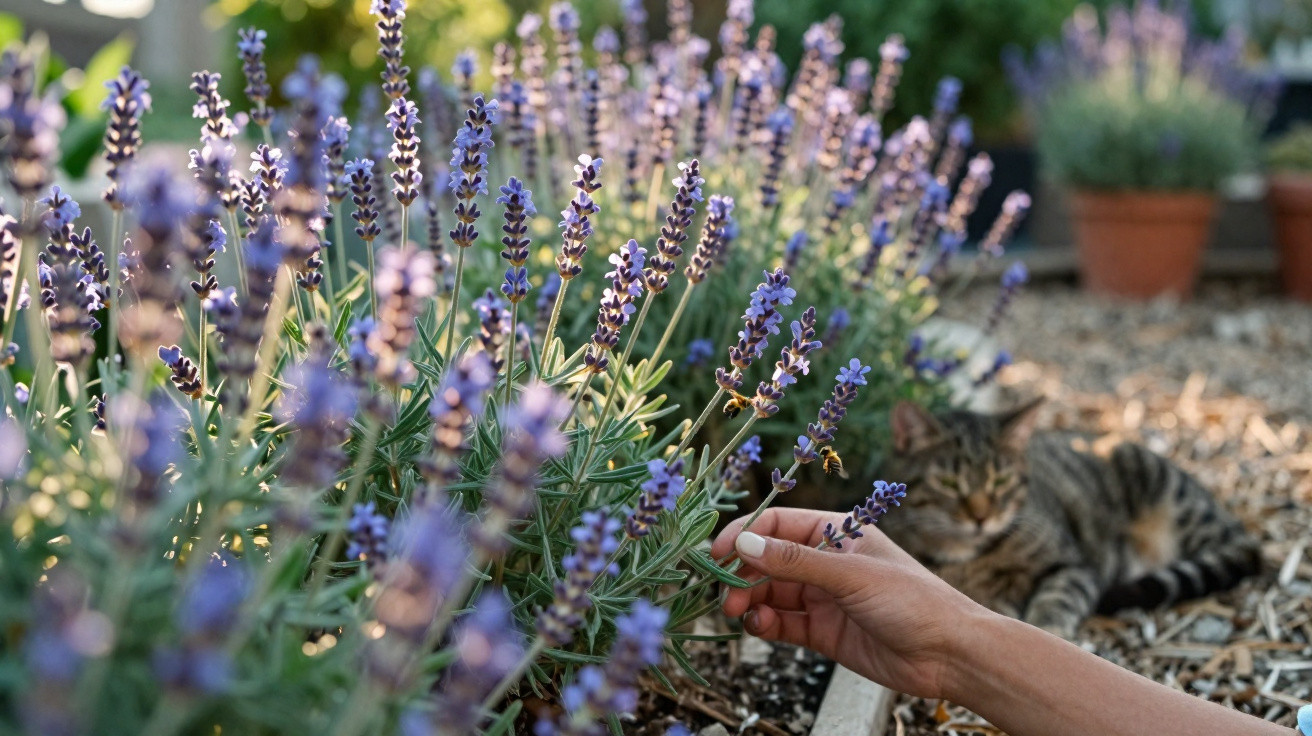
Many amateur gardeners instinctively choose lavender when they want a Mediterranean look and a pleasant fragrance. Yet another remarkably tough perennial is quietly stealing the limelight: it has an intense scent, flowers for months, attracts bees minute after minute – and forgives almost every care mistake.
Lavender’s little-known rival: catmint Nepeta × faassenii
The plant in question is catmint, more precisely the variety Nepeta × faassenii. Long valued by specialists, it still tends to be overlooked in many private gardens. Quite unfairly so, as this perennial combines several qualities sought by busy gardeners: it is robust, easy to care for, flowers for months and has an instantly noticeable scent.
A fragrance between mint and a herb garden
Run your hand through the grey-green, slightly felted foliage and you are rewarded straight away: the leaves release an aromatic, menthol-like and spicy scent, reminiscent of a blend of mint, a herb garden and a hint of eucalyptus. Unlike some other fragrant plants, it does not need sweltering heat to do this. Even on mild spring and summer evenings, a delicate fragrance hangs over the border, patio or balcony.
“Simply brush the leaves for a moment – and the entire seating area smells of fresh herbs.”
This is exactly why catmint is so well suited to seating areas, paths or window boxes near windows: its scent can be enjoyed every day without requiring much effort.
A bee magnet in constant action
Why bees love this perennial
From an insect’s perspective, Nepeta × faassenii is something of an all-you-can-eat buffet. It produces countless small, lipped flowers packed closely together on its flower spikes. Nectar and pollen are plentiful, dependable and easy to reach.
Typical visitors include:
- honey bees, moving quickly from flower to flower
- various bumblebee species, often active early in the morning
- butterflies, which linger longer on the flower spikes
Anyone gardening in a town or with a relatively small garden can do a great deal for insect diversity with catmint. Just a few vigorous plants are enough to provide a reliable food source for months.
“Plant Nepeta and you do not just bring colour to the border – you get an entire bee show as well.”
More nature, less work
As catmint grows so densely, it shades the ground and suppresses many unwanted weeds. This saves time spent weeding and removes the need for chemical treatments. Combined with its value for pollinators, that makes it a classic “win-win plant” for a natural-style garden.
Tough enough for prolonged frost and heatwaves
Frost down to minus 20 degrees? No problem
Many Mediterranean plants lead to disappointment after severe winters. Catmint is not one of them. Its above-ground stems die back in autumn, but the rootstock easily survives even double-digit sub-zero temperatures. In ordinary garden soil, it can cope with values down to around minus 20 degrees.
In spring, it sends up strong new growth from the root area. This creates a dense, floriferous clump year after year – without costly replacement plants, fleece winter protection or moving pots around.
Drought? This perennial stays calm
Nepeta copes surprisingly well with weather extremes. Its fine, slightly hairy foliage reduces water loss, while its roots penetrate deeply enough to access moisture reserves. Once the perennial is well established, it withstands extended dry spells and heatwaves far better than many traditional bedding plants.
- Watering is only needed while it establishes and during extreme drought
- ideal for sunny borders, rock gardens, slopes and front gardens
- the perfect choice for anyone who does not want to be out with a watering can every day
“If you sometimes forget to water, catmint is exactly the right choice.”
A rush of colour from spring into autumn
Up to seven months of flowering
One major advantage of Nepeta is its exceptionally long flowering period. In mild locations, the first blooms appear as early as April; in cooler areas, they follow shortly afterwards. A simple trick can extend the display almost until the end of October: after the first main flush in summer, lightly trim the plants with shears.
Cutting back encourages fresh new growth with plenty of new flower spikes. Rather than a brief burst of colour, this creates an almost seven-month flowering period with gentle waves of bloom.
Blue clouds instead of a patchy border
Visually, catmint delivers precisely what many gardeners want from lavender – only more reliably. Depending on the variety, its colours range from soft blue-violet to a strong, cool blue. The flowers rise in dense spikes above the bushy, gently arching foliage.
The plants work particularly well in these settings:
- as a soft edge along paths and patios
- combined with roses, which stand out even more against the blue carpet
- in cottage gardens, as flowering companions between vegetable beds
- in large pots on sunny balconies or roof terraces
“Anyone dreaming of a blue carpet of flowers in summer can hardly overlook Nepeta.”
Planting time, position and care: how to get started
The best time to plant
Spring is ideal, once the soil has noticeably warmed up and severe night frosts are no longer expected. This gives the perennial time to develop roots before the hottest part of summer begins. Early autumn is also suitable, provided that the ground is still warm.
A step-by-step guide to a robust perennial
Planting is straightforward and requires little prior knowledge. For strong growth, the following method is worthwhile:
- Choose the position: sunny to partially shaded; the more sun it receives, the more abundant the flowering.
- Prepare the soil: it should drain well and be fairly lean; work sand or grit into heavy soil.
- Dig the planting hole: make it around twice the size of the rootball.
- Plant it: briefly soak the rootball, place it in the hole, fill with garden soil and a little compost, then firm it in.
- Water it in: water thoroughly immediately after planting.
During the first few weeks after planting, the perennial benefits from reasonably regular moisture. Once established, it manages with considerably less water.
Practical tips, combinations and possible pitfalls
Plants that pair well with catmint
Visually, catmint is happy to serve as the stage on which other floral stars can shine. It works especially well with:
- roses in pastel or bold shades
- coneflowers, ornamental salvias and gaura
- grasses such as fountain grass or blue fescue
- other drought-tolerant perennials, including yarrow or coreopsis
The result is borders that look structured, remain attractive for a long time and do not flag even in hot summers.
A few notes on cats and self-seeding
As its name suggests, some cats react strongly to certain catmint species. Nepeta × faassenii is generally less likely to be “mauled” than classic catnip used as a cat toy, although individual animals may still take a liking to it. Anyone with many neighbourhood cats nearby should keep an eye on their plants during the first few weeks.
In good soil and with sufficient sunshine, catmint can self-seed. If this is unwanted, cut back the faded flowers in good time. The cuttings can be added to the compost without any issue or used as a fragrant mulch layer in the border.
“With a little trimming, catmint stays where it belongs – and flowers twice as long in return.”
Anyone already growing lavender in the border does not need to pull it out straight away. The effect becomes much more interesting when both grow together: lavender provides that classic holiday feeling, while catmint offers longer flowering, more bees and considerably less stress in heat or frost. For many gardens, this perennial is therefore quietly becoming the new favourite for sunny, low-maintenance dream borders.











Comments
No comments yet. Be the first to comment!
Leave a Comment