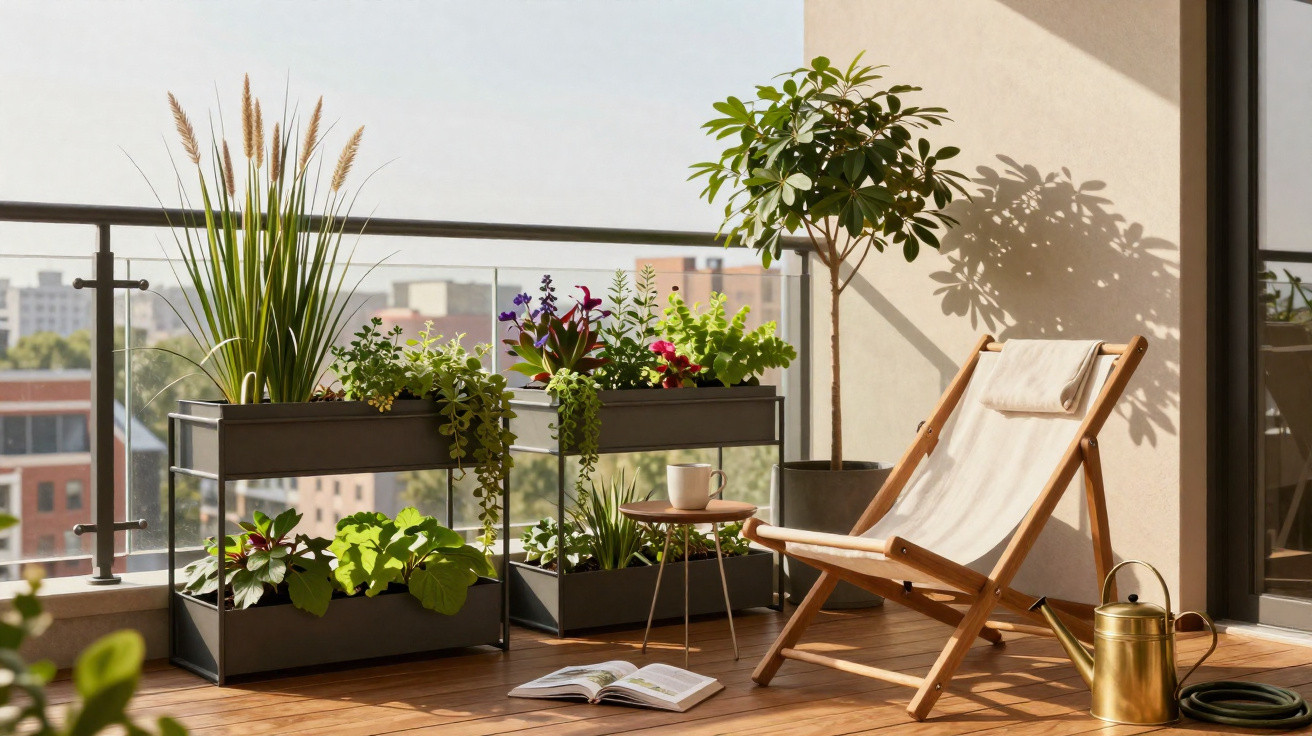
In the past, making a balcony look nice usually meant putting a few pots by the railing and perhaps adding a chair. That no longer feels sufficient for many people. Outdoor areas are becoming an extension of the home: a compact lounge, an al fresco dining room or an open-air home office. This is where a new planting idea comes in, visually retiring conventional pots.
Why traditional flower pots are suddenly looking dated
Balconies and terraces have changed considerably in recent years. Rather than simply serving as places to keep plants, they are increasingly treated as fully fledged rooms. With outdoor rugs, fairy lights, lounge sofas and small side tables, many people are turning their balcony into a kind of second living room.
Against this backdrop, basic pots placed on the floor can quickly look cluttered and disorganised. A mix of shapes, heights, colours and materials makes the eye jump around. The floor can appear overcrowded even when there are not actually many plants.
“The new balcony look for 2026 is guided more by interior design than by traditional garden decoration.”
That is why the 2026 trend follows one clear idea: plants should no longer be scattered randomly across the floor, but arranged in a structured, elevated way, much like pieces of furniture.
Plants on legs: the major trend for miniature raised beds
At the heart of this development are long, often rectangular planters mounted on frames. These stands are commonly made from black metal or light-coloured wood, supported by slim legs and resembling stylish outdoor sideboards.
They offer several benefits at once:
- Most of the floor remains clear, making the space feel larger.
- Plants are lifted upwards and become more noticeable.
- The containers create clean lines instead of a collection of individual pots.
- The balcony looks tidier and more contemporary.
Their elevated position brings foliage and flowers to eye level or seated height. Instead of looking towards bare walls or railings, anyone sitting on the balcony sees a compact, carefully planned green area – almost like a floating flower bed.
Playing with height: how to create a modern, lively balcony
A key rule of this trend is to deliberately work with different levels. Rather than lining up every plant at the same height, the aim is to create a landscape of varying elevations.
How the height mix works
Three levels are generally combined:
- Close to the ground: Low crates, small stools holding herbs, or short ornamental plants.
- Mid-height: Planters on frames, positioned at roughly table height.
- At eye level: Hanging baskets, wall shelves or vertical climbing supports.
This tiered approach makes a balcony not only greener but also more spatially interesting. Plants take on the function of room dividers without feeling heavy.
“Rather than walls of glass or wood, ‘green walls’ are created that offer privacy while letting air and light pass through.”
For instance, a dining area and a small lounge zone can be visually separated on one terrace without installing any additional partitions.
Turning a balcony into living space: plants as a design feature
Why is this idea gaining such momentum in 2026? One reason is the changing way people view their homes. Particularly in cities, every square metre and every corner matters. Outdoor space is seen as a valuable extra room that many people want to use all year round.
Within this setting, plants take on a new role. They do more than decorate: they organise and shape the space. Planters act like furniture chosen deliberately to complement tables, chairs and textiles.
Two style directions are especially popular:
- Modern minimalist: Black or white metal frames, crisp lines and a small number of striking plants.
- Cosy Scandinavian: Wooden frames, pale fabrics and natural fibres, paired with abundant greenery and warm lighting.
Metal scores highly for durability and lends an urban look. Wood creates a warmer, more homely feel familiar from indoor spaces. The two materials can also be combined easily – for example, a black metal frame beside a wooden chair.
How to put the trend into practice
Anyone redesigning their balcony in 2026 does not need to undertake a complete overhaul. A few considered changes are often enough:
| Step | Action |
|---|---|
| 1 | Replace one or two old pots with elongated raised planters. |
| 2 | Plan different heights: floor level, frame level and hanging basket level. |
| 3 | Choose no more than two materials, such as metal and wood. |
| 4 | Use lighting, including fairy lights and small solar spotlights. |
| 5 | Arrange plants so that greenery frames the seating area. |
The advantages are especially clear on small balconies. Moving plants upwards frees up space for a small table, a sun lounger or a comfortable armchair.
Which plants suit this new style of planting
Not every variety is equally suited to raised containers or narrow plant shelving. The most sought-after choices are plants that work well in groups and are happy to trail slightly:
- Trailing geraniums or petunias for strong bursts of colour
- Herbs such as rosemary, thyme and basil for fragrant kitchen corners
- Grasses for movement and a calm, modern appearance
- Succulents and small perennials for low-maintenance arrangements
- Climbing plants such as ivy or clematis on narrow trellises
Anyone needing to consider weight – for example, on older balconies – should avoid very large pots filled with lots of compost. Several smaller, lighter containers are usually the better option.
Risks, care and practical advice
Raised containers also come with a few considerations. As they usually hold less compost than large tubs, the growing medium dries out more quickly. During summer in particular, it is worth using:
- an irrigation system or water reservoir in the containers;
- light-coloured containers on very sunny balconies;
- a mulch layer of bark chippings or gravel to retain moisture.
Balconies in windy locations require sturdy frames. To prevent anything from toppling over, the feet should be sufficiently wide. In very exposed positions, narrow securing straps or fixing the planter to the wall can help.
Combinations that work particularly well in 2026
The trend becomes particularly interesting when paired with other features. Several examples appear frequently in current decorating schemes:
- A slim planter frame behind a bench, creating the effect of a green backrest.
- A tall metal shelving unit filled with herbs beside a barbecue or outdoor kitchen.
- Hanging plants above a small bistro table, forming a natural canopy.
- A combination of a tall planter box and an outdoor rug that visually defines a “room”.
For a subtler approach, begin with just one raised planter and see how it changes the feel of the space. Even a narrow planting board can direct the eye and give a balcony a noticeably more premium appearance.
At its core, the trend is based on a simple idea: plants move up from the floor into the design level occupied by furniture, shelving and lighting. Applying this principle to a balcony not only creates more space, but also makes the outdoor area feel much more like a true living room.







Comments
No comments yet. Be the first to comment!
Leave a Comment