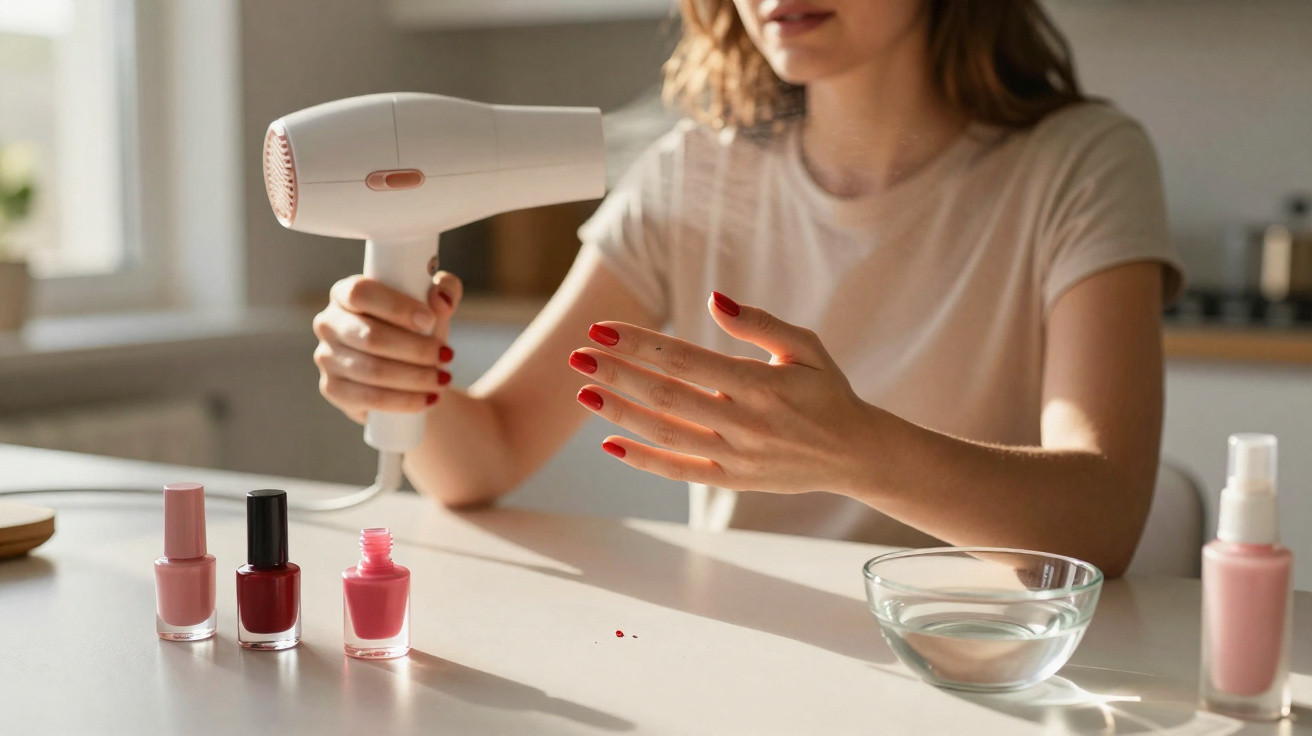
You have painted your nails at last: two careful coats, followed by a top coat because you promised yourself you would “do it properly this time”. Now you are trapped in that familiar T-Rex position, fingers spread wide and trying not to touch a thing. The kettle starts to whistle. Your phone vibrates. The need to make the process faster feels almost overwhelming.
Then you spot the hairdryer. An easy answer, surely? A brief blast of hot air, dry nails in moments, and you can carry on with your day. You plug it in, aim it at your hands and let the warm air pass over your newly painted nails.
Ten minutes later, one nail catches against your jeans and the colour smears like softened butter. It appeared dry on top, but beneath the surface it was still soft and mobile. That is when the real problems begin.
Why your hairdryer secretly ruins your nail polish
At first glance, using a hairdryer seems like a smart shortcut. Heat dries your hair, so it should dry nail polish too, shouldn't it? The warm airflow feels pleasant, the glossy finish appears to settle, and for a few minutes it is easy to believe you have found a fool-proof trick. You may even gently tap a nail and decide, “Yep, done.”
Then everyday life gets in the way. You pick up your keys, put on a jacket or send a quick text. Suddenly, there are dents, odd streaks and smudges that resemble fork marks dragged through soft icing. You are not being careless. Your polish was simply not dry all the way through; it was only giving that impression.
Conventional nail polish does more than simply dry. It cures as its solvents evaporate, allowing the pigments and resins to create a firm film. Hot airflow makes the outermost layer dry rapidly, meaning a skin forms over the top. The layers underneath, however, remain warm and soft. When you knock or press your nails, the semi-liquid polish below shifts and the whole finish can ripple. Rather than helping, the heat can seal that softness inside.
What hot air really does to nail polish
Think of baking a cake at twice the usual temperature. The outside browns quickly, looks ready and might even smell baked. Slice it too soon, though, and the centre is raw and sticky. A hairdryer can have the same effect on a manicure. A film develops on the outside before the inside has had sufficient time to set. Each small contact can make the polish move, wrinkle or form bubbles.
A Paris nail technician told me about a client who repeatedly arrived with smudged nails and was convinced that she had “cursed hands.” Eventually, the technician asked about her at-home routine. The client proudly said she used a hot hairdryer between every coat, “like they do at the salon.” But salons do not work that way. They use controlled airflow, frequently cool air, or specialist lamps for gel polish. Once she stopped applying hot air at home, the client's unexplained smudges nearly vanished.
There is a chemical explanation, too. Heat may thin the upper layer enough for it to settle into the nail's minute ridges, leaving an uneven finish. It may also promote bubbles when solvents escape too fast, much like air pockets in fizzy drink that has been shaken excessively. Those bubbles make the film weaker, so the polish chips sooner even after your nails eventually feel dry. So you don’t just get smudges, you get manicures that last half as long as they should.
Smarter ways to dry your polish without wrecking it
The reassuring news is that a neat, quick-drying manicure does not require expensive gadgets. What you need is thinner layers, cooler airflow and a little planning. The most useful step is to apply exceptionally thin coats: one light sweep rather than a thick layer. Allow each coat to sit for a few minutes before adding another. Thin layers dry more evenly from within, reducing the chance of a concealed soft centre.
If waiting is difficult, choose cool air rather than heat. Most hairdryers offer a cool setting or cold-shot button. Keep the dryer well away from your hands, so that you feel a light breeze instead of a gale. The aim is not to heat the polish but to improve air circulation, allowing solvents to evaporate. After one or two minutes, you can also place freshly painted nails in a bowl of cold water to help the surface set quickly. It will not instantly harden a thick coat, but it may guard against gentle knocks.
Realistically, very few people wait the complete 30–60 minutes brands suggest before polish reaches full hardness. There is washing to put away, messages to return, children to look after and dinner to prepare. A nail expert I spoke with put it simply:
“Heat is comforting, but polish loves patience. Cool, thin, and still beats hot, thick, and rushed every single time.”
To give yourself the best chance of a lasting result, keep these points in mind:
- Apply thin coats and leave a couple of minutes between each one.
- Use a quick-dry top coat formulated to speed up curing.
- Pick cool airflow or a fan instead of hot air from a hairdryer.
- Do not go to bed or wear tight clothing immediately after painting your nails.
- Schedule your manicure for a time when you can avoid using your hands for at least 20–30 minutes.
Choosing your battles: patience now or fixes later?
There is an emotional element here that is rarely acknowledged. A spoiled manicure is seldom only about your nails. It can mean rushing before work, squeezing in a “self-care moment” when you hardly have time, then seeing it turn into sticky fingerprints and chipped tips. Everyone knows that moment of looking down at dented polish and thinking, “Why did I even bother?”
Giving up the hairdryer habit is a small way to push back against that pressure to rush. It means choosing an approach that respects the polish, your hands and your time. Spending five more minutes today can spare you the irritation of repainting several nails tomorrow. That is not frivolous; it is sensible. It reduces mental load and removes small annoyances from a day already full of them.
You may notice another change as well. When you stop blowing hot air over your nails and view the drying period as a brief pause, the entire ritual can feel different. Those 15 peaceful minutes can become time for a podcast, a cup of tea or a deep breath on the sofa, rather than another task to optimise. Your polish should last longer, and smudges should become less common. You may also find that the lowest-tech routine leaves you feeling the most polished.
| Key point | Detail | Value for the reader |
|---|---|---|
| Hot air leaves polish soft | The surface dries quickly while the lower layers remain warm and squishy | Explains why manicures smudge even when they “seem” dry |
| Cool, thin, still wins | Thin coats, cool airflow or a fan, plus a quick-dry top coat | Offers a straightforward routine for faster, longer-lasting results |
| Plan your drying window | Allow 20–30 minutes with very little hand use | Limits frustration and avoids having to redo smudged nails |




Comments
No comments yet. Be the first to comment!
Leave a Comment