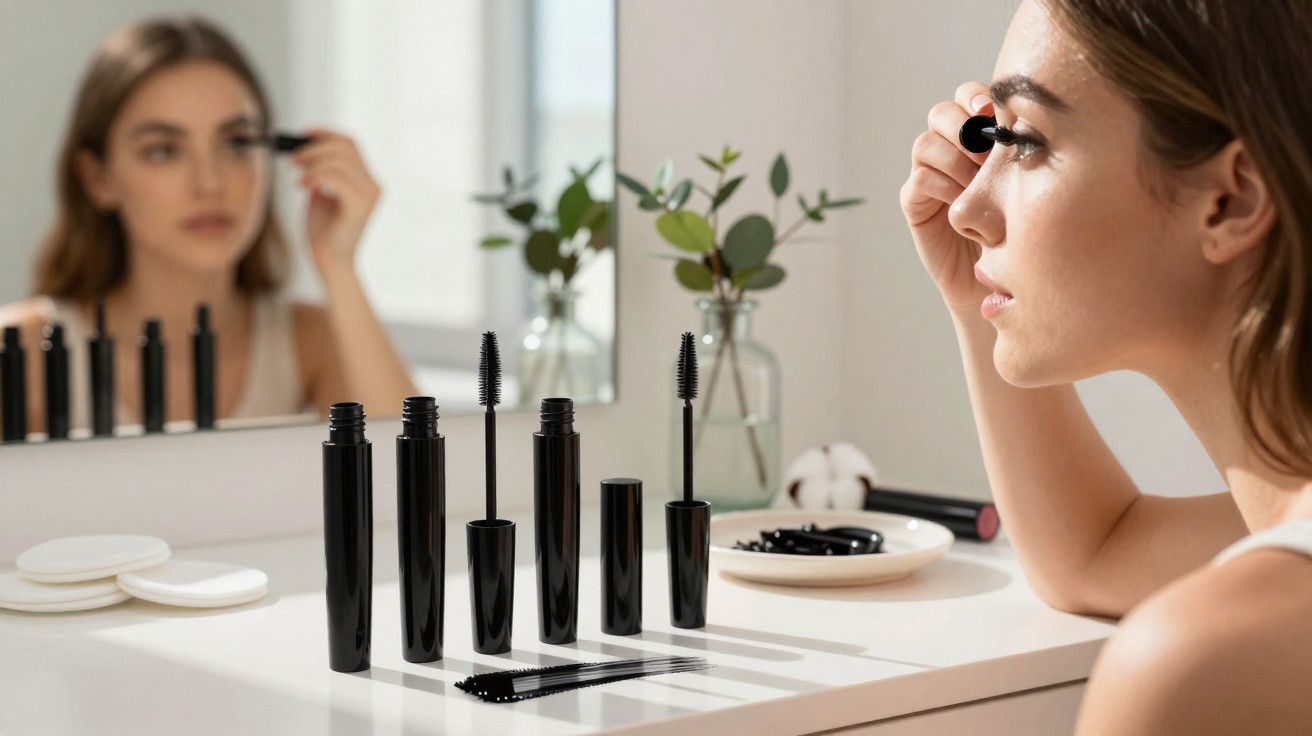
Few beauty products can transform the eyes as quickly as mascara. Found in both the most natural make-up looks and more elaborate creations, it has evolved with new formulas, technologies and wands designed to deliver increasingly targeted results, going beyond definition to create an intense volume effect.
What changes from one formula to another?
Despite looking similar at first glance, mascaras use specific formula technologies to achieve different effects. In general, the blend of waxes, pigments, polymers and film-forming agents determines characteristics such as adhesion, colour intensity, flexibility and resistance.
Volume-focused mascaras, for instance, usually feature fuller-bodied formulas that can coat the lashes with a greater amount of product. Those created for lengthening and definition, on the other hand, generally promote a more even application, preventing several lashes from sticking together as layers are built up.
Another category that has become more popular is known as tubing mascara. Unlike traditional mascaras, these use polymers that form tiny “tubes” around the lashes. This technology generally offers good smudge resistance and, depending on the formula, allows the product to be removed with warm water and gentle pressure on the lashes.
Waterproof versions remain a strategic option for heat, humidity, tears or extended wear. Their increased resistance can also help maintain the curl of the lashes after using an eyelash curler. In return, they usually require more careful removal with products suitable for water-resistant make-up.
Why the mascara wand matters
While the formula defines how much product reaches the lashes and how it performs once dry, the wand helps control where and how that formula is applied.
Fuller-shaped applicators hold more product and create an effect of thicker-looking lashes. The larger and denser the brush, the greater its tendency to coat several lashes at once. Wands with short, well-spaced bristles, meanwhile, make definition easier. They work almost like tiny combs, reaching individual lashes and helping to reduce the appearance of lashes stuck together.
The applicator’s design also affects the result. Curved brushes follow the shape of the lash line and can help lift the lashes during application, making them good allies for those seeking curl. Hourglass-shaped wands, narrower at the centre and wider at the ends, have become popular among volume mascaras. Their shape reaches different areas while depositing plenty of product.
Tapered applicators, with a finer tip, make it easier to reach the smaller hairs at the inner and outer corners of the eyes. For those looking for precision, slim, small brushes can also be easier to control, especially on the lower lashes. “The biggest wand does not always deliver the best result. People with smaller eyes or short lashes may achieve far more precision with a fine applicator. The important thing is to consider both the desired effect and the anatomy of the eyes and lashes,” says Chloé Gaya, make-up artist and artistic director of the Jacques Janine chain.
The same product can perform differently depending on the length, density and natural curl of the lashes, and recognising these characteristics is the first step towards finding the ideal combination.
Product suggestions: Peel-Off Panda Ultra Volume Mascara by Dailus; Magic Curls by Ruby Kisses; BT Wonder Lash Mascara by Bruna Tavares.
By Juliana Vaz








Comments
No comments yet. Be the first to comment!
Leave a Comment