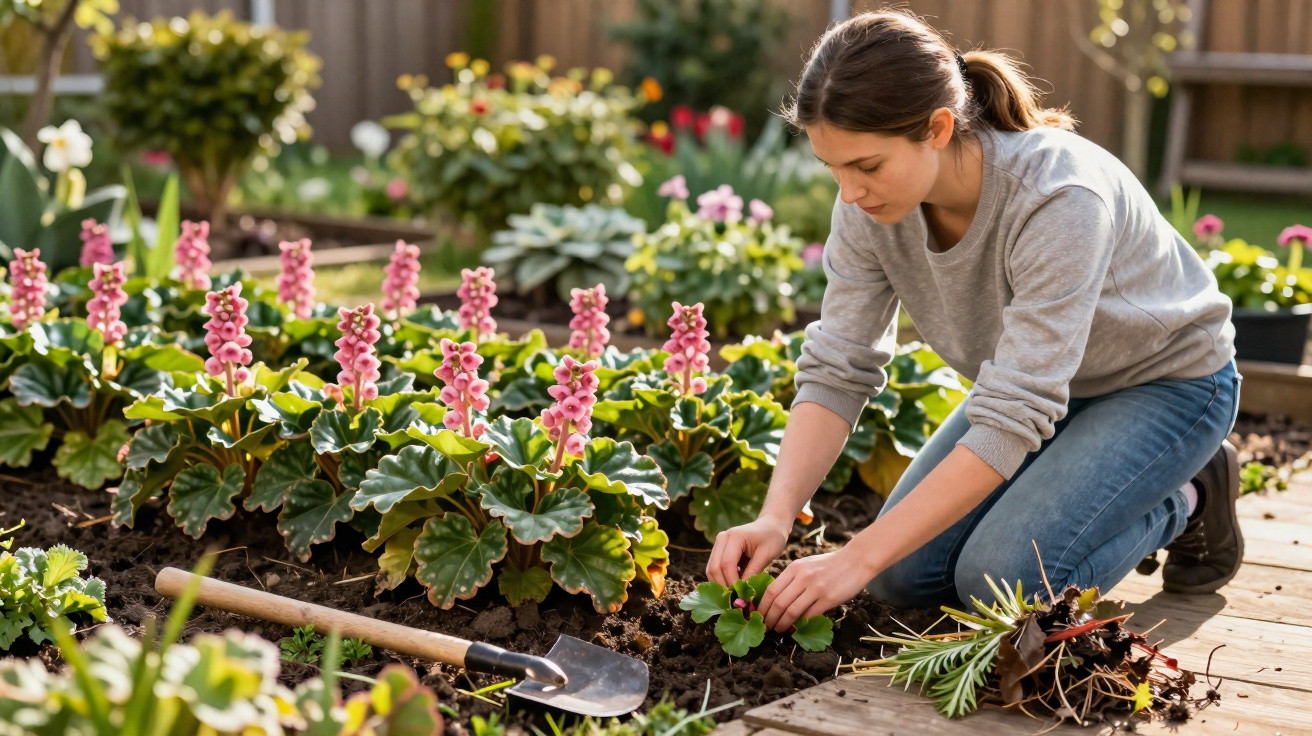
With one particular perennial, you can spare yourself a large part of this drudgery.
Between perennials, beneath trees and against the wall of the house – weeds push through anywhere the soil is left bare. Chemical treatments are off limits for amateur gardeners, and the frustration mounts. This is where an underrated garden perennial comes in: it covers the ground so densely that wild plants barely stand a chance. And now is an ideal time to plant it.
The perennial that makes weeding flowerbeds almost unnecessary
This plant is the Bergenia, most commonly sold under its botanical name, Bergenia purpurascens. Many people know it from cemeteries or traditional cottage gardens, where it has often survived for decades with virtually no care. It is exceptionally tough, tolerating severe frosts down to minus 20 and, in some cases, even minus 30 degrees, while remaining evergreen through winter.
Over a few years, individual plants form broad clumps. Each perennial grows to around 30 to 50 centimetres tall and 40 to 70 centimetres wide. Its leaves are large, thick and leathery: bright green at first, then often developing reddish to purple tones in the colder months. In early spring, sturdy stems carrying pink flowers rise above the foliage – decorative and popular with insects.
Thanks to its dense, long-lasting carpet of leaves, Bergenia acts like living mulch and greatly slows the growth of weeds.
Garden experts rate Bergenias as excellent ground-cover plants. They are particularly useful in perennial borders, along paths or at the base of trees, where they perform two tasks at once: decorating the space while protecting the soil.
How Bergenia stops weeds from emerging in the first place
The effect against wild plants is remarkably easy to explain. Bergenia’s thick leaves overlap like roof tiles, closing over the area more densely over time. This lets considerably less light reach the soil. However, many common weeds need light to germinate: without it, their seeds either barely germinate or do so extremely slowly.
At the same time, the leaf cover acts as a physical obstacle. Even when a seed does sprout, its delicate shoots often cannot force their way through the dense foliage. They either wither in the shade of the Bergenias or snap while trying to reach the light.
- Less light at ground level = fewer germinating weed seeds
- Dense foliage = a mechanical barrier to new shoots
- Living mulch = soil stays looser and more evenly moist
- Less bare ground = reduced drying out and erosion
Experts assume that a well-established planting of ground cover can cut the amount of emerging weeds by 70 to 90 percent. You will not eliminate weeding entirely, but the time required falls noticeably – especially in larger gardens.
The best time to plant in the United Kingdom
For gardens in the United Kingdom, spring and autumn are the two main planting windows. March and April are especially appealing months. At that point, the soil is still well supplied with water after winter, while temperatures are gradually rising.
If you plant Bergenias in early spring, they can establish strong roots by summer – and the weed-suppressing effect often begins in the first year.
Autumn planting also works well, provided the ground is not frozen. The plants will still produce new roots, enter winter firmly established and begin the following spring with a clear head start in growth.
Where the plant is especially effective at stopping weeds
Bergenias are considered versatile performers in ornamental gardens. They cope with more sites than many people expect:
- Partial shade: ideal, for example on the north side of the house or beneath lightly shaded trees and shrubs
- Sun: possible if the ground is not extremely dry and the midday sun is not relentlessly fierce
- Dry shade: for instance beneath mature trees or shrubs where little rain reaches the ground
Typical places where Bergenias serve as a weed barrier include:
- At the foot of deciduous trees and larger shrubs
- Along garden paths and driveways
- On slopes that are difficult to mow or weed
- In rock gardens or beside dry-stone walls
- As edging for perennial borders
Bergenias are less suited to very dark or permanently wet corners. In such spots, they can be combined effectively with other ground covers, such as robust cranesbill varieties or lesser periwinkle varieties. This creates a closed, varied planting area in which wild plants can scarcely find any gaps.
Step by step: creating a carpet of Bergenias
Preparing the soil: work once, enjoy years of peace
There is some manual work at the outset. However, the effort pays off later because you will need to weed far less often.
- Remove all existing weeds thoroughly, especially deep-rooted weeds such as ground elder or couch grass.
- Loosen the soil to a depth of around 20 centimetres, removing stones and hard clods.
- In heavy, clay-rich soil, work in some sand or fine gravel so water can drain more freely.
- For very poor soil, mix in a thin layer of well-rotted compost.
Bergenias do not tolerate waterlogging. The soil should therefore be loose but not overly rich – they do not need luxury, only good drainage.
Planting correctly and leaving enough space
Set the individual plants around 35 to 40 centimetres apart. This may look generous at first, but the gaps will fill themselves within one to two years.
Proceed as follows:
- Dig planting holes slightly wider than the root ball.
- Position the plant so that the junction between root and shoot, known as the root collar, sits level with the soil surface.
- Firm the soil lightly so that no air pockets remain.
- Water thoroughly, allowing the soil to settle around the roots.
During the establishment phase, a thin layer of mulch – such as leaves or bark compost – between the plants is helpful. It protects the soil until the Bergenia leaves have closed the gaps.
Care: little effort, substantial results
During their first year in the ground, Bergenias benefit from regular watering when dry spells persist. They do not cope with waterlogged roots, but once established they tolerate mild dryness. Later, many established plantings manage without additional watering – even in difficult locations.
Care guidance at a glance:
| Task | Frequency | Note |
|---|---|---|
| Watering in the first year | during dry periods | Keep the soil fresh, but do not saturate it |
| Cutting back faded stems | after flowering | keeps the planting looking tidy |
| Removing old or brown leaves | as required | reduces fungal problems and maintains a neat appearance |
| Dividing and rejuvenating | every 3–5 years | keeps clumps vigorous and allows them to be extended |
Feeding is generally unnecessary. If the plants begin to lose vigour, a little compost in spring is entirely sufficient. In most cases, weaker growth is caused by too much shade or overly wet roots rather than a lack of nutrients.
Risks, limitations and clever combinations
As hardy as Bergenias are, there are a few points to keep in mind. In exceptionally severe winters, the leaves may be damaged by frost. However, the plant will generally reshoot reliably from its rootstock. Slugs show remarkably little interest in the thick leaves, which makes Bergenias particularly attractive compared with some other perennials.
Allergies to Bergenias are rare, but people with sensitive skin should still wear gloves when cutting back the plants. The leaves contain tannins, which can cause mild irritation on very sensitive skin.
Bergenias become especially interesting when paired deliberately with other plants. Early-flowering bulbs such as crocuses or small daffodils work well between the clumps. They push their leaves and flowers through the gaps before the Bergenias are in full growth. Later, the thick leaves take control again and keep the soil covered.
In perennial borders, grasses, hostas or ferns can add further structure. It is worth considering growth height and leaf shape. Bergenias are low-growing and spreading, so tall, delicate companions above them create an interesting contrast without weakening the weed-suppressing effect.
Anyone wanting to maintain their borders over the long term with as little work as possible can hardly avoid ground covers. Bergenia plays a leading role here: long-lived, undemanding, visually appealing and at the same time a natural shield against weeds – one of those classic garden plants that you plant once, then wonder why you did not use it much sooner.










Comments
No comments yet. Be the first to comment!
Leave a Comment