It began like any other Saturday spent cleaning: old joggers, a vacant stare into the kitchen cupboard, and that quiet sense of guilt lurking in the back of your mind. You know the feeling – you open the cabinet above the hob looking for salt, and instead of salt, you notice that yellowish, sticky layer of dust. Years of frying splatters, steam and “I’ll do it next time”.
That day, I had no patience for hours of scrubbing. But I could no longer overlook that greasy grey film. So I reached for the most innocent-looking thing in the whole cupboard: an old jar, half-forgotten at the back on the left. It was not even a cleaning product.
Then something happened that genuinely surprised me. In a good way.
The unassuming jar that suddenly does everything
We all have a jar like this somewhere that barely gets a second thought: an old jam jar, a screw-top jar from pickled vegetables that we saved “for later”. Mine contained a dull white powder and had simply been labelled “bicarbonate of soda”. Nothing glamorous, no bright advertising claim, just a jar.
Out of sheer frustration, I unscrewed it that day. A damp cloth, a little powder, one deep sigh, and off I went. I expected a half-hearted attempt that would end, once again, with three YouTube cleaning videos and a resigned “I’ll do it next week”. What happened instead was almost embarrassingly effective.
Months earlier, a friend had told me that she cleaned nearly everything with the contents of that jar. I laughed and thought: of course, another TikTok trick that will never look the same in my kitchen as it does on video. Yet she swore by it. “Forget the expensive kitchen cleaners; just use soda, a little washing-up liquid and warm water,” she said.
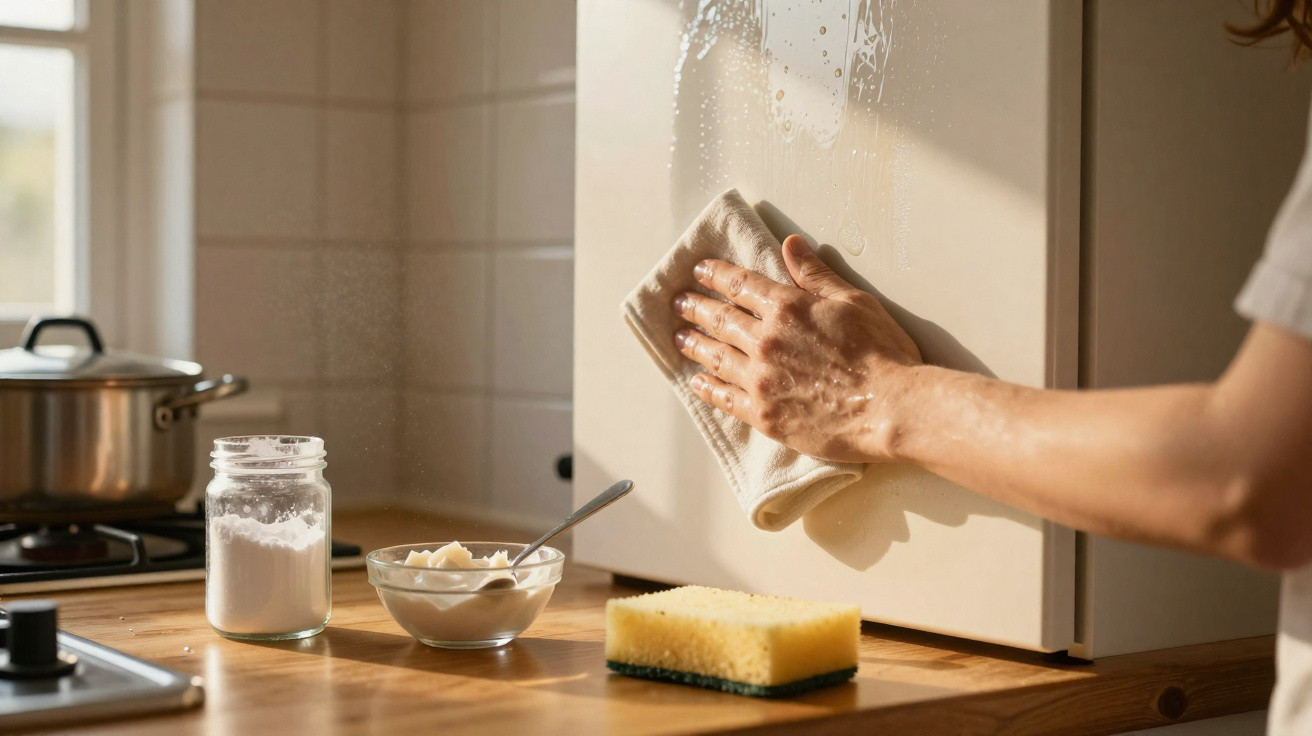
That day, I decided to treat it as a small experiment: one shelf, one corner, one wipe. As I moved the cloth across the wood with only half-hearted enthusiasm, I watched the yellow grease film come away as though it had taken offence. No forceful circular motions, no flushed face, no burning biceps. Just wiping.
The finish was so smooth and shiny that it almost looked fake.
The less dramatic explanation is not magic but a chemistry lesson. Soda – whether sodium carbonate or bicarbonate, depending on the product – is alkaline. Grease is acidic to neutral. When they come together, they react, the grease loosens and the surface is “relaxed”. Add a little washing-up liquid, which surrounds the grease molecules, and suddenly you have a team that takes years of built-up hob grime off your hands.
Kitchen cabinets above the hob are classic trouble spots. Warm steam rises, carrying tiny grease particles that quietly settle on wood, lacquer and handles. If you do not wipe them down regularly, they form that unpleasant, slightly sticky coating which a damp cloth alone merely smears around. That is precisely where the innocent jar comes in.
Cleaning greasy kitchen cabinets with soda
Now for the uncomfortable truth: this is exactly where the argument starts. On one side is the “if you are not sweating, it is not proper cleaning” camp: people who believe only in stiff brushes, harsh cleaners and plenty of elbow grease. On the other are those looking for every shortcut because, honestly, cleaning is rarely a hobby and usually a chore.
The soda method puts these two camps directly at odds. Sprinkle a little powder onto a wet cloth or directly onto the surface, leave it briefly to work, wipe it away – and that is it. Waiting time: perhaps one minute. Effort: ridiculously low.
And that is exactly why so many people do not trust the result.
One common mistake happens before the first wipe: using far too much or far too little. Half a teaspoon of soda on a thoroughly damp microfibre cloth is enough for an entire cupboard door. Yet many people pour on half a load, rub furiously and then wonder why there is a slight grey haze or dull patches afterwards. In that case, the “miracle jar” is not to blame; overenthusiasm is.
The second trap is impatience. Grease that has built up over years rarely disappears in ten seconds. Let the mixture of soda, warm water and a dash of washing-up liquid sit for 2–3 minutes. You do not need to scrub, but you do need to give it time. We give everything time – television series, social media, scrolling. Why not give cleaning product some time as well?
Most people who give up halfway do so out of frustration. They wipe once, still spot yellow edges and think: “See, another fake trick.” What they fail to notice is that the first layer has already gone; the second simply needs another pass.
Let us be honest: nobody does this every day. Not every week. Sometimes not even every year. That is precisely why it feels so dramatic when the original cupboard colour suddenly reappears.
The psychological effect should not be underestimated either. Anyone who has spent years believing that only hard work counts can easily see shortcuts as “cheating”. But the grease marks are gone. The surface shines. Your hands do not hurt. Who are you still trying to prove something to?
A practical soda routine for cupboard doors
Here is a tested process that has worked for me and in countless households:
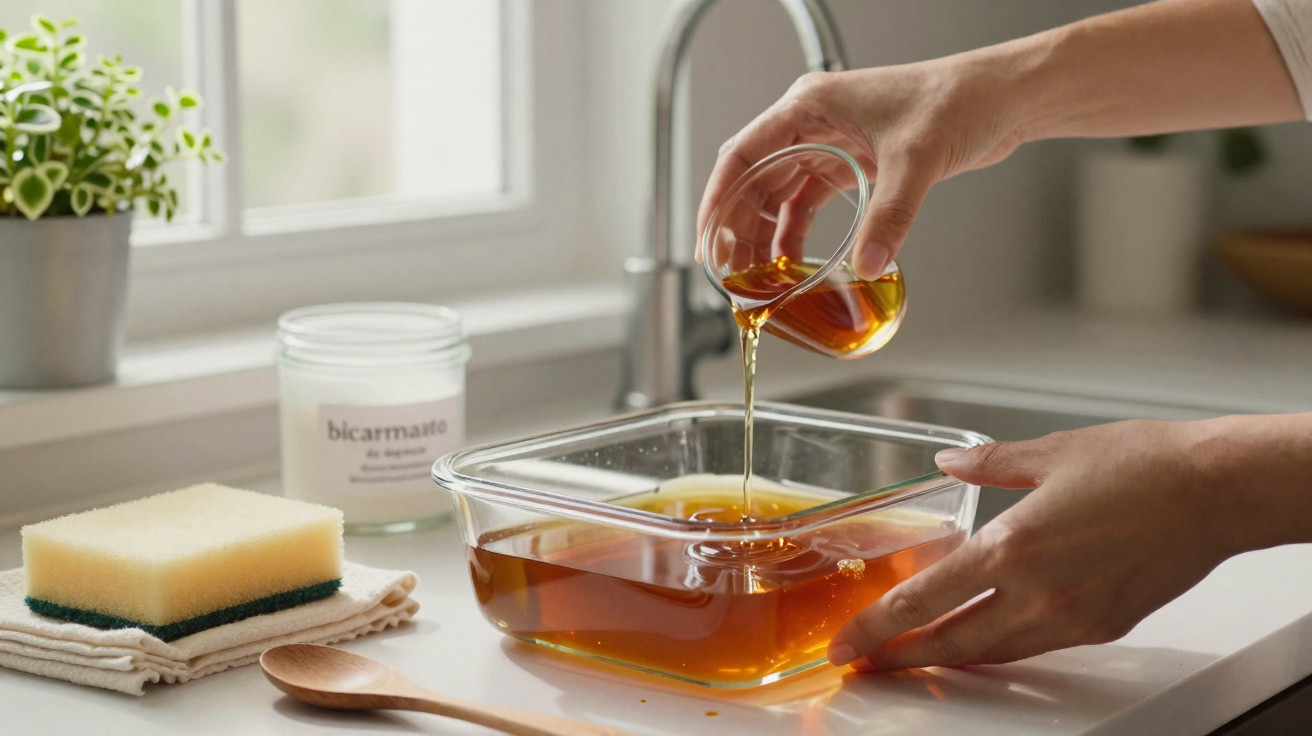
First, remove anything stored near the area you are cleaning. Then prepare a small bowl of warm water with a squirt of washing-up liquid and one teaspoon of soda. Stir until most of it has dissolved. Dip in a microfibre cloth, wring it out so that it is properly damp rather than dripping wet, and work from top to bottom.
Start with the top edge of the cabinets, as this is often where the most residue sticks. Rub it over briefly, then move to the next surface. While you clean the second area, the mixture continues to work on the first. Afterwards, go over everything with a clean, lightly damp cloth to remove the residue. Finish by wiping once more with a dry cloth.
Suddenly, your cupboards look as though you have secretly replaced them.
What many people overlook is that wood, foil finishes and lacquer do not all react in the same way. A frequent mistake is attacking delicate fronts with overly aggressive powders or abrasive sponges. You may not notice tiny scratches immediately, but they will collect dirt even faster later on. Use soft cloths instead, avoid cream cleansers, and test the method on an inconspicuous spot first.
Another mistake is the “I’ll do everything at once” syndrome. You intend to rescue the whole kitchen run in an hour, begin with huge motivation, then stop halfway through in annoyance. A clear, small target is better: today, only the cupboards above the hob; tomorrow, the side beside the fridge. Tiny steps instead of cleaning overload.
And yes, there are days when even the thought of cleaning feels like too much. On those days, it is enough to look at the jar and put the rest off until next week. That is fine too.
“I always thought that if you were not scrubbing, you were not cleaning properly,” a reader told me recently. “But since discovering the jar of soda, my arms are relaxed – and my cupboards are genuinely clean for the first time in years.”
We underestimate how much small routines can ease the load when they do not hurt. That innocent jar in the kitchen cupboard almost represents a small rebellion: moving away from the belief that something is valuable only when it involves struggle and effort.
- Simplicity beats perfection – a manageable method is better than an unrealistic cleaning plan.
- Gentle chemistry rather than aggressively scented products – your lungs will thank you.
- Consistency without pressure – one cupboard at a time, rather than the entire kitchen in one go.
- The secret pride when somebody asks: “Are your cupboards new?”
- The quiet freedom of knowing that one jar is enough. Truly.
In the end, that one jar in the cupboard is almost a small test: which group do you belong to? Those who swear that only sweat counts? Or those willing to tackle old grease film with a lighter touch?
Perhaps the most interesting answer is: a little of both. Sometimes effort, sometimes a shortcut. Sometimes a scrubbing brush, sometimes a jar of soda.
And perhaps it all begins with simply touching that one sticky cupboard door today – and seeing what happens.
| Key point | Detail | Added value for the reader |
|---|---|---|
| Jar of soda as a secret weapon | An old screw-top jar containing bicarbonate of soda or washing soda replaces several specialist cleaners | Save money, use fewer products and keep a more organised cleaning cupboard |
| Gentle but effective method | Warm water + washing-up liquid + soda, a short contact time and no hard scrubbing | Less physical strain and faster visible results |
| Realistic cleaning routine | Tackle one area at a time instead of “everything at once” | Less overwhelm and a greater chance that you will actually get started |







Comments
No comments yet. Be the first to comment!
Leave a Comment