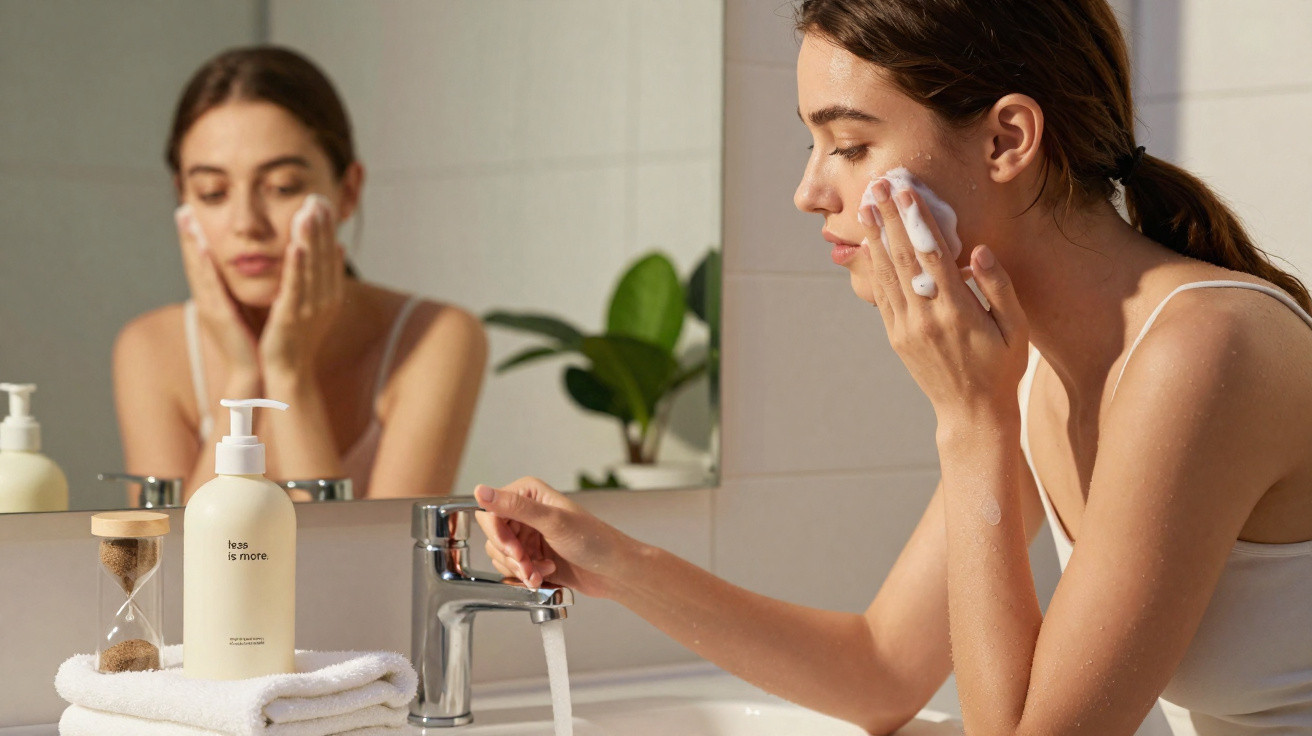
The bathroom mirror has steamed up, the tap is flowing, and your playlist is playing softly behind you.
It has been a long day, your skin feels “dirty”, and every instinct tells you to scrub for longer, linger beneath the warm water and allow the cleanser to really work. Half a minute turns into one minute, then two. Your cheeks begin to tingle and your nose feels taut, yet you carry on massaging because flawless-skin routines on social media seem to look exactly like this.
When you dry your face later, the familiar sting appears. A few hours on, there may be redness or perhaps small flakes around your nose. You might blame the weather, hormones or your pillowcase, but rarely the way you cleanse your face.
But what if the harm begins at the sink, every time you wash your face for slightly too long?
Why “extra clean” can quietly damage your skin
Washing your face may seem harmless: just water and foam, surely? In fact, it is a negotiation with your skin barrier. You can either protect it or strip it away. The facial barrier is a fine, delicate layer of cells and lipids that locks moisture in while keeping irritants out. Extended contact with soapy products gradually wears down that protection.
Massaging cleanser in for one, two or three minutes does more than remove dirt. It also breaks down the natural oils that hold skin cells together. That squeaky, tight sensation many people still view as proof of being “clean”? It is your barrier surrendering.
Healthy skin is not squeaky. It feels settled, unremarkable and almost boring. Often, the trouble begins at the sink.
Dermatologists encounter this pattern every day. Someone arrives complaining of “sudden sensitive skin” at 30, 40 or 50: increased redness, more products that sting, and breakouts that do not resemble teenage acne. They may have changed moisturisers three times and cut dairy from their diet, yet their face still burns after cleansing.
When doctors ask how long they wash for, the reply is often imprecise: “I really work it in.” “Maybe a couple of minutes?” Some people follow viral “60-second rule” videos, then add further time of their own to be safe. Others cleanse two or three times daily because they believe it shows discipline.
At a microscopic level, this additional effort accumulates. A 2022 review of barrier function found that excessive cleansing and long surfactant exposure raise transepidermal water loss - simply put, water escapes from your skin. That loss can show up as dullness, tightness or a shiny-yet-dehydrated appearance that no highlighter can correct.
Think of your skin barrier as a brick wall: cells are the bricks and lipids are the mortar. Prolonged cleansing does not remove the bricks; it dissolves the mortar. As less “glue” keeps everything joined, tiny openings develop. Allergens, pollution and even fragrance molecules can enter through them, causing inflammation.
That is why skin can be oily and desert-dry simultaneously. While its deeper layers lose water, the skin attempts to defend itself by producing more sebum. It also explains why rosacea, eczema and perioral dermatitis can flare in people who are simply “trying to clean well”. A routine intended to help can become part of the issue.
Some cleansers make this harder because they are formulated to cling to skin. Gel and foaming products often use surfactants that require only 20–30 seconds on the face to work effectively. Leave them on for 90 seconds and they continue stripping. Add hot water, and lipid removal speeds up further. The effect is subtle and cumulative, like fine cracks spreading through glass.
How to wash your face without harming your barrier
There is one simple rule that many dermatologists would gladly display above every sink: complete cleansing in under 60 seconds. That total includes wetting your face, massaging and rinsing. Treat it like brushing your teeth: be thorough, not obsessive. For many people, a gentle 20–30-second massage is enough.
Begin with lukewarm rather than hot water. Hot water alone may weaken the barrier, particularly when this is repeated twice daily. Choose a cleanser made for your skin type, but favour mild, low-foaming formulas if your face ever feels tight. Massage in small circles over oilier areas, before quickly passing over drier zones such as the cheeks and eye area.
As soon as you can feel the cleanser’s slip across your whole face, the massage is complete. Rinse until no slick residue is left, then finish. Remaining under the running water for “just a bit longer” is often when barrier damage slips in.
The most frequent error is assuming that additional washing will “fix” what is visible on the skin. A breakout? Cleanse longer. Heavy make-up? Cleanse longer. A day spent in a polluted city? Cleanse longer. The internal belief that cleanliness equals control can be powerful, particularly when you feel anxious about your skin.
In reality, lengthy face-washing sessions usually result from routine and distraction. People scroll on their phones while they massage cleanser into their skin. They leave cleanser on as though it were a mask while arranging towels or tidying the bathroom. They double cleanse, turning every evening into something close to a mini facial.
Let us be honest: nobody truly does this every day exactly as the tutorials suggest. Life is untidy. You are late, exhausted and you miss steps. The aim is not a strict ritual, but a handful of non-negotiables that defend your barrier: brief contact time, a gentle formula, no aggressive scrubbing and moisture applied immediately afterwards.
“Your cleanser is a rinse-off product, not a treatment mask,” explains London-based dermatologist Dr. Amrita Das. “If you’re leaving it on long enough to answer your emails, you’re probably irritating your skin and paying for it with sensitivity later.”
Simple prompts can help reset the habit. Hum a brief song while cleansing or count slowly to 25 in your mind. Leave your phone outside the bathroom to avoid scrolling with cleanser on your cheeks. If your skin is already red, flaky or stinging, approach it as a rehabilitation programme: wash less often, reduce the contact time and choose the gentlest formula available.
- Ideal face-washing time: 20–40 seconds of massage, under 60 seconds total
- Water temperature: lukewarm, never steaming hot
- Frequency: once at night for most people, with a quick rinse or gentle morning cleanse if required
- Immediate follow-up: apply a hydrating toner or moisturiser within 1–2 minutes
- Warning signs: stinging after cleansing, ongoing tightness, fresh flakiness or redness
The understated benefit of doing less at the sink
There is something unexpectedly radical about doing less to your face today. Skincare culture prizes effort: more steps, more actives and more time at the sink. Yet many dermatologists say that the glow people seek often comes only after they stop overdoing things, beginning with the most basic stage: cleansing.
Reducing the time you spend washing your face gives the barrier an opportunity to repair itself. Lipids can settle back where they belong. After several weeks, people frequently notice the same changes: make-up applies more smoothly, redness is less intense and the urgent evening urge to scrub fades. Skin stops “shouting” and returns to a calmer, more stable state.
We have all looked in the mirror and felt tempted to start again, stripping everything until the skin is raw and spotless. The irony is that your skin already wants to support you - it is designed to protect and repair itself. Sometimes the kindest option is to step aside, switch off the tap sooner and allow your barrier to breathe.
| Key point | Detail | Why it matters to the reader |
|---|---|---|
| Washing time | Limit cleansing to under 60 seconds, with 20–40 seconds of massage | Reduces the risk of dryness, redness and chronic sensitivity |
| Temperature and texture | Lukewarm water plus a gentle, low-foaming cleanser suited to your skin type | Protects the lipid barrier and maintains comfort after washing |
| Overall rhythm | One proper cleanse in the evening, with a lighter, hydrating morning routine | Simplifies the routine, saves time and helps stabilise skin in the long term |









Comments
No comments yet. Be the first to comment!
Leave a Comment