Early in the morning, the scene is so familiar that it barely registers. Still half asleep, you reach for the right utensil and meet a clanging, jammed-up heap of metal. Nothing is broken, yet everything is irritating. It feels as though your kitchen is working against your movements when it ought to be making life easier.
Then there is the peculiar clip endlessly circulating on social media: someone cuts a pool noodle in two, slots the pieces into a drawer, and suddenly everything seems... quiet. It is almost absurd, but you watch it to the end. The idea stays with you all day. Why is it so effective?
Why a pool noodle belongs in your kitchen drawer
The first sight of a vivid blue pool noodle tucked into a kitchen drawer can seem like a gag. This inexpensive foam tube, usually associated with children’s swimming pools, becomes the focus of a strangely satisfying organisation video. But when the drawer shuts without its usual metallic clatter, it starts to make sense. Before you can quite explain it, your mind gets the point: this is not really about the noodle, but about control.
Many kitchen drawers become tiny personal battlegrounds. Cutlery drifts to the back, spare lids knock together and sharp knives roll about unchecked. You open the drawer, rummage around and sigh. Then you watch somebody halve a pool noodle, arrange it in place and turn a noisy muddle into calm order. A single cheap foam tube changes the sound of the drawer. It is the sort of low-tech solution that makes you question what else you have made unnecessarily complicated.
So why does a pool noodle work so well in this setting? It comes down to straightforward physics and a little common sense. The foam is firm enough to provide tension while remaining soft enough to cushion. Wedged against the sides or bottom of a drawer, it prevents trays and organisers from shifting. There is no longer an empty space at the rear for everything to slide into. The noodle occupies the unused room that manufacturers leave behind. You’re basically customising the drawer that your kitchen brand never truly finished designing.
How to cut a pool noodle in half and transform your drawer
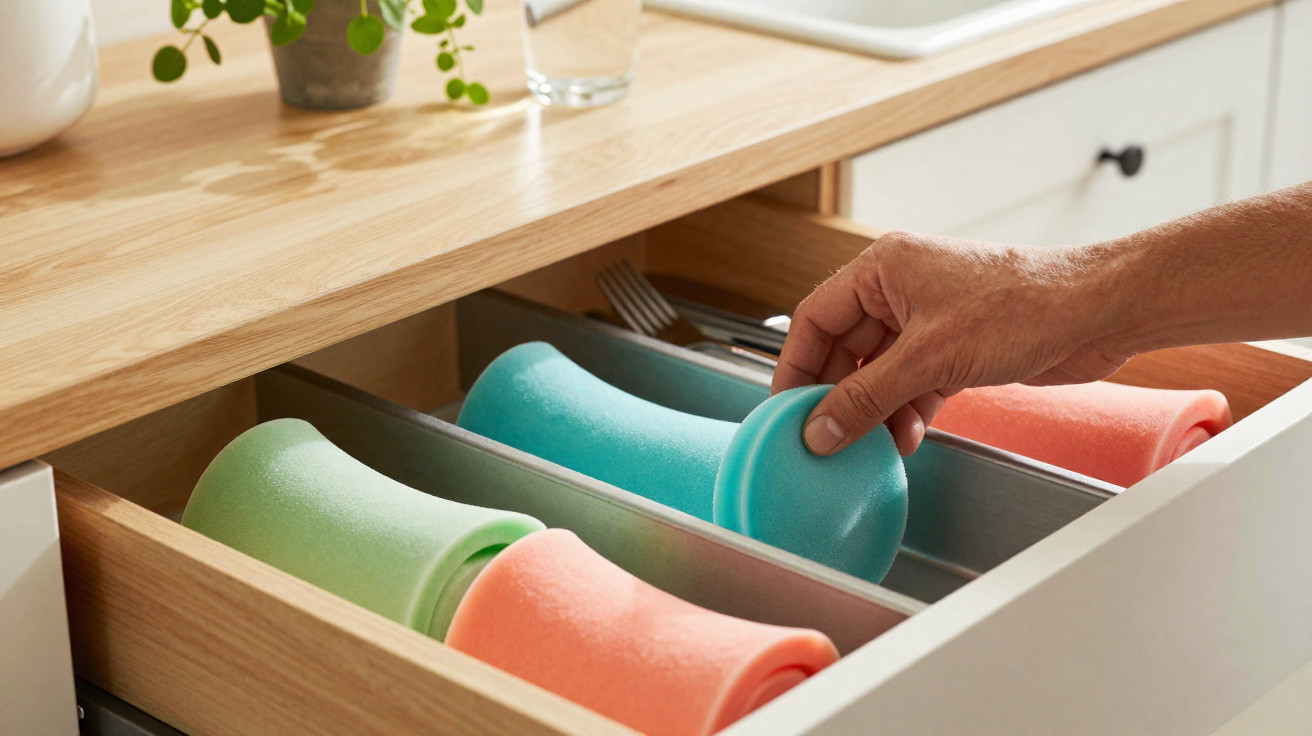
Begin with one ordinary pool noodle, such as the inexpensive type from the supermarket. Place it flat on the worktop, with your drawer tray or organiser beside it, to judge the required length. With a bread knife or sharp kitchen knife, cut off a piece matching the drawer’s width. Next, split that section lengthways, leaving you with two long, crescent-shaped foam pieces.
Set these half-moons at the sides or back of the drawer, with the curved edge against the drawer wall and the flat edge against the organiser. The aim is simply to make the fit secure enough that the tray cannot move whenever you pull the handle. If a gap remains, cut a further small section and tuck it into place. It need not look immaculate; all you need is a little resistance when you try to shift the tray. That is your drawer quietly telling you: “I’ve got this.”
Most of us have opened a drawer to find that a sharp knife has travelled from its safe corner to a position alarmingly close to the edge. This foam trick is not solely about tidiness; it can also prevent that brief flash of concern. One woman I spoke to explained that her toddler would fling drawers open, causing ladles and whisks to slide about. “After I added the pool noodle,” she said, “the drawer sounded… soft. Nothing slammed forward anymore.” Her experience is far from unusual. Kitchen accidents often begin with small items failing to stay where they should.
A 2023 survey by a UK homeware retailer found that more than 60% of respondents called at least one drawer in their home “out of control”. That is not a matter of laziness, but of designs that fail to reflect daily life. Foam wedges, including a pool noodle, close that gap. They make a mass-produced, one-size-fits-all drawer suit your room, your utensils and your routines. It is rather like adding a handwritten note to a printed book.
In practical terms, the noodle serves as a buffer. Your drawer dimensions are fixed, whereas organisers are not usually made to fit them exactly. That spare 2–5 cm at the back or side is what allows disorder to develop. Whenever you open or close the drawer, inertia sends the tray into the vacant space. Over one day, objects shift by a few millimetres; over a month, the whole drawer feels out of place. Foam removes that runway. It cushions impact, distributes pressure and holds the tray where you originally put it. You’re not organising harder, you’re just removing the chance for disorder to creep in.
Common mistakes, small wins and why this hack feels oddly emotional
The technique is simple, but the small details matter. Saw through the noodle gradually rather than pressing down forcefully, so the foam does not split or crumble. Try the first piece in the drawer before cutting the remainder, since every drawer varies slightly, even within one kitchen. For a shallow drawer, cut a slimmer strip lengthways to ensure it does not protrude or raise the organiser.
Build the arrangement in stages instead of aiming for perfection immediately. First add a strip at the back to prevent movement, then assess whether side pieces are also necessary. Where a drawer bottom is uneven or slightly warped, place several short pieces under the tray as soft feet. They will level it and absorb noise. Do not be concerned if the foam colour clashes with your décor: once the drawer is shut, it is out of sight. This is a functional solution, not an Instagram display.
Where do people get it wrong? Usually, by thinking too much about it. They cut elaborate little foam shapes, attempt to cover every millimetre, and give up halfway through. Or they overfill the drawer until it will scarcely close. Let the noodle be a helper, not a new source of stress. If one piece solves the problem, leave it at that. Once the drawer glides smoothly and the rattling has stopped, the job is complete.
Let’s be honest: nobody completely reorganises their kitchen every day. That is why this small, slightly silly trick is so appealing. It is fast, affordable and effective, even when the rest of the kitchen is far from flawless.
“I thought the pool noodle thing was ridiculous,” admits Thomas, a 39-year-old dad from Birmingham. “Then I tried it in our cutlery drawer. The noise disappeared overnight. Now my wife jokes that it’s the most useful thing we’ve ever done for under three quid.”
His response is typical: initial scepticism followed by understated acceptance. These are the adjustments that seldom feature in glossy kitchen catalogues because they are too mundane and too truthful. They suit real homes, where drawers creak, rooms carry sound and mornings move quickly.
- Cut gradually and test-fit one piece before preparing the others.
- For shallow drawers, use foam at half or quarter thickness.
- Start by placing foam at the rear, adding side support only where it is required.
- Save an offcut for any future reorganisation.
- Give priority to the “no rattle” test rather than appearance.
A foam noodle, a quieter kitchen, and what you might notice next
Once you have cut a pool noodle in half and discreetly fitted it into a kitchen drawer, something modest changes. Life’s overall chaos remains, but one place that previously fought you now works with you. A small everyday annoyance disappears. You pull the drawer open, take what you need, and nothing clanks, shifts or catches you out. It is almost embarrassingly satisfying.
That is the hidden attraction of viral home hacks like this one. They appeal to the part of us tired of buying elaborate answers to simple issues. One affordable piece of foam achieves what a costly “anti-slip smart organiser system” often does not. It adjusts, cushions and allows for imperfections. It does not care if the drawer is slightly warped, your cutlery set is mismatched or you hurriedly throw things in on a busy Tuesday evening.
This modest noodle may prompt further questions. What else in your home could be improved in five minutes using something already to hand? Which noisy moments are simply gaps waiting to be cushioned? Some people use leftover sections beneath chopping boards, inside noisy cupboards or to protect delicate glasses. Others stop after fixing one drawer, taking quiet satisfaction whenever it opens in orderly silence. Either way, it is difficult not to mention it to somebody.
| Key point | Detail | Benefit for the reader |
|---|---|---|
| Pool noodle as a spacer | Cut it in half and wedge it behind or beside drawer organisers | Prevents trays from sliding, while reducing mess and noise |
| Simple made-to-measure fit | Trim the foam to suit the precise depth and height of your drawer | Converts a generic drawer into a tailored space |
| Low-cost, low-effort hack | Gives a cheap, widely available item a new purpose | A quick improvement to everyday comfort without significant spending |







Comments
No comments yet. Be the first to comment!
Leave a Comment