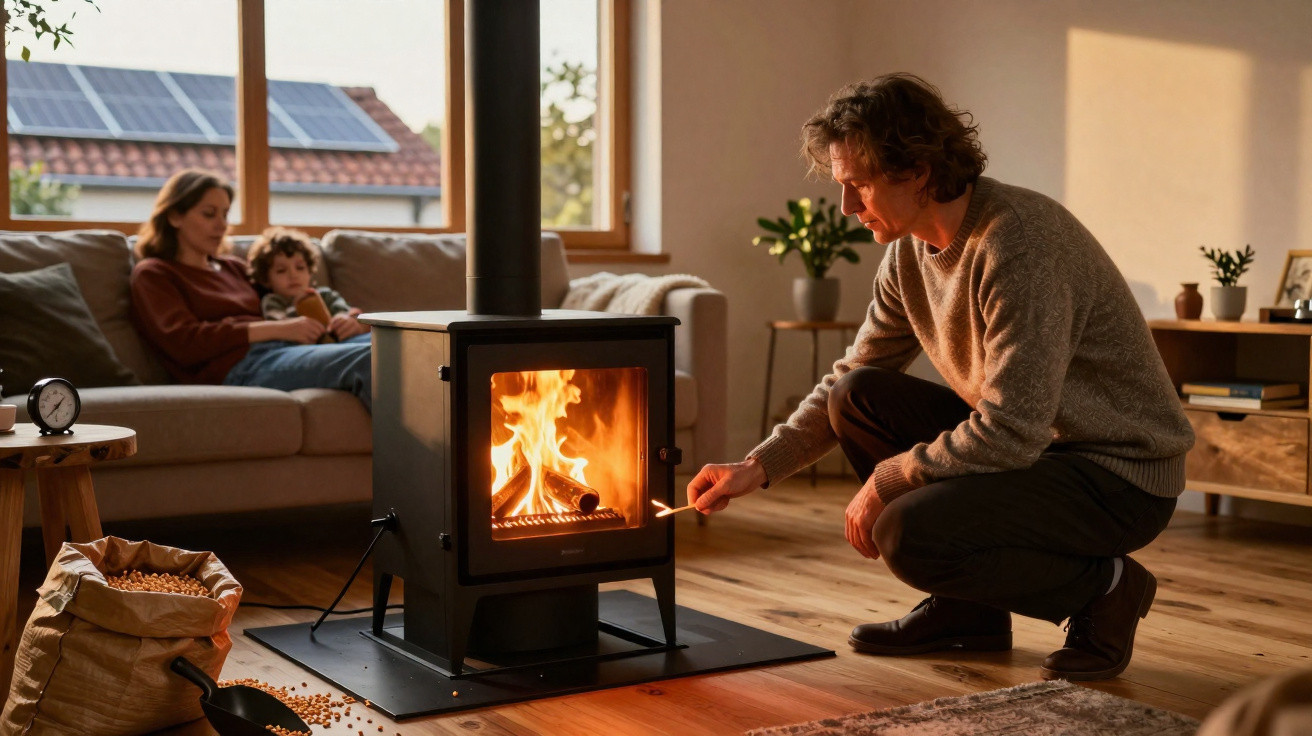
From isolated farmhouses to suburban semi-detached homes, an increasing number of households in France are choosing pellet stoves that require no electricity whatsoever. These simplified heaters offer security during grid failures, potentially lower operating costs and a more deliberate, slower way of heating the home.
What an electricity-free pellet stove really is
At first sight, an electricity-free pellet stove resembles a conventional pellet model: a metal casing, glass door and hopper filled with compressed wood pellets. The crucial difference is inside. It has no circuit board, fan, display or mains lead.
Ordinary pellet stoves use electricity for a motorised screw that feeds fuel, an ignition system and fans that distribute heated air. The off-grid alternatives remove each of these elements and work through straightforward physical principles.
Gravity replaces motors
The pellets sit in a hopper positioned above the combustion chamber. As fuel burns, pellets fall into the brazier purely under their own weight. No sensor prompts their movement, and there is no motor to fail.
By swapping electronics for gravity, households trade convenience for reliability, especially when the power cuts out.
This gravity-fed arrangement is almost agricultural in its simplicity. After the flow has been set, it remains consistent, helping to maintain a reasonably stable heat output for several hours.
Manual lighting and practical control
The stove is lit in the traditional manner, using a firelighter or kindling stick. The user opens the door, arranges the pellets, lights a match and allows a few minutes for the flame to become established.
Heat is subsequently managed by altering the air inlets and, on certain models, the pellet feed rate. Increasing airflow creates a more vigorous fire and uses pellets more quickly. Reducing it extends burning time but decreases the temperature.
Natural warmth rather than blown hot air
Because there are no electric fans, these stoves provide heat through radiation and natural convection. The metal casing becomes hot and radiates warmth, while heated air rises and slowly moves around the room.
This creates a gentler, more consistent warmth and, importantly for many owners, total quiet.
No fan noise, no humming electronics – just the faint crackle of burning pellets and the glow of the flame.
Why households in France are choosing them
Energy independence in an uncertain period
France has faced recurring warnings about pressure on the electricity grid, particularly during cold spells. In rural locations, even brief cuts can leave a property without heating for hours. Some families no longer consider that acceptable.
An electricity-free pellet stove continues to operate provided there are pellets available and the chimney works properly. It needs neither a generator nor battery backup.
- Operates during power cuts
- Lowers reliance on the grid
- Offers backup heating alongside heat pumps or electric radiators
For households concerned about geopolitical disruption or sudden fuel-price rises, this added sense of control matters.
Durable mechanics and fewer faults
A conventional pellet stove has several possible points of failure, including motors, temperature sensors, electronic boards and control panels. Such components can be affected by dust, voltage surges and everyday wear.
Removing most of these parts means electricity-free models are less likely to break down in the middle of winter, reducing the need to find a technician.
Fewer electronic parts often means fewer surprises, fewer emergency call-outs, and a longer usable life.
Operating costs and pellet prices
As they do not consume electricity, these stoves incur no power costs for fans or ignition. That alone will not transform a household budget, but it does make a contribution.
The principal advantage lies in the fuel: pellets produced from sawmill residues are generally cheaper per kilowatt-hour in France than electric heating or many fossil fuels, particularly when purchased in bulk.
Quiet comfort at home
Fan noise is a common criticism of standard pellet stoves, especially in open-plan rooms. The fan starts up, increases in speed and then slows again.
Without a fan, attention shifts to the flame itself. Users often say the warmth feels more like that of a traditional wood-burning stove, while avoiding the need to deal with large logs.
Limits and compromises buyers should understand
More cleaning and regular attention
A gravity-fed pellet stove still creates ash and fine dust. Its brazier requires routine emptying, while flue pipes need checking and cleaning at the appropriate intervals.
With no dedicated airflow to keep the glass clean, the viewing window may blacken more rapidly than on fan-assisted models. It therefore needs wiping more often.
Efficiency and distribution of heat
Many electricity-free pellet stoves achieve efficiencies of 80–85%. This is a good level for home heating, although it is marginally below the best electronic stoves, which can exceed 90% in test conditions.
Heat also usually remains concentrated in the room containing the stove. In the absence of fans or ducting, bedrooms further away may stay cooler unless the layout of the home enables warm air to circulate freely.
| Aspect | Electric pellet stove | Electricity-free pellet stove |
|---|---|---|
| Needs mains power | Yes | No |
| Heat distribution | Often fan-assisted | Natural convection |
| Noise level | Noticeable fan noise | Very quiet |
| Control options | Programmable, thermostatic | Manual |
| Breakdown risk | Higher (electronics) | Lower (mechanical) |
No smartphone operation or automated schedules
Ease of use is among the largest trade-offs. These stoves cannot connect to Wi-Fi, work through apps or be set to light an hour before the user returns home.
The owner has to light the fire, regulate the air supply and monitor pellet levels. To some people this is an inconvenience; to others, it is an appreciated ritual that gives structure to winter evenings.
Why the trend is especially strong in France
France has a longstanding culture of wood heating, ranging from open fires to cast-iron stoves. Moving from logs to pellets is commonly viewed as a shift towards heating that is cleaner and easier to manage.
Across many rural departments, power cuts still happen frequently enough for households to give serious thought to backup heating. Recent discussions about grid capacity and the expense of refurbishing nuclear plants have not reassured everyone.
Electricity-free pellet stoves sit at the crossroads of tradition and modernity: a flame you can see, with a fuel you can pour from a bag.
Government support for lower-carbon heating has also made pellet technology more familiar to the public, although subsidies can sometimes be more focused on fully electronic models.
Practical situations: who benefits most?
A family in a small town may retain its gas boiler while fitting an electricity-free pellet stove in the living room. On ordinary days, the boiler supplies the basic heating; on cold evenings, the stove takes over and reduces gas consumption.
In a remote mountain chalet, this same type of stove may serve as the primary heating source. Its owners can buy pellets ahead of winter, confident that they will remain warm even when storms bring down electricity lines.
For people living in urban flats with strict building requirements and no flue, these stoves are often unsuitable. Instead, the trend is being driven by houses that already have chimneys or can accommodate a dedicated flue.
Important concepts and risks to consider
One technical concept worth knowing is “draw”: the chimney's capacity to pull smoke and combustion gases upwards. Electricity-free stoves depend wholly on natural draft. A badly designed or blocked flue can result in weak combustion, additional soot and possible safety risks.
Carbon monoxide is still a genuine danger where a stove is poorly installed or inadequately maintained. Annual inspections by a professional, suitable ventilation and compliance with local building regulations are essential, even with the simplest mechanical model.
Fuel storage also presents a risk, as pellets must remain dry. A damp garage or leaking shed can spoil several hundred kilograms of pellets over a single winter. Keeping them in sealed bags or a dry silo is as important as selecting the appropriate stove.
Some households use these stoves alongside solar panels. The solar installation powers lighting and appliances, while the pellet stove supplies heat without draining the battery bank. This combination is attracting interest among homeowners in France who seek resilience rather than complete dependence on technology.















Comments
No comments yet. Be the first to comment!
Leave a Comment