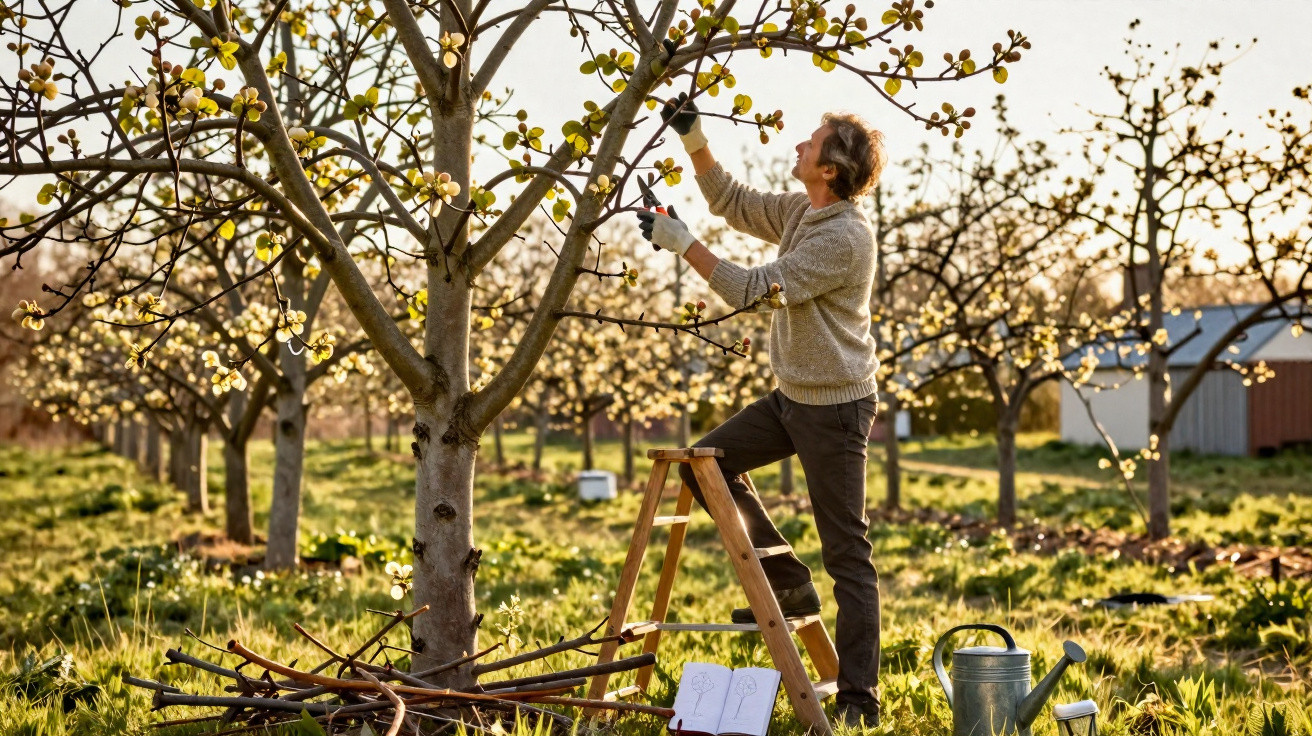
I stood beside the old apple tree, my breath visible in the cold and my secateurs tucked warmly inside my coat pocket. A blackbird reprimanded me from the fence, as though I were late for a ceremony that had existed long before any of us. The tree seemed weary and overgrown, its wood full of tangled stories. I thought of my dad teaching me that one precise cut could rouse a branch from its rest. “You remove something,” he would say, “to give something else a chance.” It sounded simple, though it took more courage than that. The soil was still, the sap was still, but my hands were not.
Light, air, and the subtle science of pruning
Pruning is chiefly about creating light and airflow, rather than punishing a tree. Opening the canopy lets sunshine reach the fruiting wood and allows breezes to pass through moist areas where mould tends to linger. This is not sculpture. It is about directing how a tree breathes and nourishes itself. Winter light reveals the tree’s framework, making the purpose of every limb, bud and spur easier to understand. Prune for openness, and the crop will follow.
Gillian, whose garden is three plots along, inherited a Bramley that had grown into the shape of an umbrella. Its centre was far too shaded, while apples appeared around the outer edges like a restrained apology. She spent three winters gradually opening it up: removing several large limbs in the first year, then thinning it carefully and consistently afterwards. By the third summer, apples were growing on the inner branches for the first time in years. They could be picked without a ladder or a battle with foliage. Neighbours began exchanging recipes once more. It is the sort of achievement that a photograph on a phone cannot properly capture.
Trees respond to sunlight and hormones. Apical dominance encourages growth upwards; taking out a top leader sends energy sideways and activates dormant buds. Fine wood carries much of the following year’s fruit, whereas ageing, crowded spurs become unproductive. A 45-degree branch angle provides a balance between vegetative growth and fruiting: too upright, and it produces shoots; too horizontal, and it sulks. Treat every cut as a traffic sign, redirecting movement, relieving congestion and preventing hold-ups. You are allowing buds to mature, wood to harden and fruit to develop colour without blemishes.
Apple tree pruning: timing, tools and vital cuts
In temperate climates, apple and pear trees should receive their main prune in late winter, after the hardest frosts have passed but while the trees remain dormant. Stone fruits are better pruned during summer, helping them avoid silver leaf and gummy wounds. Begin with the three Ds: dead, diseased and damaged wood. Those cuts are essential. Next, remove branches that cross, rub together and create wounds. Trace each branch back to its collar, then make a neat cut immediately beyond that small swelling. An outward-facing bud points next season’s growth in the right direction, like a compass. Put sanitation first, shape second and fruit last.
In truth, few people sharpen their secateurs as frequently as gardening books recommend. Blunt blades rip bark and create opportunities for trouble, so spending a moment sharpening them beforehand prevents problems later. The greatest error is removing too much too quickly. Do not take away more than a quarter of the canopy in one winter, or the tree may respond with an explosive flush of watershoots. Never leave stubs, as they decay and form poor callus. Do not apply wound paint to apple and pear trees; they recover most effectively when left exposed. Most of us have looked at a beloved tree that is tired and tangled, then felt unexpectedly accountable for it.
Prune towards the wood you intend to retain, rather than concentrating on what you plan to cut out. That approach changes the whole task. When training a young tree, establish its structure early: choose three to five evenly spaced limbs for an open centre, or maintain one distinct leader for a pyramid form. Established trees benefit from thinning rather than drastic cutting. Spread major reductions across several seasons, using restrained “renewal” cuts into younger wood to restore vigour. A measured hand achieves more than one ambitious Saturday.
“The best prune is the one you can’t see in July,” an old orchardist told me. “You notice the breeze, the sunlight, and the fruit. The cuts have vanished into confidence.”
- Maintain strong branch unions: choose 45–60° angles and avoid tight V-shaped crotches.
- Understand the training system: use a central leader for pears and renewal cuts on apples to renew spurs.
- For summer jobs, rub away soft watershoots and shorten coarse growth at the tips to settle the tree.
- Consider training methods such as espalier and cordon, which resemble sunlit fences; prune them lightly and regularly.
- Cleanliness is important: wipe blades between questionable cuts to reduce the spread of canker.
What your future harvest needs from you
A future harvest does not need dramatic intervention. It needs sensible timing, a sharp blade and the confidence to stop once the right cut has been made. It needs light running along the scaffold branches, rather than an impenetrable green wall. It needs a gardener able to see a bud and picture the future branch carrying fruit at shoulder height. Trees retain the effects of our care: next summer’s crop begins with this winter’s decisions. Divide the work between seasons and the tree will meet you halfway. A pruned tree makes a different sound in the wind, and that is not merely poetic. It is the sound of deliberately created space.
| Key point | Detail | Benefit for the reader |
|---|---|---|
| Best time to prune | Apples/pears in late winter; stone fruits in summer | Lowers disease risk and encourages strong healing |
| Where to cut | Just beyond the branch collar, back to an outward-facing bud | Quicker callusing, safer wounds and growth directed towards the light |
| How much to remove | Up to 20–25% of canopy in one dormant season | Avoids shock and outbreaks of watershoots while improving light |




Comments
No comments yet. Be the first to comment!
Leave a Comment