You open a kitchen drawer looking for a spatula, only for it to stop halfway because a stray potato masher and three unidentified lids are in the way. You push, jiggle it and mutter under your breath. Once the drawer finally gives way, you look at the chaos and have the thought most of us know well: “I need a bigger kitchen.”
But what if your kitchen is not too small - what if the issue is how its space is divided up?
The same frustration crops up in bathroom cupboards, bedroom chests of drawers and that so-called “catch-all” drawer we act as though is not there. We buy storage boxes, baskets and organisers, yet the clutter always finds its way back.
One small adjustment can transform the situation.
The small shift that secretly doubles space
When you watch somebody clear out a cluttered drawer, the same pattern is immediately obvious. Everything is laid flat in one layer, like an untidy collage. Pens, cables, folded T-shirts, plates and beauty products are all competing for the same narrow span of space.
Because drawers and cupboards are naturally horizontal, we instinctively arrange our possessions horizontally too. It seems sensible, but it quietly wastes around half of the available volume.
The simple change that doubles capacity is this: stop storing things flat and start storing them upright.
Imagine a drawer packed with T-shirts. When they are folded the “classic” way, they become stacks. You can see the top T-shirt and perhaps the one below it, while the rest disappear beneath the pile. Every time you take one, the whole stack falls apart like a poorly made house of cards.
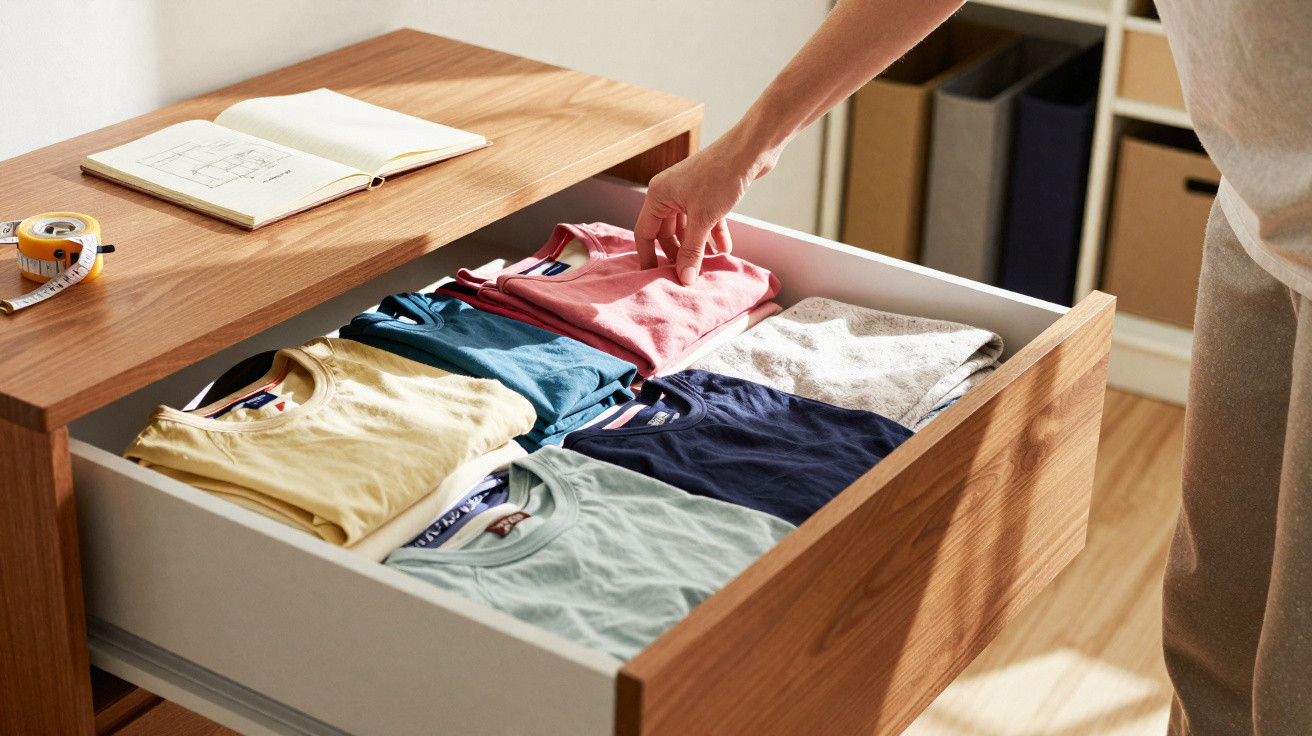
Now picture that drawer containing exactly the same clothes, except each T-shirt has been folded into a compact rectangle and positioned upright, like files in a filing cabinet. Every colour is visible at once. You can remove one shirt without pulling three more along with it.
A family I interviewed said this straightforward change transformed two crammed children’s drawers into one spacious, easy-to-use drawer - without donating a single T-shirt.
The reasoning is almost painfully straightforward. Horizontal stacks squander a drawer’s height, as you keep piling items on top of each other until the drawer becomes too full to open properly. Vertical storage divides the same volume in another way: it makes use of the full height and width, with no unused areas at the back.
In cupboards, towers of plates act much like piles of shirts. Put plates upright in a rack and the shelf suddenly accommodates twice as many, while you can slide one out without causing a ceramic avalanche.
The drawer did not become larger - the way you view space did.
How to switch from flat to upright, room by room
Begin with a single drawer - just not the most chaotic one. Choose an easy success, such as socks, T-shirts or tea towels, and empty it all onto a table.
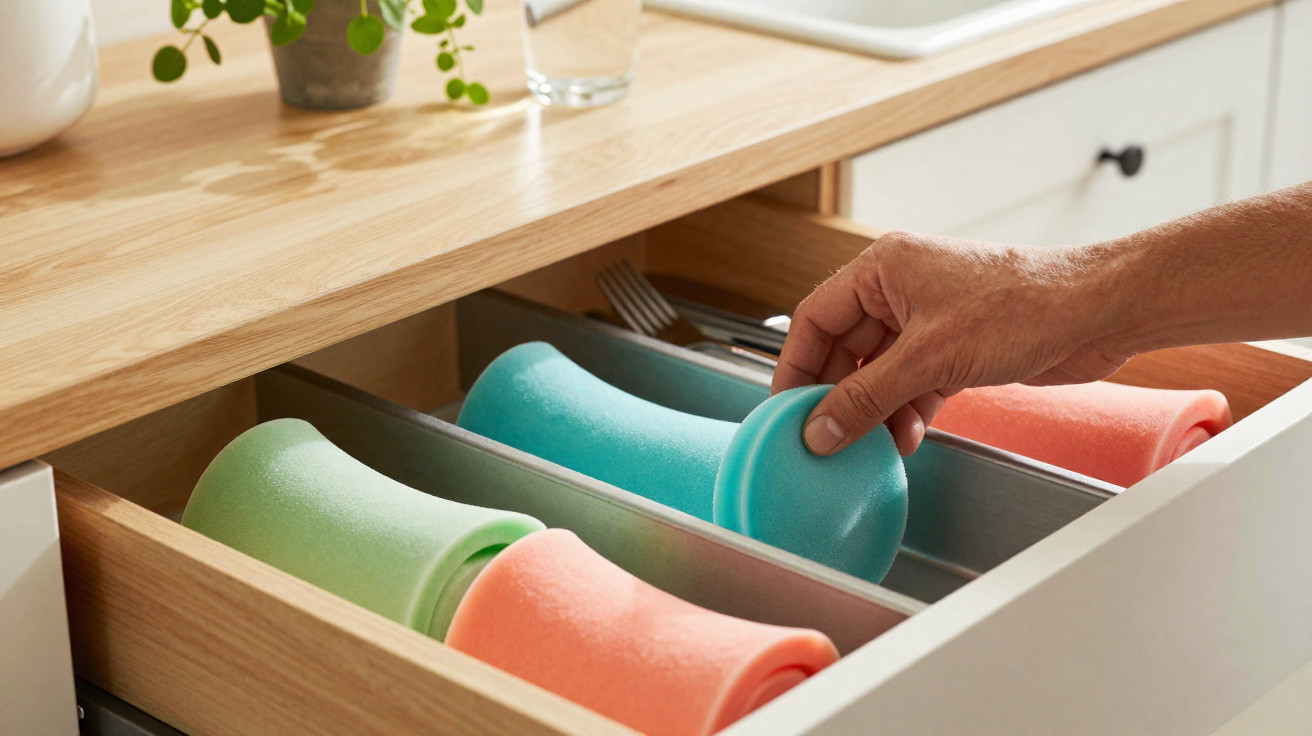
Next comes the essential move: fold to suit the drawer’s height, rather than the item’s original size. With clothes, aim for a small, solid rectangle that can stand independently. For kitchen utensils, sort items by category and position them upright in containers, much like pencils in a desk pot.
As soon as objects can “stand” rather than lie flat, the drawer becomes a miniature library of belongings.
This is where many people stumble. They expect a Pinterest-worthy result from the first day, with flawless lines and colour-coordinated stacks. That expectation can ruin the system before it has even begun.
Adopt this approach instead: “functional first, pretty later.” Fold items approximately, check whether they stand and make adjustments. That is all. Your drawer does not need to look ready for a magazine; it simply needs to open freely and let you see its contents.
Let’s be realistic: no one manages this perfectly every day. There will be rushed mornings, lazy evenings and partly folded laundry. The key is creating a method that still works reasonably well when you are exhausted.
There is also a concern about becoming too organised. Some people fear that an excess of boxes and dividers will make everyday life feel restrictive. One woman I spoke with about her bathroom cupboards summed it up perfectly:
“I thought organizers would turn me into some control freak. Instead, it turned my cabinet into a calm space where I can actually find my own toothpaste.”
The best small tools for upright storage are remarkably uncomplicated:
- Shallow boxes - halved shoe boxes work well - for keeping upright items in rows
- Plate racks or bookends that hold dishes and lids vertically
- Small containers for cables, chargers and beauty products, grouped according to use
- Drawer dividers that prevent clothing “files” from falling over
- One “wild card” area for unusual items that do not belong in another category
When space changes, habits change too
After converting a few drawers and cupboards to upright storage, a subtle shift takes place. Instead of thinking, “I don’t have enough space,” you begin to notice how you are using the space already available.
The kitchen drawer that once jammed every morning feels easier, almost courteous. Your bathroom cupboard is no longer a black hole filled with partly used bottles; it becomes a calm grid, with hair products here, skincare there and travel miniatures in a small box, all standing neatly in place.
You may even experience a quiet sense of relief whenever you open a drawer and see everything side by side, rather than searching through layers of “I’ll sort that later.”
Storage advice is sometimes expected to come with a moral message about owning fewer things or becoming a perfect minimalist. The reality is gentler. You can enjoy your possessions, hold on to those souvenirs tucked at the back of a drawer, and still gain twice as much usable space simply by changing the direction in which they sit.
When you consider it, much of the stress caused by clutter comes not from how much we own, but from having no idea where anything is. Upright storage is not so much a decorating technique as a visibility trick.
You are not only doubling space; you are also cutting in half the small daily annoyances that gradually drain your energy.
That is the understated strength of such a minor change. You do not need new furniture, a larger flat or a dramatic clear-out. You simply play a small game of Tetris with what you already own, and the room gradually reorganises itself around that decision.
Some people begin with kitchen drawers; others start with make-up, office supplies or children’s clothes. Wherever you choose to begin, the result feels the same: this drawer now works with me rather than against me.
Once you have watched a small space expand in this way, you will never see a flat, overfilled drawer in quite the same light again.
| Key point | Detail | Value for the reader |
|---|---|---|
| Switch from flat to upright | Store clothes, dishes, utensils and products upright rather than in stacks | Immediately uses the full volume of drawers and cupboards without renovation work |
| Organise with simple containers | Use boxes, racks and dividers to hold items in vertical “rows” | Cuts down on chaos and makes every item visible at a glance |
| Prioritise function over perfection | Allow for “good enough” folding and adaptable zones | Builds a system that withstands real life and busy days |







Comments
No comments yet. Be the first to comment!
Leave a Comment