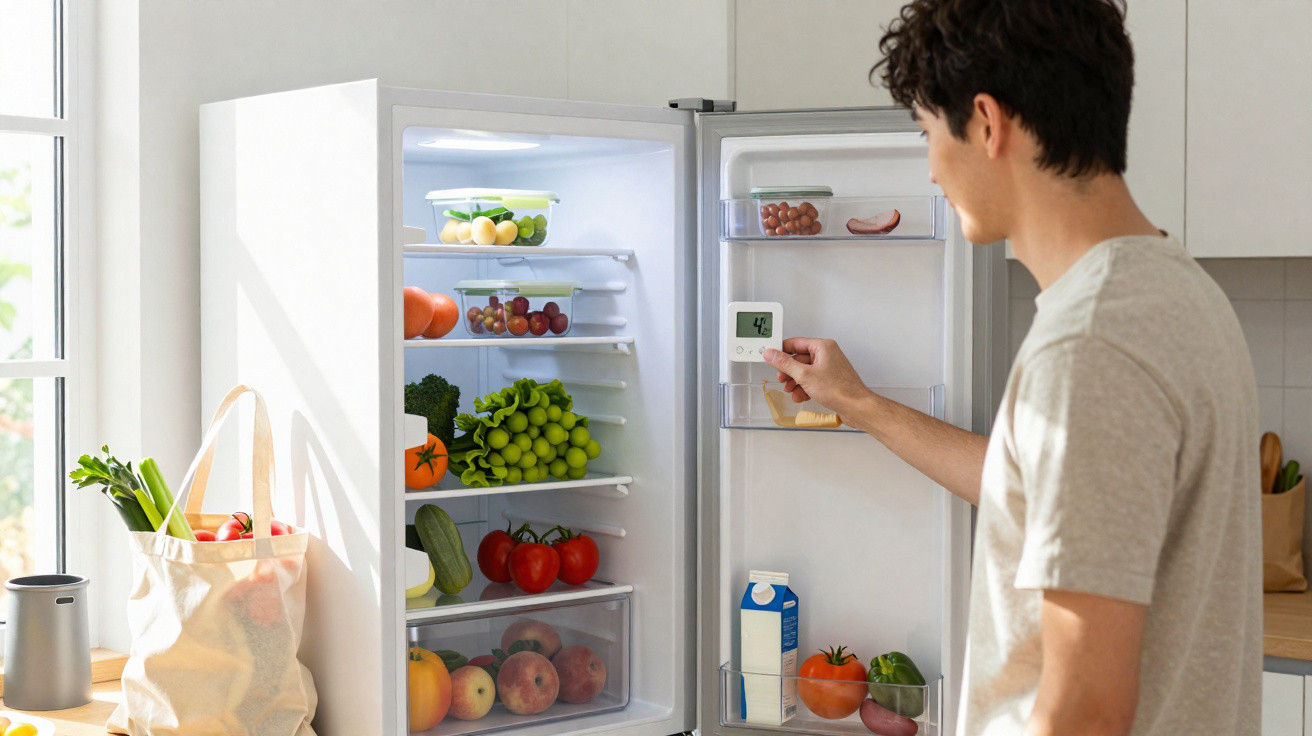
By Sunday evening, the refrigerator fills up quickly: lunch leftovers, discounted yoghurts, still-damp salad leaves and chicken to cook on Monday. A few days later, an odd smell is coming from the vegetable drawer, while the strawberries have already lost their shine. We all know that minor frustration: throwing away food we only just bought. Often, the culprit is neither the product's quality nor the date printed on its packaging. It is the inconspicuous dial, sometimes set at random, inside the fridge. A temperature that is too high speeds up food spoilage and allows certain bacteria to thrive unnoticed. A tiny detail with very real consequences. Sometimes, just a few degrees are enough.
The figure to remember: 4 °C, not 7 or 8
In many kitchens, the refrigerator runs “as it always has”. The dial sits in the middle, the display reads 6 °C, or nobody is quite sure what the small number from 1 to 5 means. Yet the coldest area of a fridge should remain between 0 and 4 °C, and the French National Agency for Food, Environmental and Occupational Health & Safety recommends keeping sensitive foods at or below 4 °C. Above this level, food deteriorates more quickly. Fresh products may still look fine, but their shelf life is reduced, sometimes sharply.
According to several surveys and household-habit trackers, almost one in three people in France may fail to follow this storage temperature, either because they do not check it or do not know about it. For Claire, in Lyon, the issue became clear after she had opened and thrown away three packets of ham in the same month. Her fridge displayed 8 °C, which still seemed “cold, though”. After putting a thermometer in the coldest compartment, she discovered that her appliance even rose to 9 °C after food shopping. The use-by dates had not changed. The storage conditions, however, made all the difference.
Cold slows down the activity of micro-organisms, without stopping it altogether. As the temperature rises, bacteria responsible for certain forms of spoilage find more favourable conditions, particularly on meat, fish, prepared meals, opened dairy products and homemade leftovers. A refrigerator is not merely a cool cupboard: it is a fragile protective chain. Leaving the door open for too long, putting away dishes that are still hot or pressing groceries against the back wall can be enough to disrupt this unobtrusive system.
Why your refrigerator may be warmer than you think
The first step is straightforward: put a fridge thermometer in the coldest section, which is often at the bottom of the appliance or just above the vegetable drawer, depending on the model. Leave it there for several hours without opening the door every ten minutes, then check the reading. If the temperature is above 4 °C, lower the setting gradually and check again the next day. The number displayed on the front does not always reflect the actual temperature inside the fridge. The thermometer remains the most reliable guide.
A common mistake is assuming that every shelf has the same temperature. Eggs, butter and drinks can cope with a less cold area, whereas fresh fish, raw meat, opened cooked meats and ready meals need to be kept in the coldest part. Let us be honest: nobody really does this every day, particularly after a rushed large food shop. Even so, putting food away as soon as you get home, rather than leaving it waiting on the worktop, can prevent a great deal of unnecessary waste.
The aim is not to turn your kitchen into a laboratory, but to adopt two or three habits that are easy to maintain. As food-safety professionals often advise:
“Sensitive food should be put into the cold quickly and stored in the appropriate area of the appliance.”
- Set the coldest zone between 0 and 4 °C.
- Avoid overloading the shelves: cold air needs to circulate.
- Let cooked dishes cool before refrigerating them, but do not leave them for hours.
- Clean the seals and check that the door closes properly.
- Maintain the cold chain between the shop and home.
Small habits that stop food ending up in the bin
A fridge that is too full is often a poorly organised fridge. When food is stacked in front of the air vents, cold air cannot circulate as effectively and some areas become surprisingly warm. Take a look inside after a food shop: the most perishable items can end up trapped right at the top, behind a bottle of juice or a forgotten container of leftovers. Keeping food that needs using quickly at the front, with newly bought items behind it, also helps cut waste. It is simple, almost obvious, yet easily forgotten when daily life gets busy.
The refrigerator door deserves particular attention. It is the area most exposed to temperature changes, because every opening lets in some warm air. It is common to keep milk, sauces, desserts or leftovers in small jars there, out of habit and because it is convenient. For perishable foods, it is better to keep this space for condiments, jams, drinks and products that cope better with these fluctuations. Cold is not distributed evenly, even in a recent, well-maintained appliance.
It is also worth considering what is happening around the fridge. An appliance pushed against a wall, placed near an oven or covered in dust at the back has to work harder and may still fail to maintain the correct temperature. Hot summer weather often exposes the issue: the motor runs for longer, yoghurts do not keep well and vegetables soften too soon. Regular defrosting, if your model requires it, and a little room for ventilation can genuinely make a difference. It is not dramatic. That is precisely why it is so easy to overlook.
| Key point | Detail | Benefit for the reader |
|---|---|---|
| Ideal temperature | Keep the coldest zone between 0 and 4 °C | Slow the spoilage of sensitive products |
| Proper storage | Keep meat, fish and prepared meals in the coldest zone | Reduce risks and keep food for longer |
| Useful check | Use a thermometer placed inside the fridge | Know the real temperature beyond the displayed setting |






Comments
No comments yet. Be the first to comment!
Leave a Comment