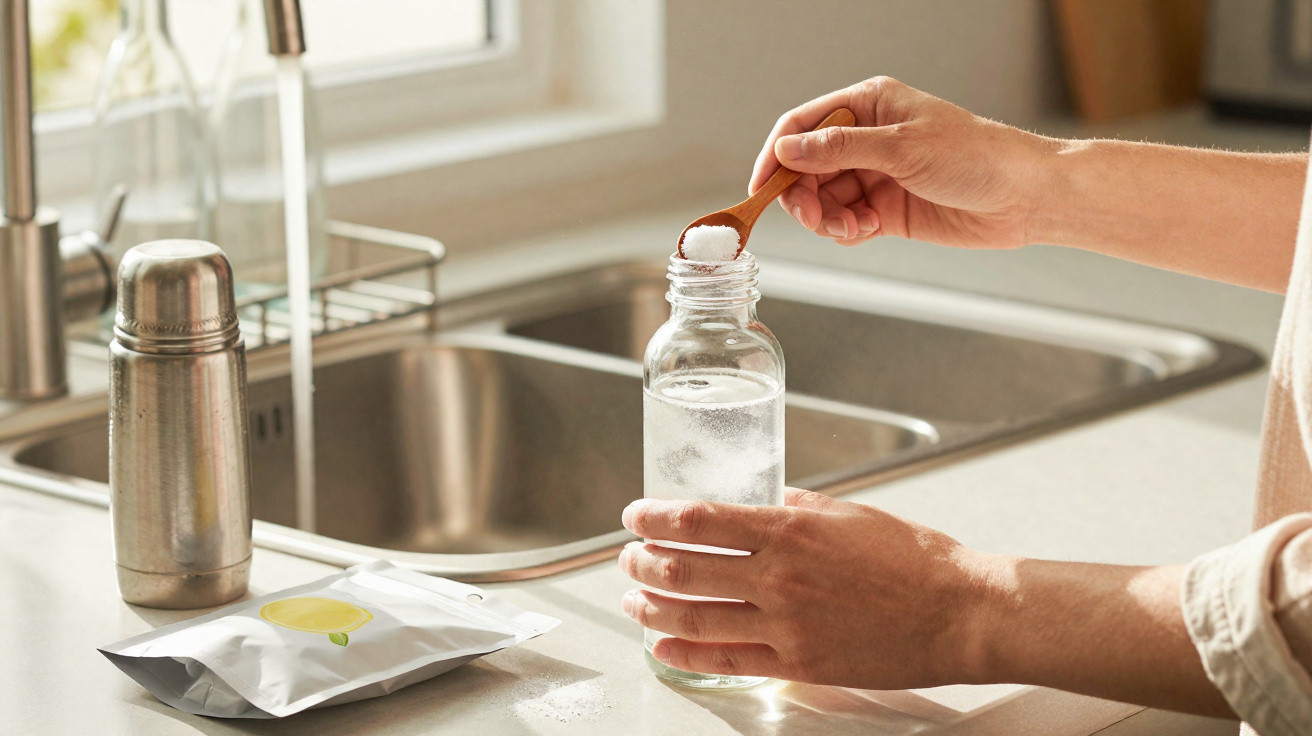
Food-grade citric acid provides a straightforward way to remove limescale that has built up inside bottles and vacuum flasks. Unlike a mixture of bicarbonate of soda and vinegar, it retains its acidic properties, breaks down mineral deposits and does not leave behind the strong smell commonly associated with vinegar.
Why do bicarbonate of soda and vinegar become less effective when mixed?
Vinegar is acidic, whereas bicarbonate of soda is alkaline. Once they are combined, they react by fizzing and releasing carbon dioxide, but this also neutralises some of the acidity needed to dissolve the calcium carbonate found in limescale.
Although the fizzing may help loosen surface debris, it does not necessarily deliver a deeper clean. To tackle mineral scale, using an acidic product on its own is generally more effective than mixing ingredients that weaken each other's action.
Which product works best against mineral deposits?
Citric acid gradually dissolves the whitish layer created by minerals in water. As it is sold in powder form, you can prepare only the amount required, and it does not leave the lingering aroma that some people notice after using white vinegar.
Distilled vinegar can also remove limescale when used on its own. The benefit of citric acid is its milder scent and the ease of adjusting the strength of the cleaning solution.
How should citric acid be used in bottles and vacuum flasks?
Before using it, check whether the manufacturer allows acidic solutions to be used on the inner lining. If the material is compatible, follow this method:
- dissolve one or two tablespoons of citric acid in hot water;
- pour the solution into the bottle or vacuum flask;
- leave it to work for 20 to 30 minutes;
- use a soft brush if any residue remains stuck to the surface;
- rinse several times under running water before using it again.
What precautions prevent damage and residue in the container?
Do not leave the solution inside the bottle for hours, and never mix it with bleach, strong detergents or other chemical products. Lids with valves, rubber seals and removable parts should be taken apart and cleaned in line with the manufacturer's instructions.
- do not use steel wool or materials that could scratch the inside;
- avoid boiling water if the manual does not permit it;
- do not use this method on aluminium or sensitive linings without checking compatibility first;
- rinse until any taste or smell has disappeared;
- allow every part to dry fully before closing the container.
Regular cleaning prevents limescale from returning
Limescale forms again when water containing calcium and magnesium is left in the container and evaporates. Emptying the bottle after use, washing the interior and leaving it open until dry helps reduce scale build-up and damp odours.
When deposits are already visible, food-grade citric acid acts more directly than a combination of bicarbonate of soda and vinegar. Moderate use followed by thorough rinsing keeps bottles and vacuum flasks clean without relying on abrasive products that could damage the internal finish.



Comments
No comments yet. Be the first to comment!
Leave a Comment