The mirror has misted over, droplets cover the tiles, and your towel feels as though it has been sitting in the bath beside you.
You open the window a crack, flap your arms like a makeshift fan and smear long, pointless marks across the glass. Two hours on, the bathroom still carries a faint scent of wet dog and laundry left too long.
Moisture does not simply disappear. It settles into curtains, works its way into grout and gradually nourishes the greyish marks you try to ignore in the corners. You burn a candle, spritz a product promising “fresh ocean breeze”, close the door and hope that will do the job.
It is oddly reassuring to assume this is simply how bathrooms are: humid, steamy and a little worn-out. But an increasing number of people are discreetly dealing with it using one straightforward item hung near the shower.
And it is not an expensive dehumidifier.
Why bathroom moisture has become everyone’s concern
Spend ten minutes looking through home-hack videos on your phone and the pattern becomes obvious. Moisture is the latest household villain. People are posting fogged mirrors, marked ceilings and blackened silicone seals, all asking one question: why does my bathroom remain wet for hours?
The explanation is rather unexciting. Homes today tend to be more tightly insulated, bathrooms are frequently compact and without windows, and many of us enjoy long, hot showers. The steam has little opportunity to escape. It hangs around, soaks into every surface and makes the bathroom feel like a miniature cloud indoors.
What was once dismissed as an “oh well” irritation is increasingly being seen as an issue for both health and household finances.
On a dull November morning in Manchester, a young couple posted a TikTok showing their mould-covered bathroom ceiling. The paint had blistered, black patches lined the corner above the shower, and their towels never dried completely. Commenters responded with versions of the same experience: rented flats with a constant damp odour, shared bathrooms with barely functioning fans, and children’s baths in rooms that never seemed properly dry.
One person said her landlord accused her of “not opening the window enough” despite there being no window. Someone else shared an energy-bill screenshot showing that running an electric dehumidifier every evening had become a substantial monthly expense in itself.
Behind the jokes and snappy edits was a consistent message. Moisture was not merely an appearance problem. It meant mould spores, allergies, crumbling grout, flaking plaster and the low-level worry of living somewhere that never genuinely smells clean. That is why the easiest solutions - those that can be hung up in seconds - are drawing so much interest.
Moisture acts like an unwanted visitor. It travels where it pleases, lodges in fabrics and seldom departs without encouragement. Hot vapour rises, meets colder surfaces and turns into water droplets. Some run down mirrors and walls, but much of the water remains trapped in the tiny pores of silicone, grout, paint, timber and even plasterboard.
Bathrooms are often the smallest spaces in a property while containing several sources of water: the shower, bath, basin, heated towel rail and sometimes a washing machine. Every shower adds a remarkable amount of humidity to a limited amount of air. When that air cannot circulate or leave quickly, it reaches saturation point.
As humidity remains high in the room, everything takes longer to dry. Towels stay wet, bathmats develop an odour and each new shower begins in a room that is already damp. This is why one uncomplicated adjustment - hanging the right item in the right place - can interrupt the entire pattern.
The bathroom moisture hack: hang this beside the shower
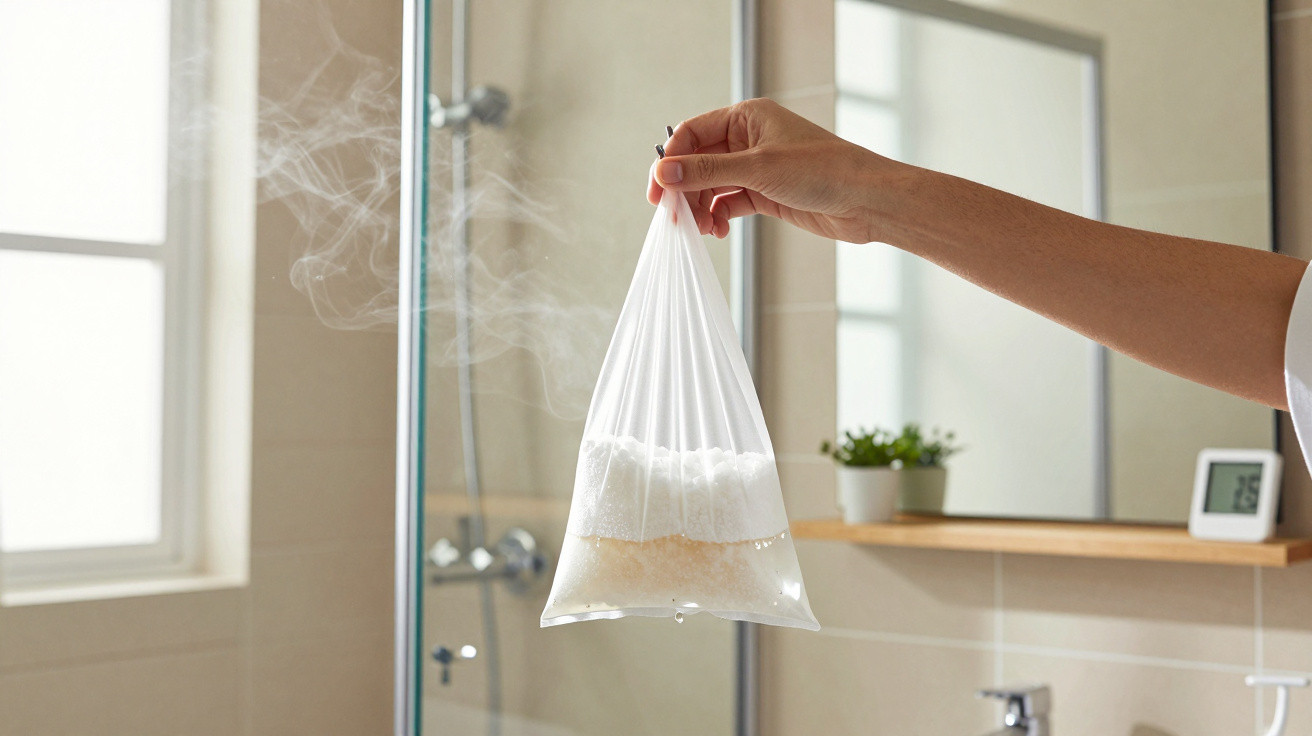
The low-tech solution repeatedly appearing in ordinary bathrooms and viral clips is simple: suspend a moisture-absorbing bag or block close to the shower and allow it to work without fuss. Think of it as an air sponge powered by gravity, positioned at head height to catch humidity before it spreads around the bathroom.
These products are generally dehumidifier bags made with calcium chloride or silica. They can be hooked onto a rail, suction hook or small over-door hanger beside the shower curtain or glass screen. As steam rises, the crystals draw water from the air, gradually turn to liquid and drain into a small built-in collection pouch.
There is something unexpectedly satisfying about seeing the clear droplets gather at the bottom: evidence that it is more than marketing hype.
In practical terms, one basic bag may be the difference between a bathroom that feels swamp-like and one that dries within an hour. People living in humid cities strongly recommend them. A reader in Lisbon told us her bathroom “stopped smelling like an aquarium” within two weeks of discreetly hanging a bag close to the shower rail.
On a small balcony in Naples, one family used to put all their bathroom towels and mats outside every day, including through winter. They felt locked in a never-ending struggle against damp. Their bathroom had no window and only a feeble extractor fan, which rattled loudly enough to wake the baby, so it was rarely switched on.
They tested scented sprays, candles, additional towel rails and even leaving the door open to “let the air move”. None of it made a real difference. A neighbour who worked at a hardware shop eventually gave them a pack of hanging moisture absorbers, saying, “Put one by the shower. You’ll see.”
They attached the first bag to the shower caddy. After a week, the lower pouch contained an unexpectedly large amount of clear water. Their bathmats no longer felt cold and wet beneath bare feet. A month later, the mould marks in the silicone had stopped spreading. It was not magic, only steady and silent removal of moisture.
The same story is playing out in different forms in London bedsits, Tokyo micro-apartments and suburban family houses across the world.
Why position it beside the shower instead of elsewhere in the bathroom? That is where the spike in humidity is greatest. During a shower, tiny droplets and warm vapour rise directly around you. Air beside the curtain or glass panel becomes its own small climate zone - warmer, wetter and denser than the air in the rest of the room.
Putting the moisture absorber in that airflow lets it meet the most saturated air first. The crystals operate more quickly when more water is available in the atmosphere. It is much like placing a sponge beneath a leak rather than on the other side of the room: the same object, with a far better result.
The other part of the principle is time. The bag continues drawing water from its surroundings after you have left the bathroom and gone to bed. This helps the room return to a drier starting point before the following morning. Across days and weeks, it lowers the total moisture burden carried by your walls and fabrics.
How to use a bathroom moisture absorber without a strict routine
The main step is straightforward: choose a hanging moisture absorber intended for smaller rooms and position it as near as sensibly possible to the steam source. For most households, this means the shower rail, a wall hook near the showerhead or a caddy placed just outside the direct spray area.
Keep it sufficiently far away that it is not splashed, otherwise the crystals can dissolve too quickly and become sludgy. A gap of one or two hand widths from the main path of the water is a sensible target. The bag needs to sit in warm, humid air rather than inside the shower stream.
If you have a bath instead of a shower enclosure, place it above the middle part of the tub, nearer the wall where the hot water lands.
Let us be honest: nobody truly follows a routine like this every day. You do not need a military-style bathroom regime, nor are you likely to want one. The attraction of this method is that it works quietly in the background.
A few common errors are worth avoiding, however. Many people hang the bag almost at ceiling height because “hot air rises”. That is correct, but the thickest and steamiest air circulates within the first metre above the shower. If you can easily reach the bag while standing in the bath or shower, it is probably at the right height.
Another frequent mistake is to view the bag as a permanent fitting. It is not. Its task is complete once the crystals have liquefied and the reservoir at the bottom is nearly full. Keeping it there for months “just in case” will not remove additional moisture; it will only become a rather miserable decoration.
One environmental health expert we spoke to summed it up simply:
“People imagine they need expensive machines to fight damp, when half the battle is where you put the first line of defence. A five-euro absorber, hung in the right spot, can protect finishes that cost hundreds to repair.”
To maintain the hack with very little effort, focus on small habits rather than major projects:
- Replace the bag when it is 70–80% full rather than waiting until it overflows.
- Pair it with a brief period of extractor-fan use after hot showers; even 10 minutes helps.
- Shift its position slightly if one area of the room appears to remain damp.
- Select unscented options if you are sensitive to fragrance - its purpose is moisture control, not perfume.
- Inspect walls and grout monthly for early marks, while they are still easy to clean.
There is also an emotional benefit to hanging something small and useful. It can alter how you view the room. Rather than being a lost cause or simply “how the building is”, the bathroom becomes somewhere you can gradually improve, one small hook at a time.
The understated benefit of a dry bathroom
A faster-drying bathroom has a different feel. The air seems lighter, towels do not stick to your skin and the faint musty background smell fades away. You may not register the change after a single day. Instead, you may notice it when entering somebody else’s damp bathroom and sensing the difference.
A moisture absorber hung beside the shower will not transform your home into a laboratory-standard climate-controlled space. Its effect is subtler: it lessens the everyday amount of water your walls, textiles and lungs must cope with. In time, that can mean less scrubbing, fewer unexplained marks and fewer corners you tell yourself you will deal with later.
At a human level, it is quietly comforting. It is one small action, repeated by thousands of people worldwide, that helps make homes a little healthier and more comfortable.
We have all stepped onto a cold, damp bathmat and thought, “I really need to sort this bathroom out.” The answer may not be a full renovation or costly appliance. It might begin with a small plastic hook, a hanging bag and a choice to let something else deal with the moisture for once.
Next time steam curls around your shower, take note of where it travels. That is where your new bathroom ally should be suspended, quietly drawing water from the air while you carry on with your day.
| Key point | Detail | Benefit for the reader |
|---|---|---|
| Positioning near the shower | Hang the moisture-absorbing bag in the area most exposed to steam | Maximises effectiveness without changing your shower habits |
| Crystal moisture-absorbing bags | Use bags containing calcium chloride or silica | Genuinely reduces humidity rather than simply masking odours |
| Monitoring and replacement | Change the bag when it is nearly full of liquid | Keeps the system effective and helps limit mould growth |


Comments
No comments yet. Be the first to comment!
Leave a Comment