You settle down expecting soft, balanced support, only to feel your body gently sink into a well-known hollow: the place you sleep every night. Your hip drops slightly too low, your lower back curves a touch too much, and one shoulder seems trapped. You convince yourself it is nothing. You are simply exhausted.
A few weeks go by. You wake feeling stiff, stretch out, crack your neck and blame your age, desk chair or the weather. Anything except the large rectangle occupying half the bedroom. Then, one morning, you glide your hand over the mattress and notice it unmistakably: a dip, as though your shape has been pressed into the foam. The mattress has stayed in the same position for months, perhaps even years.
That is when an unwelcome question quietly surfaces: What if this is gradually ruining my back?
What happens if you never rotate your mattress
Although a mattress appears level and impartial, it gradually takes on your shape. Each night, your heaviest areas – your hips, shoulders and buttocks – bear down on the same sections. When you never rotate the mattress, those particular spots absorb the strain time after time. The materials wear out, springs lose their resilience, and foam remains compressed instead of properly springing back.
Eventually, the sleeping surface changes from even, comfortable support into a shallow body-shaped mould. At first it may feel reassuring, as if the bed is cradling you. Gradually, however, your spine loses its natural position. This is usually how it starts: minor, barely noticeable depressions that eventually contribute to genuine pain.
Picture a couple in their mid-30s who share a king-size mattress bought in a sale five years earlier. Both have desk jobs, go to the gym now and then, and are reasonably fit. They have never rotated their mattress. He always sleeps on the left-hand side, lying on his side. She always sleeps on the right, partly on her front.
Before long, the two sides resemble parallel tracks. Place a marble in the centre and it would slowly roll into one of the grooves. He starts waking with lower-back tightness and blames deadlifts. She develops a dull pain between her shoulder blades and searches online for “bad posture at work”. Neither thinks to inspect the mattress first. But when they eventually remove the bedding in full daylight, they can see the outlines their bodies have left in the fabric.
Physically, these body impressions alter the way force is distributed through your spine. Rather than spreading your weight evenly, the worn-out areas concentrate pressure. Your lumbar curve may become more pronounced, your shoulders may twist, or your pelvis may tip. Across hours of sleep, this poor alignment creates micro-stress in discs, ligaments and the small stabilising muscles.
Long-term back pain usually develops gradually. You do not wake up one morning “broken”; instead, you feel slightly stiffer and more sore, repeatedly. A mattress that is never rotated speeds up that pattern because the same overloaded sections receive no relief. Its materials have no opportunity to distribute wear, and your body has no chance to rest on a genuinely even surface. In effect, you are sleeping within the problem, literally sunken into it.
How to rotate your mattress and make it a habit
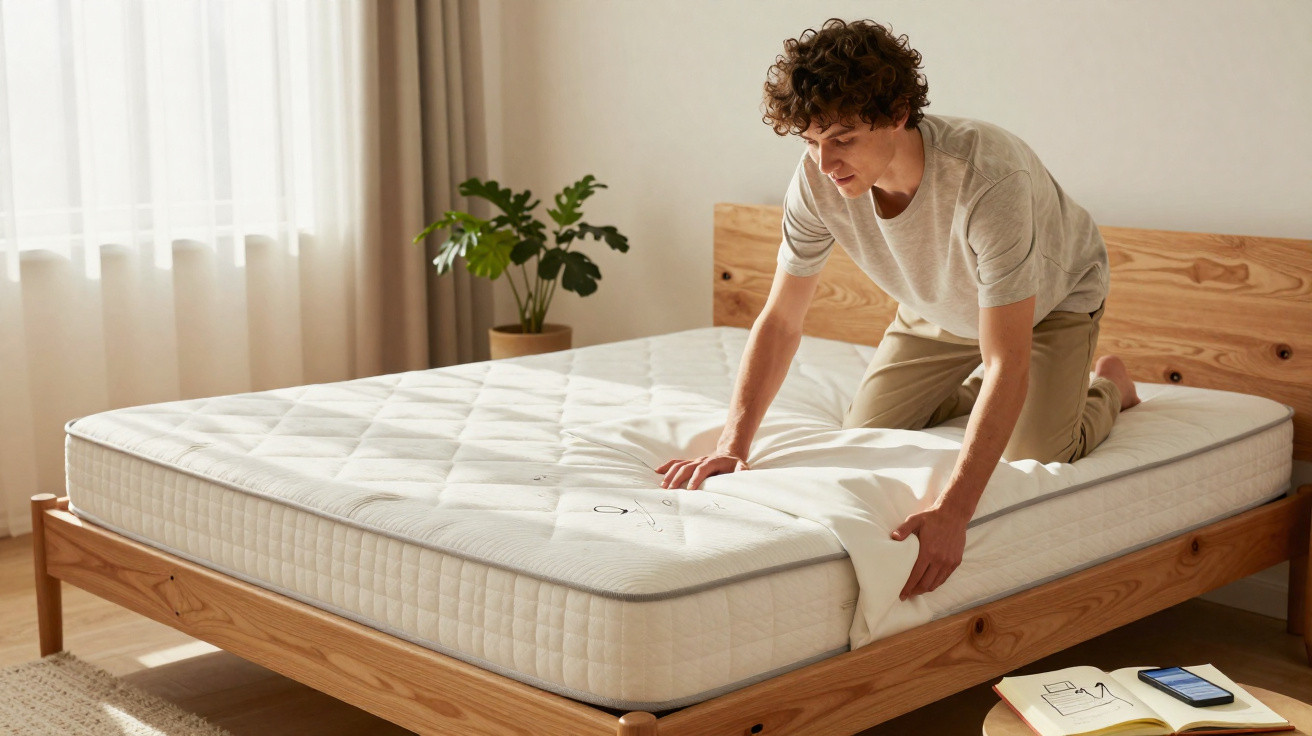
The six-month rotation rule may sound like the sort of instruction printed on a care label you will only read once. The process itself is straightforward: rotate the mattress by 180 degrees, putting the head end where your feet normally go. This one action spreads the pressure across sections that have been used less and those already under strain. Your hips no longer press into the same exhausted patch of foam every night.
The simplest approach is to link it to a regular date you will remember, such as the first day of spring and the first day of autumn, or the weekend the clocks change. Remove the bedding, take a corner each if there are two of you, and turn it as if it were an oversized steering wheel. If you live alone, stand it on its side first to make turning it more manageable. It takes under three minutes, but may extend the period of proper support by years.
Let us be honest: hardly anyone actually does this regularly. Most of us stretch out on the same side, in the same sleeping position, for years, until our backs start protesting properly. If there are already visible body impressions, rotating will not work miracles overnight, but it can prevent the damage from progressing as quickly. Treat it as damage limitation for both your spine and your finances. The grooves may not disappear entirely, but you can stop them turning into trenches.
Many people put it off until they have a “free weekend” or plan a major spring clean. That weekend rarely arrives. It is better to establish a small routine you can genuinely keep: change the sheets, inspect the mattress and rotate it twice a year. It is hardly glamorous, but this kind of mundane habit can quietly help prevent chronic pain from taking hold.
Experts often discuss mattress rotation in highly technical terms, but fundamentally it is about everyday comfort. As one sleep specialist told me over the phone:
“People think of rotation as maintenance for the mattress. I see it as maintenance for the spine sleeping on it.”
The thought stays with you when you consider how many hours your back spends on a mattress every year. Small habits, repeated over time, determine whether those hours restore you or cause harm. A mattress that wears evenly remains more neutral, so your muscles do less unseen work overnight simply to keep your vertebrae aligned.
- Rotate every six months – turn it 180 degrees from head to foot; there is no need to flip it unless its design permits this.
- Look out for early warning signs – visible dips, rolling towards the centre, or new stiffness in the morning.
- Recognise when it is finished – if rotation no longer improves matters and the hollow is clear, your mattress has reached the end of its useful life.
Living with your mattress rather than suffering from it
There is an unusual intimacy in our relationship with our beds. They are where we are most vulnerable: weary, unguarded, sometimes hurting and sometimes happy. With an unrotated, worn mattress, that personal space can slowly begin to work against you. You may start putting off early nights because you know you will toss and turn, trying to find a position that does not hurt.
Rotating the mattress every six months is not a magic cure, but it buys valuable time. It postpones the development of deep body-shaped trenches and gives your back different pressure patterns throughout the year, rather than the identical impact point every night. It is a quiet way of saying: I am not leaving my spine to chance.
We seldom discuss mattresses with friends, but perhaps we should. When someone says, “I’m always sore when I wake up”, the cause may not be ageing or stress. It could be a tired rectangle of foam that has never been rotated. There is something surprisingly freeing about changing the perspective: it is not that you are fragile; your mattress is simply worn in the places that never had a rest.
| Key point | Detail | Why it matters to the reader |
|---|---|---|
| Rotation every 6 months | Turn the mattress 180° from head to foot | Distributes wear and helps limit the formation of dips |
| Monitor “body impressions” | Visible dips or a sensation of rolling towards one side | Lets you act before pain becomes chronic |
| Spinal alignment | A flatter surface distributes pressure more evenly | Reduces the risk of lower-back and neck tension |
















Comments
No comments yet. Be the first to comment!
Leave a Comment