At 2:17 a.m., in that hazy state between sleep and waking, someone throws off a heavy duvet, starts to shiver and then fumbles blindly for the throw at the end of the bed. Minutes later, everything happens the other way round: first too cold, then too warm, followed by that unsettled middle ground where your body cannot settle at a comfortable temperature. The clock shines. The bedding moves. Your mind will not switch off.
It may seem like a minor household issue, but it is quietly disrupting sleep for many people. It is not insomnia or stress, but simply the wrong level of warmth at the wrong moment. When morning temperatures can range from 10°C to 22°C within a single week, bedding becomes a problem nobody has taught us how to tackle. There is a solution, however. Once you understand it, your bed can work much like a dimmer switch.
The understated benefits of blanket layering
Scroll through pictures of any immaculate Instagram bed and the same thing appears: layers. There is a sheet, a lightweight blanket, perhaps a quilt, and a throw folded across the bottom. This is more than styling. It is a set of temperature controls. Every layer holds a slim pocket of air, which your body warms and retains around itself. One blanket is one large gamble on temperature; three lighter layers let you make precise adjustments.
Our bodies do not remain at one “perfect” temperature throughout the night. Core temperature falls as we drift off, rises nearer morning, and changes with hormones, dinner and stress. One thick duvet can feel wonderful at midnight but stifling by 4 a.m. With layers, you have options for those subtle, drowsy changes without needing to wake properly. Comfort becomes adaptable rather than fixed.
A quietly telling National Sleep Foundation study found that people who reported “easy temperature control in bed” also reported greater sleep satisfaction and fewer nighttime awakenings. Not all of them referred to blankets, but the connection is clear. Consider the friend who insists on a weighted blanket, but only when it is paired with a light cotton cover they can quickly push back. Or think of the couple who stopped disagreeing over the bedroom temperature after creating two separate stacks of thinner layers on the same mattress.
We rarely describe blankets as technology, but that is effectively what they are when they are layered deliberately. One provides everyday comfort, another adds warmth, and another allows a quick adjustment. Rather than treating warmth as an on-or-off setting, layering divides it into manageable, human-sized increments. Your half-asleep mind can cope with “push this throw down” far more easily than “get up, alter the thermostat, return to bed”. That distinction can turn a broken night into an uninterrupted one.
How blanket layering reshapes your sleep
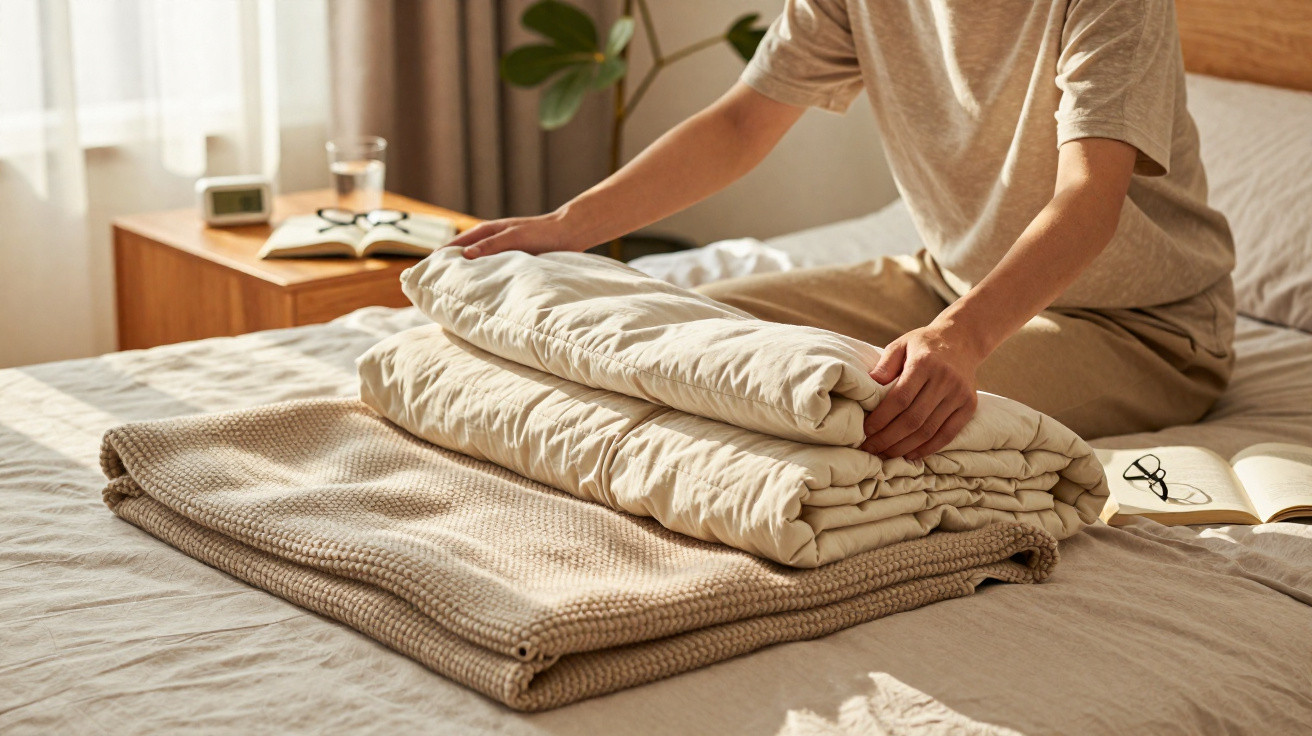
On a humid spring evening in a compact city flat, a couple decides to try a different arrangement. They use a flat sheet, a lightweight cotton blanket, a thin duvet folded in half at the bottom of the bed, and a knitted throw close at hand. Nothing elaborate. Overnight, one person pulls the duvet up over their legs only. The other stays beneath the sheet and blanket, then half-wakes at dawn, draws the throw over their shoulders and falls asleep again. There is no full awakening and no dramatic tossing and turning.
They are making the kind of micro-adjustments that your nervous system appreciates. The body responds better to small, gradual changes than sudden ones. When warmth can be altered in 10–20% stages rather than being “all or nothing”, the brain remains more settled. This is why hotel beds with several covers can feel unexpectedly accommodating. You may pull one down or tuck another around yourself without consciously considering it. The bed feels flexible rather than unyielding.
In physical terms, layering is about air. Every blanket captures air, and that air provides the insulation. Several fine layers, with air between them, can compete with one heavy layer while offering much greater flexibility. Use cotton next to the skin for breathability, perhaps wool above it for dependable insulation, then add a light throw that can be moved easily. When your body needs a minor adjustment, it encounters less disruption. Your sleep architecture quietly thanks you.
The method: creating a “temperature-flex” bed
Begin with a breathable foundation: a fitted sheet and, ideally, a flat sheet in cotton or linen. Both materials draw away moisture and allow heat to disperse. Add a medium-weight blanket over this, one that would be sufficient by itself on a mild night. This is your “default” layer, and it will probably remain in place through the year.
Next, add your warmer layer: a duvet or quilt. Rather than tucking it in firmly, allow it to lie loose so that it can be folded halfway down. Treat it as a comfort dial. Folded at the foot of the bed, it offers very gentle warmth. Pulled halfway over your legs, it provides a medium level. Drawn up to your shoulders, it gives maximum coverage. Finally, keep a lighter throw or small blanket within arm’s reach, either at the bottom or side of the bed, for quick adjustments when you are half asleep.
The essential approach is this: a base sheet + medium blanket + adjustable upper layer + “emergency” throw. In most homes with shifting seasons, that arrangement can handle everything from “why is it so muggy?” to “did someone leave a window open in January?” You do not need to buy extra bedding; you simply reorganise what you have into a system that responds to you rather than working against you.
Fine-tuning, frequent errors and little comforts
A common error is choosing the thickest duvet immediately and deciding the job is done. It can seem sensible and cosy on a chilly evening, only for you to wake hot, damp and irritable at 3 a.m. Another familiar mistake is piling on too many synthetic blankets, which hold in heat while preventing humidity from escaping. Warm but clammy does not feel luxurious. Your skin needs breathable layers.
Try to view bedding in terms of functions rather than individual items. The layer nearest your body should feel soft and allow air to circulate. The middle layer should be your dependable, medium-weight blanket for most nights. The top layer is your weather protection: something you can pull on or remove rapidly. If you sleep hot, keep those top layers lighter and prioritise airflow. If you are always cold, place a slightly heavier throw closer to the upper half of the bed so that your torso takes priority.
Let us be honest: nobody really does this in meticulous detail every day, like in an interiors magazine. Even so, a handful of small habits can make a real difference. On laundry day, you might replace a heavier blanket with a lighter one as the forecast changes. Before going to sleep, fold the duvet down to the middle of the bed if the room feels close. Such tiny actions can lead to better nights and fewer arguments with your own bedding.
Listening to your body rather than perfect beds
A sleep coach I spoke with expressed it in a memorable way:
“Stop trying to win at making a perfect bed. Start trying to make a bed that forgives you.”
That is the emotional core of layering. A forgiving bed does not penalise you for being too warm one night and too cold the next. It does not require you to predict the precise temperature at 4:30 a.m. It offers choices. During a difficult week, that kind of gentleness matters more than thread count. In a good week, it quietly supports you as you get on with life.
Here is a simple “comfort checklist” to consider when you get into bed:
- Do I feel a little cool at first? (That is a good sign for falling asleep.)
- Can I put on or take off one layer with a single sleepy movement?
- Is anything weighing heavily on my chest or shoulders?
- Am I likely to wake up sweaty beneath this top layer?
- Can my partner’s side be arranged differently from mine?
At a deeper level, layering blankets is about giving yourself permission: permission to adapt, not to sleep according to a thermostat diagram, and to change your mind at 2 a.m. without making it a major event. Once you stop seeking one ideal temperature and instead create a small, flexible climate around your body, the entire night feels less like a struggle and more like a conversation.
Why adjustable warmth can quietly transform your days
Remove the buzzwords and sleep trackers, and the point is straightforward: your nights influence your days. Waking three times because your duvet is unsuitable may not seem dramatic at the time, but it leaves its mark on your concentration, appetite and patience the following day. Layering blankets is one of those modest, almost old-fashioned techniques that can directly alter how your mornings feel.
After trying a layered arrangement for a fortnight, you begin to notice the smaller changes. You wake with fewer half-remembered struggles against the covers. Seasonal changes feel less daunting because your bed can adapt between cold dawns and warm evenings without requiring a complete bedding change. You may find yourself moving one small layer in the dark without truly waking, then slipping straight back into sleep. That is your body feeling secure.
What is quietly radical is the move from merely enduring your surroundings to working with them. The room may become cooler overnight. Temperatures may fluctuate. Your body may have its own preferences. And your bed, this small layered microclimate, accommodates all of it halfway. That is not decoration. It is comfort with a strategy behind it, ready to be shared, borrowed, adapted and adjusted from one bedroom to another.
| Key point | Detail | Benefit for the reader |
|---|---|---|
| Build a layering system | Combine a breathable base, medium blanket, adjustable duvet or quilt and light throw | Lets you alter warmth in a few movements without leaving bed |
| Prioritise air and breathability | Choose several thin cotton, linen or wool layers instead of one large duvet | Reduces night waking caused by overheating or humidity |
| Match layers to your temperature profile | Hot sleepers → lighter layers / Cold sleepers → more warmth over the upper body | Provides personalised comfort, even for two people beneath the same duvet |














Comments
No comments yet. Be the first to comment!
Leave a Comment