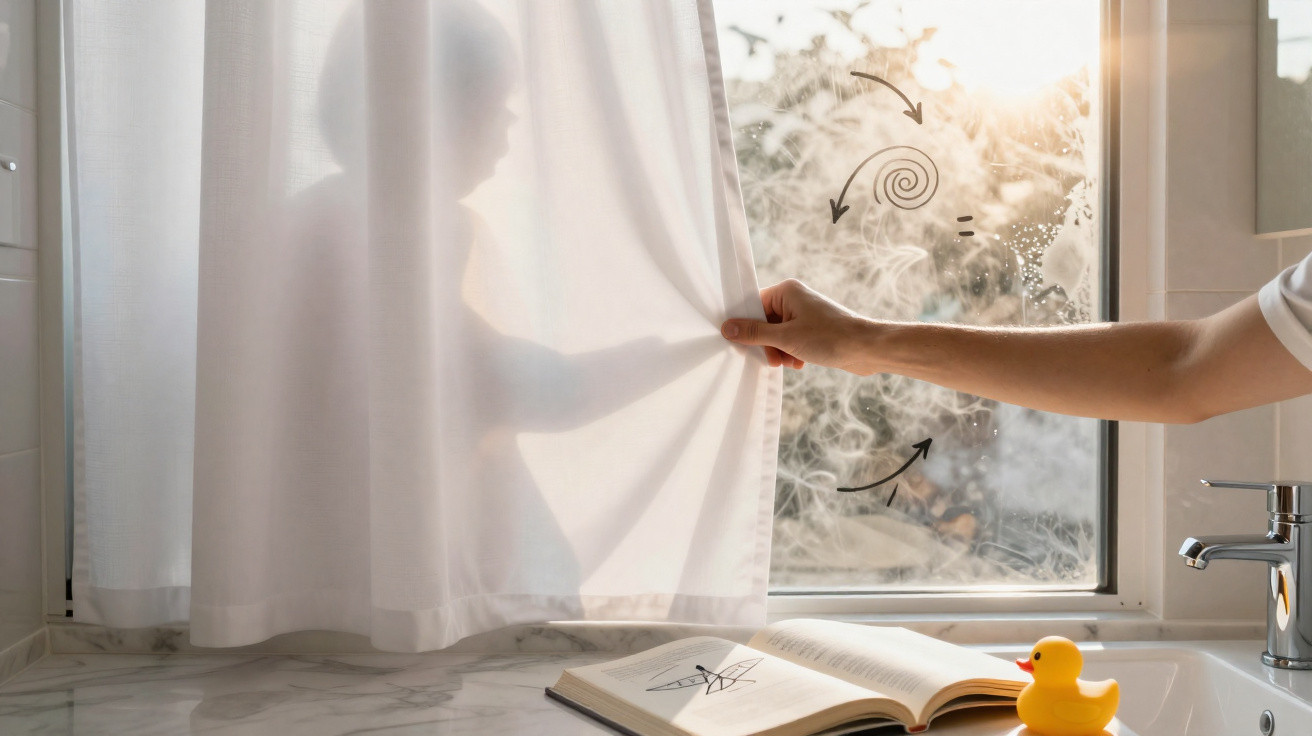
Out of the corner of your eye, you spot it: the shower curtain edging towards you like an overly attached ghost. It grazes your leg, clings to your skin and spoils the whole idea of a relaxing morning routine. You shove it away, and it creeps back. Then it happens again.
Many people put it down to flimsy plastic, faulty curtain rings or an unexplained bathroom draught. Others suspect an air vent they have somehow missed. The real explanation is more surprising - and rather more interesting. The same physics that helps aircraft stay aloft is shifting that irritating shower curtain.
The explanation lies in an 18th-century idea, concealed in the steam.
Why your shower curtain moves towards you
Watch carefully and the process is almost funny. The moment hot water starts hitting the bath, the air begins circulating. A curtain that was motionless seconds earlier starts billowing and fluttering before suddenly leaning inwards. It does not need a breeze from an open window or extractor fan; it responds to an invisible force created inside the shower itself.
On a still morning, the pattern can be easy to spot. Switch the water off and the curtain settles, drifting outwards again. Turn the shower back on and it swings towards you, almost as if following an instruction. Although it seems unpredictable, it is not random at all.
A physics professor once told students, “If you’re bored in the shower, you already live in a wind tunnel.” That is effectively what occurs in the small space formed by your body, the running water and the plastic curtain.
Social media has plenty of discussions about the “cursed shower curtain effect”. People post videos of curtains forcefully sticking to them while they squeal and leap away. Some are convinced their bathroom is haunted, while others blame poor ventilation or inferior liners. A handful become DIY investigators, using incense to reveal unseen draughts, tape around the edges, or makeshift coin-and-string weights.
Physics teachers often refer to a familiar viral experiment. Hang a lightweight shower curtain, run hot water at full pressure, then light an incense stick outside the bath. The trail of smoke curves sharply inwards close to the curtain. The water is not the only thing in motion: it is setting the air moving too.
These examples may sound minor, or even ridiculous. But they all reveal the same concealed mechanism in your bathroom: a pressure system that responds almost immediately when the water begins falling.
The central concept is the Bernoulli principle. Put simply, a fluid such as air or water produces less pressure when it moves more quickly. Faster movement means lower pressure; slower movement means higher pressure.
Inside a shower, falling water carries air down with it. The air accelerates around the falling stream, much as wind speeds up when passing between tall buildings. As the moving air becomes faster, its pressure falls. Beyond the curtain, meanwhile, the air remains steadier and has relatively greater pressure.
This creates a pressure difference: pressure is higher outside the curtain and lower inside it, near the water. Because the curtain is light and flexible, the higher-pressure air on the outside physically presses it towards the lower-pressure area. It may feel as though the curtain is “attacking” you, but it is simply following a long-established physical rule identified by the Swiss mathematician Daniel Bernoulli.
How to prevent the Bernoulli principle spoiling your shower
One of the simplest solutions is making the curtain harder to move. If Bernoulli is the invisible hand behind the problem, the answer is to give that hand more resistance. Begin with extra weight. A curtain with a weighted hem, small magnets or additional clips will stay noticeably steadier. Even several metal binder clips attached along the lower edge can make a substantial difference.
You could also draw the curtain slightly outside the bath at each end, leaving small gaps that encourage more even airflow. This reduces the severity of the pressure difference. Another option is fitting a slim tension rod halfway down inside the bath, holding the curtain nearer the wall. It may not look glamorous, but it works very well.
If you want to test it for yourself, alter just one factor at a time while keeping the curtain and water pressure the same: add weight, adjust how far the curtain is drawn, or leave the bathroom door slightly open. You can watch the physics change in real time.
The reality is that most of us are not looking to create a science laboratory at home; we simply want to shower without being hugged by plastic. On a rushed weekday morning, few people want to investigate air-pressure theory. You want to step in, wash and carry on with the day. The best approach is to choose one small adjustment that suits your routine and ignore the rest.
A frequent mistake is buying the thinnest and lightest liner available because it is inexpensive and simple to fit. That is essentially an invitation for the Bernoulli principle to take over. A flimsy curtain responds dramatically to the slightest pressure change and shifts with every small gust. Choosing a marginally thicker liner, especially one with built-in weights, can have an unexpectedly large effect.
Let’s be honest: nobody really does this every day. No one continually readjusts the curtain-rod height or tests different shower heads each week. Instead, consider the long-term setup. A shower head that sends water straight down in a tight, powerful column produces stronger air movement. A softer spray, or a head angled slightly differently, can settle the airflow and make the curtain much less troublesome.
Physics teachers enjoy using shower curtains to illustrate difficult concepts. As one researcher put it:
“If you want to feel Bernoulli’s principle in action, you don’t need a wind tunnel or a lab. You just need a cheap shower curtain and ten minutes under hot water.”
To turn that advice into a practical home solution, try combining a few small changes:
- Add weight to the curtain hem with clips, magnets or a weighted liner.
- Keep a small gap at both ends of the rod to lessen pressure differences.
- Fit a curved shower rod to leave more room between you and the curtain.
- Ventilate the bathroom slightly to prevent strong localised pockets of air.
- Choose a broad, gentle spray rather than a harsh, needle-like stream of water.
Every measure alters how air travels through your shower to some extent. Used together, they can turn a daily battle with plastic into a more peaceful wash.
Everyday annoyances and the Bernoulli principle
There is something satisfying about discovering that an annoying shower curtain follows the same principle that helps aeroplanes lift off a runway and keeps Formula 1 cars pressed to the track. The Bernoulli principle appears everywhere: chimneys drawing smoke upwards, perfume sprays and roofs lifting in powerful storms. Your bathroom is simply a small, steamy classroom.
Another way to see it is that every small household frustration can be a prompt for science. Think of a candle flickering when a door opens, a window whistling on a windy evening, or a door that slams shut on its own. None of these things is random. The invisible forces that influence weather patterns and building design also shape daily life, only on a much smaller scale.
That may not feel reassuring on a hectic morning. Even so, there is a quiet satisfaction in knowing the cause. Once you can say, “Oh, that’s just Bernoulli at work,” the curtain seems less like a personal enemy and more like a predictable, manageable feature of the room. You may even find yourself explaining the “physics in your shower” to a friend while wearing a towel on your head and laughing about it. That alone can turn a minor irritation into a story worth telling.
| Key point | Detail | Why it matters to the reader |
|---|---|---|
| Bernoulli principle | Faster-moving air has lower pressure, which pulls the curtain inward | Provides a clear, simple explanation for why the curtain “attacks” |
| Curtain weight and shape | Weighted hems, magnets or curved rods reduce movement | Gives practical solutions without needing to refit the bathroom |
| Airflow management | Small gaps, ventilation and spray pattern influence pressure differences | Allows readers to adjust their setup for a calmer, more comfortable shower |











Comments
No comments yet. Be the first to comment!
Leave a Comment