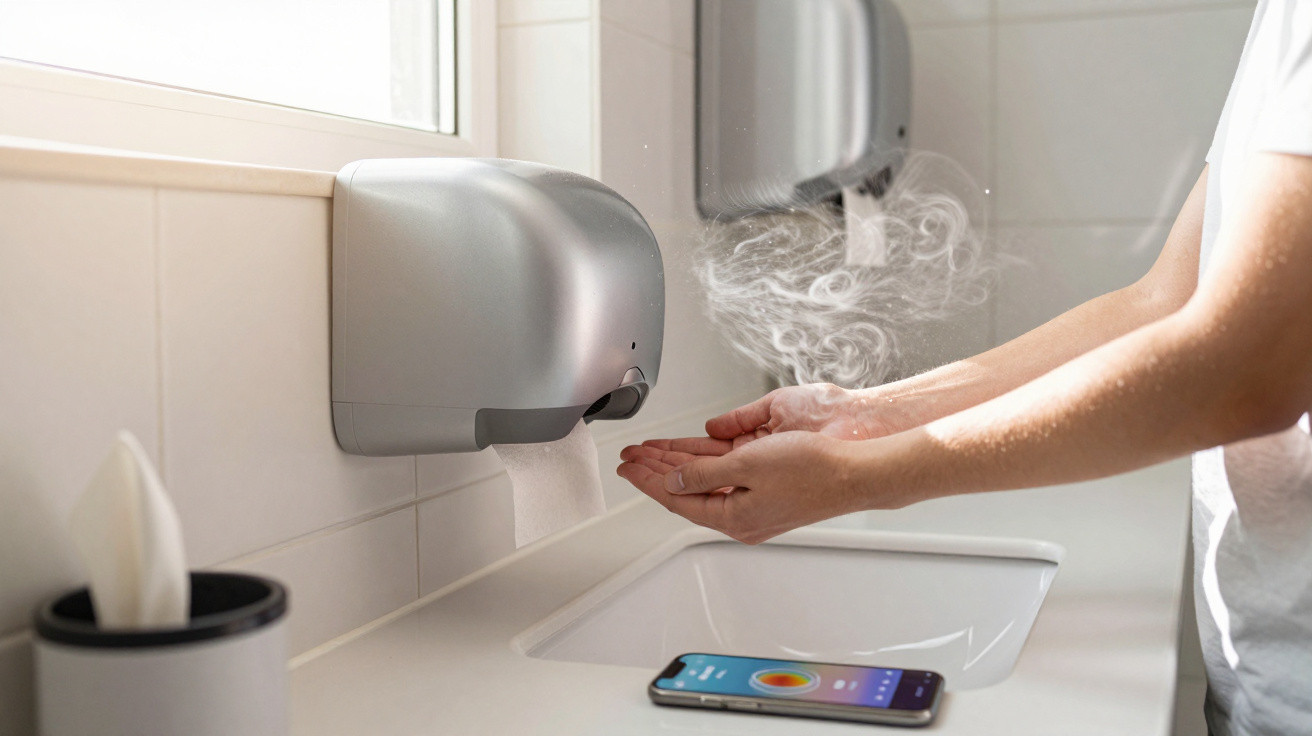
A British scientist has used straightforward methods to test what actually comes out of these machines’ air vents. Her findings have led many people to reach for traditional paper towels again – and prompted a rethink of an everyday hygiene routine.
A TikTok experiment unsettling millions
Ruth, a science teacher who shares classroom experiments on TikTok as “Devon Science”, set out to discover how much hand dryers disturb the air in a toilet – and what then lands on freshly washed hands. Rather than using complex laboratory equipment, she relied only on agar Petri dishes of the kind commonly used in school science lessons.
She placed one dish directly beneath the airflow of a hand dryer in a public toilet. A second was left in the laboratory as a control sample, exposed to comparatively clean indoor air. Both dishes remained open for the same period, before being sealed and kept warm.
After one day, dense yellow, black and white colonies had grown on the dish from the toilet – while the control dish was almost empty.
Visually, the contrast resembled a snow-covered field beside a dense, multicoloured lawn of mould. To non-specialists, it may simply look “disgusting”, but microbiologists see a clear indication: a hand dryer’s airflow carries large quantities of microorganisms onto anything in its path.
Which germs does a hand dryer blow onto your skin?
Analysis of colony-forming organisms such as these commonly identifies bacteria and fungi associated with toilet environments. Both studies and the recent experiment repeatedly point to three groups:
- Staphylococcus aureus: An organism found on skin and mucous membranes that can cause minor wounds, spots or abscesses, and which can develop feared antibiotic resistance in hospitals.
- Escherichia coli (E. coli): A gut bacterium that directly indicates faecal contamination and, in unfavourable strains, can cause diarrhoea and infections.
- Fungal spores: Black dots on agar can indicate moulds, which may irritate mucous membranes and worsen problems for allergy sufferers or people with weakened immune systems.
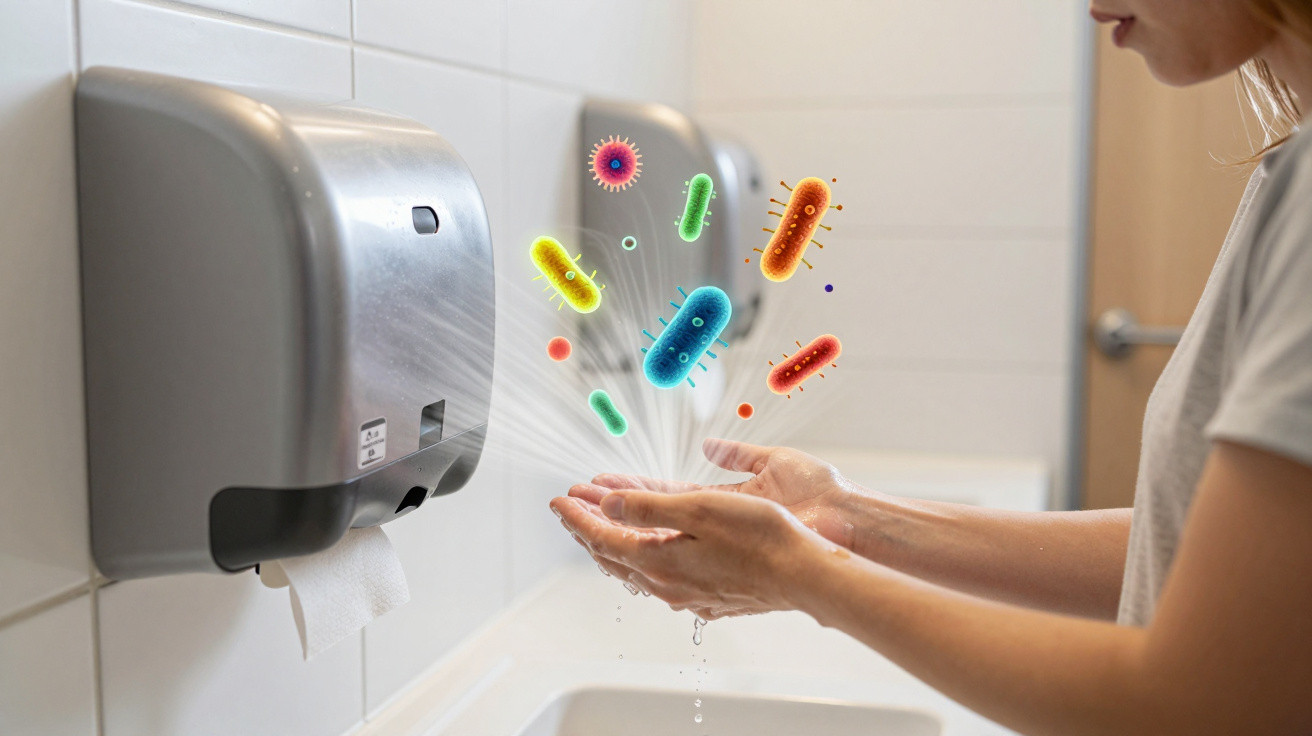
These microorganisms float in toilet air, especially after a toilet is flushed without the lid being closed. A hand dryer’s powerful air jet collects these particles, stirs them up and directs them in concentrated form onto hands, wrists and forearms.
The hand dryer problem: design and air speed
Modern high-speed hand dryers are built around one promise: hands should be dry within seconds – without paper and without waste. To deliver this, the machines use extremely fast airflow.
- Exceptionally high air speed: Manufacturers advertise airflows reaching several hundred kilometres per hour. Currents this strong can carry even heavier droplets and dust particles.
- Contamination inside the unit: In another test, the TikTok scientist swabbed the inside of a hand dryer with a cotton bud, which became noticeably dark. This suggests that dust, skin flakes, bacteria and moisture can accumulate inside over long periods.
Whenever the machine starts, this mixture is set in motion again. The result is a closed cycle: germs from the room settle inside the dryer, are stirred up again during the next use, reach newly washed hands, and then spread further through door handles or handrails on buses and trains.
Why this challenges many hygiene systems
In hospitals, care homes and canteens, hands should remain as germ-free as possible after washing because they are constantly in contact with vulnerable people or food. If the drying stage introduces fresh germs, entire hygiene chains are put at risk.
This is precisely the concern now being raised by some staff within the UK’s National Health Service (NHS), who have questioned their own hand-dryer provision in comments beneath the Devon Science video.
Can HEPA filters and UV light solve the problem?
For several years, the industry has tried to address these concerns through newer technology. Two approaches are particularly common:
- HEPA filters: According to manufacturers, these high-performance filters can remove up to 99.97 per cent of particles measuring roughly 0.3 micrometres or more from the air. In hand dryers, they are generally positioned before the air outlet and are intended to reduce the transport of larger germs.
- UV irradiation: Some premium machines incorporate ultraviolet light intended to kill bacteria inside the unit before the air is released back into the room.
Both ideas sound persuasive, but each has clear limitations. Filters gradually become blocked, lose effectiveness and need regular replacement – something that does not always happen in heavily used toilets. UV lamps only work where the airflow actually passes and where exposure time is sufficient.
Even with a technology upgrade, the hand dryer remains a device that draws in and blows out air from one of a building’s most germ-rich rooms.
In addition, many hand dryers in schools, restaurants and motorway service areas are older models without filters or UV units. They are often replaced only when they fail, while hygiene is rarely the decisive practical reason.
How does a hand dryer compare with paper towels?
Several independent studies have examined the familiar question: shaking hands dry, paper, cloth or air – which method reduces germs most effectively? The overall pattern is striking:
- Paper towels mechanically remove some germs from the skin through friction, after which they are thrown away.
- Warm-air dryers may dry hands, but can blow germs back onto the skin or at least fail to reduce them.
- High-speed dryers also disperse droplets and particles throughout the room.
Professional bodies therefore continue to recommend disposable paper towels for sensitive settings. In ordinary restaurants or shopping centres, however, the choice is usually driven by cost: paper creates ongoing expense and waste, whereas air dryers mainly require electricity and maintenance.
What you can do in everyday life
A public toilet will never be completely germ-free, but you can reduce your personal risk. Three simple measures already help many people:
- Wash thoroughly: Use soap for at least 20 seconds, including between the fingers and around the thumbs. Without proper washing, any drying method makes little sense.
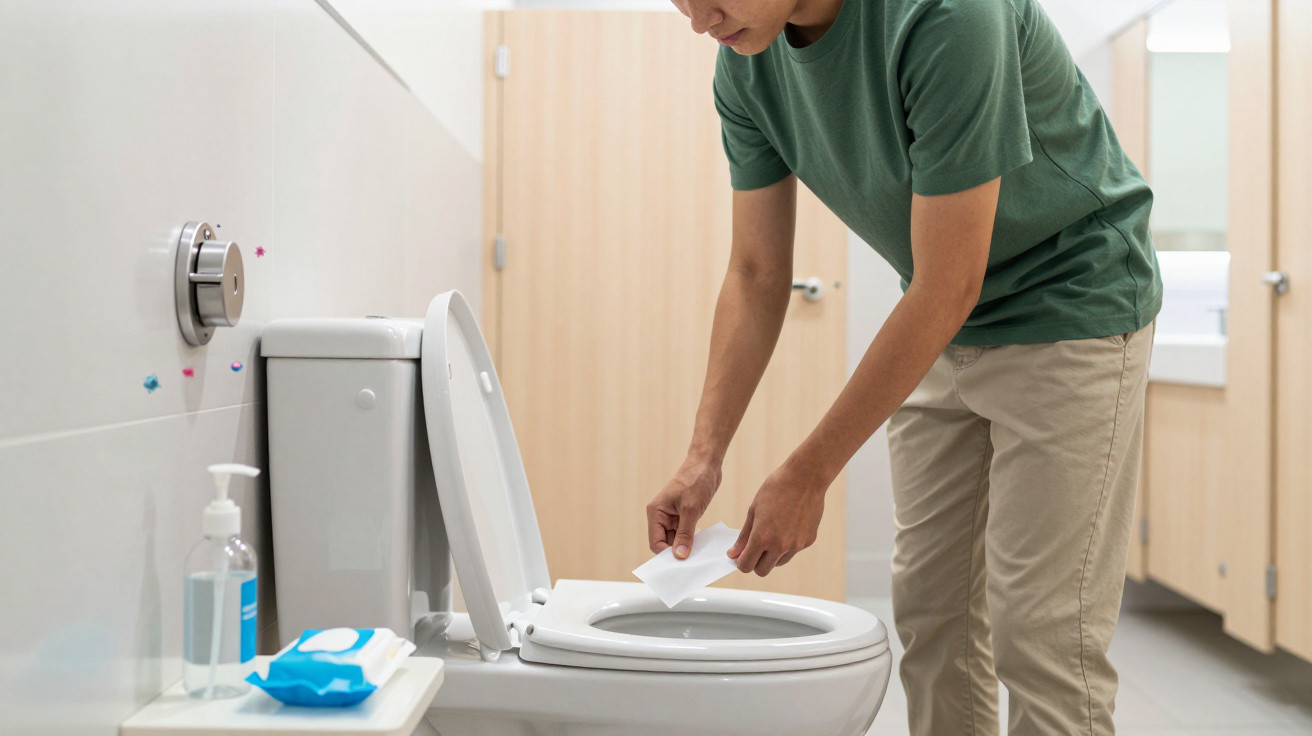
- Choose paper towels where possible: When both options are available, hygiene specialists generally select paper – and use it to open the door as well.
- Use a hand dryer briefly, or not at all: If there is no paper dispenser, avoid shaking hands, allow them to air-dry briefly and do not touch your face afterwards.
People with weakened immune systems, chronic lung conditions or open skin damage on their hands should take even greater care, as even a small additional germ load may cause problems for them.
Why toilets quickly become germ hotspots
One term appears repeatedly in discussions of this issue: “toilet aerosol”. It describes extremely fine droplets produced during flushing that spread around the room. They can contain bacteria and viruses from the water and the ceramic surface.
Flushing while standing and leaving the lid open creates a small cloud of droplets that slowly spreads through the space, settling on floors, sinks, walls and also on or inside the hand dryer. Some of these germs then remain there until the next burst of air lifts them again.
One seemingly minor action can make a real difference: close the toilet lid before flushing. This noticeably reduces the germ cloud, indirectly easing contamination of both hand dryers and washbasins.
What the TikTok video hype reveals
The Devon Science experiment is scientifically simple but highly effective in communication: many people are seeing for the first time what “air from a hand dryer” looks like on agar. The intense responses in the comments reveal how much trust had previously been placed in technological cleanliness – and how quickly that confidence changes when images are involved.
For operators of restaurants, cinemas and offices, this raises an uncomfortable question: is a modern stainless-steel hand dryer genuinely enough of a hygiene solution, or should paper towel dispensers return to the wall in greater numbers? The coming years will show whether more scientific evidence or viral videos are more likely to drive that change.


Comments
No comments yet. Be the first to comment!
Leave a Comment