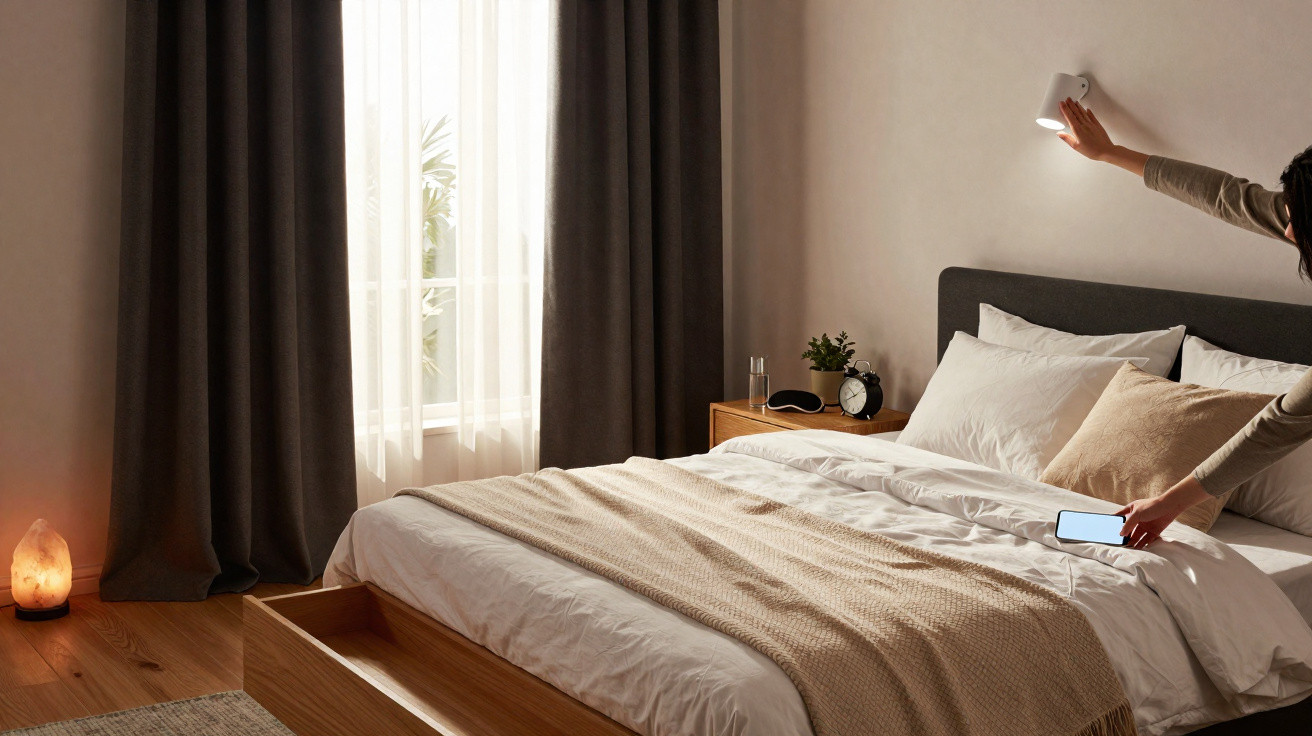
The bedroom is silent, the bedding is fresh, and your phone is finally set to silent.
Everything should be ideal. You get into bed, shut your eyes… yet wake up as though the night has somehow been taken from you. There is no crisis and no obvious insomnia, only that lingering feeling of being “not quite rested”, hovering over every morning like a grey cloud.
You put it down to work, stress, getting older or that late coffee. At 23:47, you scroll through sleep tips on TikTok, test herbal teas and buy a new pillow. Nothing makes a meaningful difference. You fall asleep quickly enough and barely recall waking during the night, but your mind remains in low-battery mode.
But what if the cause is not your mattress, job or genes, but an entirely harmless-looking feature of your room? Something that gradually chips away at deep sleep without drawing your attention. Something you probably see every night.
The invisible bedroom mistake quietly ruining your nights
One of today’s most overlooked sleep mistakes is straightforward: your bedroom resembles an office or a compact sitting room rather than somewhere to sleep. Lamps remain on, screens emit a glow, clothes are piled up, a laptop lies open on the floor and partly charged devices flash in the darkness. Your body receives one message from this setting: “We’re still on.”
Bedrooms now serve several purposes: a home office in daylight hours, a Netflix den at night and, sometimes, a makeshift exercise corner too. The calm, low-stimulation “sleep cave” has nearly vanished. When your brain cannot clearly register that “This place = sleep only”, it subtly reduces the quality of your rest. You will not necessarily notice at the time; you notice in the way you feel on waking.
During a rainy Tuesday in London, I watched a sleep physician inspect a couple’s bedroom for a television segment. It was a lovely room, with a large window, a soft rug and tasteful décor. Yet their sleep data on screen was dreadful: micro-awakenings, light sleep and unsettled breathing patterns. Still, they insisted they “slept fine”.
The doctor highlighted every cue associated with being awake: a bright vanity mirror left plugged in, a laptop open on a chair, a television mounted opposite the bed and a phone charger glowing at eye height. “Your brain sees this and thinks: activity, decisions, rewards,” he said. The couple gave a nervous laugh because it sounded extreme. He then asked one simple question: “When do you ever sit in this room just to rest, without a screen, without multitasking?” They looked at one another and had no answer.
Sleep specialists return to the same idea: the brain forms associations, much like shortcuts. Bed + darkness + nothing to do = time to sleep. Bed + emails + episodes + scrolling = conflicting signals. Across weeks and months, this weakens sleep depth. It is not always obvious or dramatic. You might fall asleep with Netflix playing and wake at the expected hour, so it feels “normal”. However, deep-sleep and REM cycles become disrupted.
It is similar to charging a phone with a cable that cuts out for a second every few minutes. In the morning, the battery may read 100%, but it runs down rapidly. A bedroom full of subtle “awake” cues can have the same effect. The issue is not one individual item; it is the room’s overall identity: somewhere your brain never completely switches off.
How to make your bedroom a genuine sleep space again
The strongest solution is not a gadget but a boundary: make the bedroom chiefly a place for sleep and intimacy, then arrange it around that principle. Begin with what you can see while lying on your pillow. Take away anything that signals “task”: a laptop, stacks of paperwork, a work bag or a television remote resting on a notebook. Conceal cables, chargers and flashing LEDs in a drawer or behind furniture.
Next, make the lighting gentler. Replace cool white bulbs with warm ones, choose a small bedside lamp rather than an overhead spotlight, and dim the room 60–90 minutes before bedtime. Keep the bedside table uncluttered: a glass of water, a book and perhaps earplugs. Each visible item should meet one test: “Does this help me wind down?” If it does not, move it elsewhere. It is a simple rule with a powerful impact.
We have all experienced a frantic evening: a late meal, emails from the sofa and one quick episode becoming three. You enter the bedroom with your mind still racing, clothes across the bed and notifications sounding. Falling asleep amid that disorder becomes so familiar that you forget what genuine calm feels like.
Try a different approach for one week. For 30 minutes before bed, do not bring fresh “day stuff” into the bedroom. No laptop, no sorting laundry, no half-open suitcase. Take two minutes - genuinely just two - to put away anything that is clearly unrelated to sleep. Fold the hoodie, shut the drawer and take the gym bag out. This is not about achieving perfection; it is about altering the message sent by the room. Your future self at 7 a.m. will quietly appreciate it.
“The goal is not a magazine-perfect bedroom,” says one sleep therapist I spoke with. “The goal is that the second you cross the doorway at night, your nervous system goes: Ah. Here, I can stop.”
Here are several small changes that build on one another:
- Move your work area into another room, or at minimum to a different wall where it cannot be seen from the bed.
- Charge your phone outside the bedroom, or far enough away that you cannot reach for it while half asleep.
- Use blackout curtains or an eye mask to block street lighting and early morning sunshine.
- Keep décor restrained: fewer posters and more clear wall space to create mental quiet.
- Keep the bed for sleep and sex only - not doomscrolling or replying on Slack.
Let’s be honest: nobody manages this perfectly every day. Life is untidy, and on some nights you will send one final email in bed or drift off with a podcast playing. That is fine. You are not trying to live in a monastery, only setting a clear direction. Every small decision that makes your bedroom feel more like a sanctuary and less like a shared workspace moves sleep quality upwards.
Small bedroom details that matter more than a mattress advert
After removing the obvious signs of wakefulness, a subtler layer remains: sound, temperature and visual clutter. Many people sleep in rooms that are a little too warm, a little too noisy and a little too bright. None may seem severe in isolation, but together they steadily undermine deep sleep.
A few trials can be revealing. Reduce the bedroom temperature by one or two degrees for a week and observe your morning energy levels. Use earplugs or white noise if you live near traffic or have thin walls. Switch off the hall light that leaks beneath the door. These adjustments may not look impressive on Instagram, but they affect how frequently your brain rises into lighter sleep stages overnight, even if you never wake fully.
Clutter also matters. This is not the fashionable version of “minimalism”, but the simple reality that visual disorder can make the body feel less secure. If your bedroom is full of belongings - an open wardrobe, an overloaded chair and piles of boxes - your brain can quietly remain alert, scanning its surroundings.
A sleep coach once described a client who altered nothing in her bedtime routine and simply spent one weekend clearing surfaces and shutting storage away. Her bed, waking time and job-related stress all stayed the same. Nevertheless, her sleep tracker showed steadier deep sleep over the following month, and she said she felt “oddly calmer” when getting into bed. Sometimes the most effective improvement is simply giving your eyes somewhere to rest.
The difficult aspect is that none of this seems urgent. You do not enter your bedroom and think, “Ah yes, this open wardrobe will cost me 18 minutes of deep sleep tonight.” You simply get on with life. During a busy week, sleep becomes another obligation to fit in rather than a space you deliberately prepare.
In practical terms, the bedroom often becomes the home’s “overflow room”: where unnoticed possessions accumulate, including clean laundry with nowhere to go, boxes from the last move and the broken lamp you may repair one day. Psychologically, it becomes a silent to-do list. Your eyes land on each object and your brain receives a brief reminder of unfinished business. These are tiny surges of stress that may not wake you, but can draw you away from true rest.
When people eventually make their room calmer, many report the same unusual response: the first few nights can feel almost too quiet and too empty. Then something gentle changes. You enter and your shoulders lower by a few millimetres. Your breathing deepens naturally. You do not actively “do” sleep better; it simply arrives more readily. That is when you understand the problem was never willpower or flawless routines. The room itself had been quietly telling you to remain alert.
Your bedroom is more than fabric and furniture. It sends a nightly message to your nervous system, repeated thousands of times each year. Change that message and the story of your sleep begins to shift. It may not transform you into someone who leaps out of bed at 5 a.m. to meditate and juice celery, and that is perfectly fine. But it can take your nights from “barely enough” to “deeply restoring”, without a miracle product.
The next time you wake tired and immediately blame yourself - too much coffee, too little discipline, too much Netflix too late - pause for a moment. Look around the room with fresh eyes and ask: “If this bedroom could talk to my brain, what would it say?” Is it murmuring “Rest”, or quietly yelling “Stay ready”?
You do not need to redecorate the entire room. It may begin with taking out the laptop, lowering one light, clearing one surface or closing one door. These are micro-changes, but every one steers the space towards a single identity: somewhere nothing is demanded of you. Somewhere you are finally off duty.
On an ordinary Wednesday night, months from now, you may lie down in a quieter, softer room and experience something you have not felt for a while. Not merely tiredness, but permission: the feeling that you have done enough today. Close your eyes. The world can wait beyond this door.
| Key point | Detail | Benefit for the reader |
|---|---|---|
| Bedroom identity | Transform the room from a multipurpose area into a sleep-first space | Improves deep sleep without complicated routines |
| Visual and light cues | Remove “awake” signals, including screens, cables and harsh lighting | Helps the brain enter rest mode more quickly |
| Subtle environmental adjustments | Adapt temperature, sound, clutter and light leaks | Reduces micro-awakenings and morning fatigue |














Comments
No comments yet. Be the first to comment!
Leave a Comment