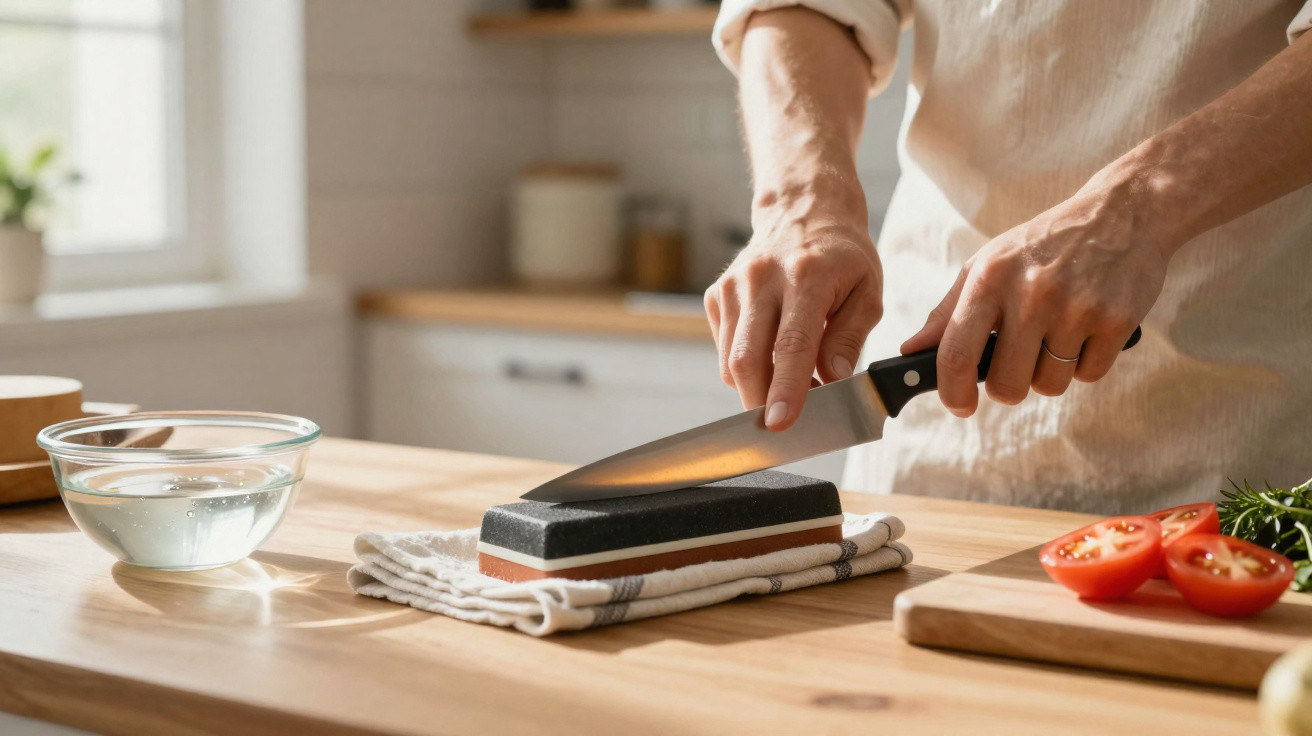
Sharpening a kitchen knife calls for more care than many tutorials suggest. A blunt blade makes cutting harder, yet trying to restore its edge with improvised objects can cause the knife to slip, damage the steel and create an accident risk on the worktop.
Why does a kitchen knife lose its edge through daily use?
A knife’s edge wears down when it comes into contact with hard chopping boards, bones, frozen food, ceramic plates, stainless-steel sinks and unprotected drawers. Over time, the blade’s microscopic edge bends, becomes rounded or develops small imperfections.
The issue is usually first noticed during straightforward tasks. A tomato is crushed before its skin is cut, an onion takes too much effort and meat slides beneath the blade. These signs mean the edge needs maintenance, not that you should apply more pressure with your hand.
Why can household sharpening tricks be dangerous?
Some techniques rely on rough surfaces, ceramics or objects not designed for sharpening. They may improve cutting performance for a few minutes, but they can also make the edge uneven, scratch the blade and raise the chance of slipping.
- The knife may move out of position and strike the supporting hand.
- Unstable objects can tip over or slide across the worktop.
- The blade can develop burrs that compromise precise cuts.
- The edge may become uneven, requiring even more force afterwards.
What is the safest way to restore a knife edge?
The safest option is to use purpose-made sharpening tools or take the knife to a professional, particularly if the blade is very blunt, chipped or bent. Honing steels, whetstones and domestic sharpeners all require technique, stability and attention to the type of knife.
Anyone without experience should ask an adult or someone accustomed to maintaining kitchen knives for help. The key precautions are to keep the blade facing away from the body, work on a secure surface and never attempt sharpening in a rush.
How do you know when a kitchen knife needs professional maintenance?
Not every blunt knife should be fixed at home. Where there is visible damage, it is best to avoid improvisation and seek proper maintenance, as a damaged edge can worsen with every poorly executed attempt.
- The edge has small serrations, chips or broken sections.
- The blade slips on food even when used with a controlled movement.
- The knife needs force to cut soft ingredients.
- The handle is loose, cracked or feels unsafe in the hand.
- The knife has already been sharpened several times without regaining its cutting ability.
A kitchen knife edge lasts longer with proper care
The best maintenance starts before sharpening is needed. Use a suitable chopping board, wash the knife separately, dry it promptly after use and store the blade in a holder, sheath or dedicated block, without allowing it to knock against other cutlery.
Restoring the original edge should not rely on dangerous improvisation. With correct storage, careful washing and maintenance carried out with suitable tools or by a professional, the knife cuts more effectively, lasts longer and makes everyday kitchen tasks safer.






Comments
No comments yet. Be the first to comment!
Leave a Comment