The cycle finishes, the dishwasher beeps, and for a moment there is that small household triumph: everything is done, the glasses are washed, and life feels vaguely organised. Then you open the door, the steam lifts… and there they are. Cloudy wine glasses. Dull tumblers. A faint white coating where there ought to be sparkle.
You run your thumb over one, peer at it beneath the kitchen light and start to question everything: is the dishwasher ageing, has the detergent changed, or are you asking too much of twenty minutes of hot water?
Someone you know insists expensive rinse aids are the answer. Your neighbour talks up a “miracle” tablet. Across social media, people seem to be putting half the produce aisle into their dishwashers.
Yet one modest yellow slice can quietly make all the difference.
Why glasses become cloudy in the first place
Before getting to lemon, it helps to understand what is clinging to the glass. That white coating is generally limescale: mineral residue from hard water that settles on smooth surfaces during washing and drying.
It is especially noticeable on glassware compared with plates. Its transparent surface reveals every calcium and magnesium mark, along with every tiny droplet that dried where it should not have.
The more dishwasher cycles your glasses go through, the more this hazy layer can appear to build up, leaving them with a “tired bar” look rather than a “freshly set table” finish.
Imagine a Saturday evening meal. You bring out your “good” wine glasses, the ones costly enough that you handle them with care. You arrange them gently on the upper rack, add your normal tablet, shut the door and select the eco programme.
Once the wash is complete, your guests are already pouring wine when you spot it: the glass no longer reflects candlelight as it once did. A light haze has formed, rather like a fingerprint that will not quite rub away.
You say nothing, but notice it again while putting the glasses back in the cupboard. It is only the slightest mistiness, yet it somehow makes the entire kitchen seem less crisp.
This coating results from several factors working together: water hardness, the amount of detergent used, wash temperature, and the length of time dishes remain in hot, humid air after the programme ends. When water contains too many minerals, every drying droplet leaves a small trace on the glass.
Eventually, those traces accumulate. In less serious cases, they are surface deposits you can tackle. In more severe cases, the glass itself becomes etched and loses its original transparency.
That is when a small, acidic and fragrant helper can quietly enter the picture.
The lemon slice trick for cloudy dishwasher glasses
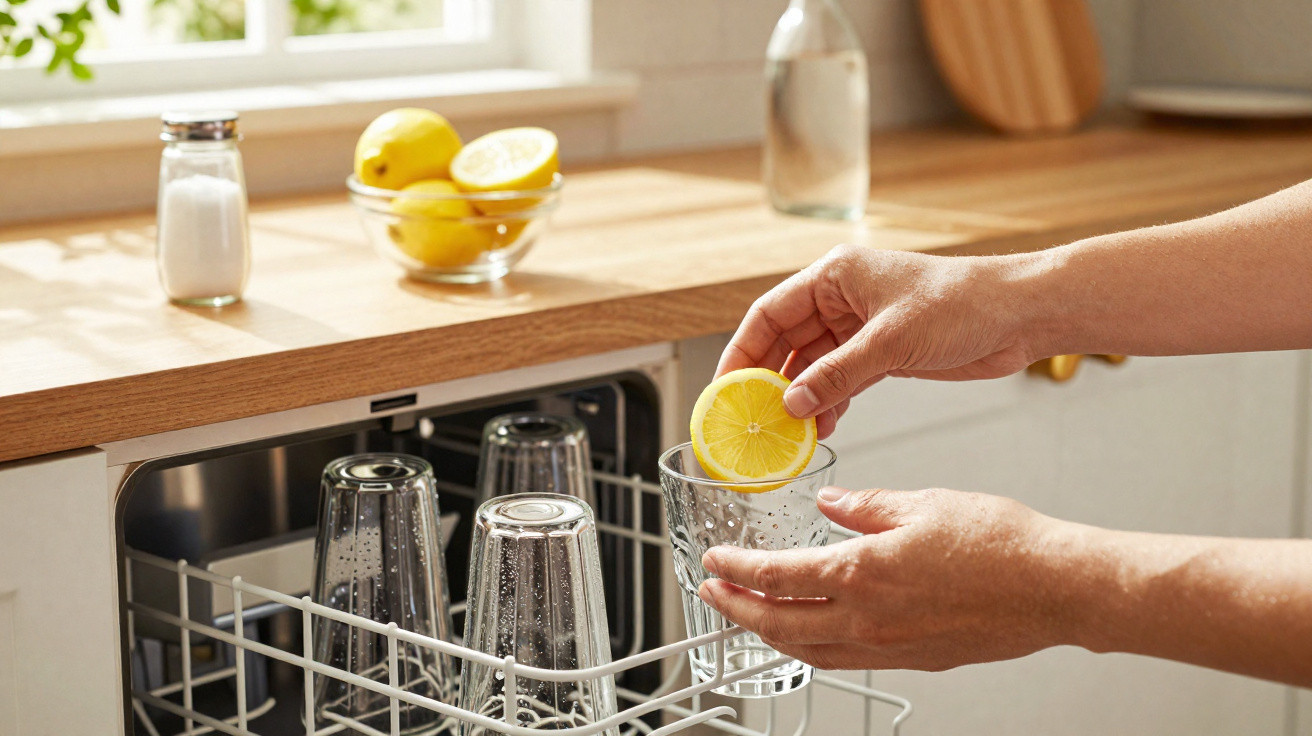
The technique people are talking about could hardly be simpler. Before switching on the dishwasher, take a fresh lemon, cut one or two thick slices and place them straight into the cutlery basket or on the upper rack. Then run your usual programme. Keep the same detergent and settings.
Lemon is not a substitute for detergent. It has another job, acting almost as a natural assistant. It releases citric acid into the wash water, gently loosening limescale deposits and making it harder for new ones to cling so firmly.
When you open the door, your glassware suddenly catches the light again. It seems a little like a magic trick, except the source was the fruit bowl rather than a chemical laboratory.
In plenty of homes, the idea began almost by chance. Someone had half a lemon left from marinating chicken, did not want to waste it, put it in the dishwasher “to freshen things up”… and then noticed how bright the glasses looked.
The advice then travelled by word of mouth and later through those short, addictive videos: a hand setting a lemon slice on the rack, a close-up of cloudy glasses, followed by the reveal - crystal-clear stems, no filter.
One woman even tried it methodically for a month. She used the same dishwasher, detergent and cycle throughout. During the weeks she used lemon, her wine glasses and jars remained visibly clearer. In the weeks without it, the whitish film started to return. It was not a laboratory study, but it was highly persuasive when she looked at her own cupboard.
The underlying science is reasonably simple. Citric acid is a mild acid which reacts with the calcium and magnesium in limescale, helping to break it down and keep it in the water rather than stuck to your glasses.
Lemon’s natural oils bring a mild degreasing benefit too, along with the fresh aroma noticeable when you open the door. It is not as powerful as a standard dishwasher cleaner, but it can provide a useful lift during everyday washes.
The key is that the lemon is working with your machine, not against it. Your usual routine stays the same while the fruit quietly improves the result.
How to use lemon in the dishwasher safely
The practical method is straightforward. Take a fresh lemon and cut 1 or 2 rounds roughly 1 cm thick. Remove any obvious seeds, then put the slices in the cutlery basket or lay them flat on the upper rack, ensuring they cannot obstruct the spray arms.
Run your programme as usual, preferably choosing one that is not ultra-short so the lemon has enough time to disperse. A single slice will normally do for a standard load; use two where water is very hard or limescale remains a persistent issue.
After the cycle, put the used lemon into the compost or bin. Do not save it for a further load, as it has already done what it can.
There are a few mistakes worth avoiding. Do not overfill the dishwasher on the basis that lemon will somehow make it clean more effectively. It will not. Overcrowded racks still cause glasses to knock together, sit at awkward angles and prevent water from circulating properly.
Avoid putting in whole lemons or large halves, as they may obstruct the spray arms or become wedged against delicate glasses. Thin slices are both safer and equally effective.
And yes, some people leave them in the machine for days. Honestly, no one manages this perfectly every day. Just do not allow old slices to linger between washes, or the fresh fragrance will be replaced by rather sad, dried-out peel.
“Using lemon in the dishwasher won’t turn an old, failing machine into a new one,” notes one appliance technician. “But for a functioning dishwasher with hard water, it can noticeably improve the clarity of glassware at almost no cost.”
- Where should the lemon go? In the cutlery basket or on the upper rack, clear of the spray arms.
- How often should you use it? Once or twice a week, or whenever you are washing plenty of glasses.
- Which lemon should you choose? Any fresh yellow lemon, organic if you prefer, with the rind left on.
- What about limes? They contain citric acid too, but their slices are smaller and may slip through baskets.
- Can commercial rinse aid be skipped? You may be able to use less, but lemon should not be expected to do everything.
Beyond the trick: what this small slice can change
A lemon slice will not fix every domestic problem, but it subtly changes the daily routine. You cook, eat, clear away and load the dishwasher… then add one easy, sensory step that smells of summer and feels a little resourceful.
Many people say that, once they begin, it is difficult to stop. The appeal is not only clearer glasses, but also the quiet pleasure of using something natural, simple and clever. It is one of those unseen habits that makes a kitchen feel more looked after.
It can raise broader questions too. How many other “old” household tips have been abandoned in favour of specialist products? How much fruit, peel and leftover food might have another use before being thrown away?
The next time you spot that dull coating creeping over your glasses, you may view the fruit bowl differently. You might even pass the experiment on to someone else who is privately irritated by cloudy wine glasses.
| Key point | Detail | Value for the reader |
|---|---|---|
| Natural descaler | Lemon’s citric acid helps dissolve limescale residue on glass | Shinier glasses without buying extra products |
| Simple routine | Place 1–2 slices in the cutlery basket or top rack each cycle | Easy to adopt, no need to change dishwasher settings |
| Low-cost experiment | Uses leftover lemon pieces you might otherwise throw away | Reduces waste while improving everyday results |








Comments
No comments yet. Be the first to comment!
Leave a Comment