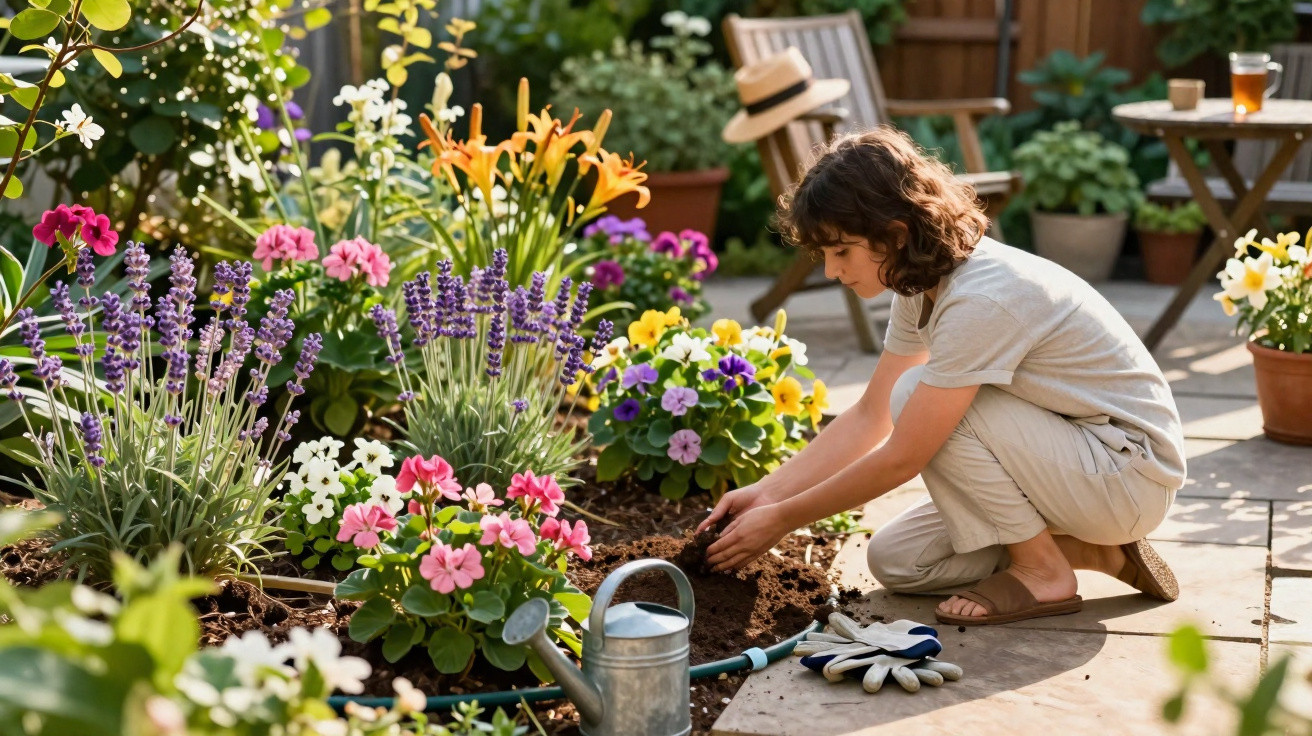
With the right perennials, this works surprisingly well.
Many amateur gardeners want flowers but do not have time for constant upkeep. This is where tough, hardy perennials come in. They return with new growth every year, cope with unpredictable weather better than demanding ornamental plants, and, with a little planning, keep the garden colourful for many months.
Why hardy perennials are so valuable
Perennials are plants that die back above ground in autumn and return in spring. Annuals, by comparison, flower for only one season and need planting again every year. Choosing long-lasting planting saves money, time and the backache caused by continual bending.
Hardy perennials forgive watering mistakes, cope better with hot spells and are not easily defeated by heavy rain.
Garden experts are increasingly pointing out that extreme weather, including heavy rain, late frosts and prolonged dry periods, is becoming more common. Anyone preparing their garden for this should choose varieties that can handle these fluctuations – and those are precisely the plants featured here.
Eight especially resilient perennials for busy and low-maintenance gardens
1. Yarrow – the tough choice for dry conditions
Yarrow has a bushy habit, can grow up to 1 metre tall and produces flat flower clusters in white, yellow, orange or pink. Its finely divided leaves have a fern-like appearance. It handles wet ground just as well as extended dry spells.
- Position: full sun to partial shade
- Soil: relatively poor and free-draining
- Watering needs: low; water only during prolonged drought
Cutting it back after its first flush of flowers encourages a second wave of blooms. Once it has earned a place in the border, it is hard to imagine doing without it – especially as it also lasts well in a vase as a cut flower.
2. Coneflower (Echinacea) – a long-serving bee magnet
Coneflower is among the most popular perennials for wildlife-friendly gardens. Its large, daisy-like flowers, with the characteristic “hedgehog head” in the centre, attract bees, bumblebees and butterflies. The plant is far tougher than its delicate appearance might suggest.
Many varieties originally come from North America, where they must cope with hot summers and sparse soils. Those who select types that perform well in their local climate can enjoy them for many years.
Coneflower is ideal if you have little time but want to bring plenty of insects into the garden.
3. Fragrant Solomon’s seal – a long-lasting shade specialist
Known as Solomon’s seal, this plant stands out for its graceful, arching stems and silvery-green foliage. Many varieties produce bell-shaped flowers in white or pale violet during spring or early summer. Their subtle fragrance brings an airy feel, particularly to partially shaded spots.
Over time, the plant spreads without immediately taking over the entire area. Solomon’s seal is usually an excellent choice for greening a difficult patch beneath trees or behind the garden shed.
4. Catmint – an easy-care repeat bloomer with aromatic appeal
Catmint is one of those perennials that is easy to forget about – until it is suddenly in full flower again. It produces blue-violet flower spikes, has a pleasant scent and attracts insects. Many gardeners say they barely need to intervene, as this perennial returns reliably year after year.
- Ideal for sunny, dry positions
- Requires very little fertiliser
- Often flowers again after being cut back in summer
Cats sometimes love the plant so much that they roll around in it. To prevent this, place it in a more protected spot or grow it in larger containers.
5. Purple stonecrop – water-storing foliage for drought stress
Purple stonecrop (Sedum) stores water in its thick, fleshy leaves. This allows it to withstand weeks of drought, which have become common on many south-facing balconies and in front gardens. In late summer, it develops pink to purple flower heads that remain attractive into autumn.
If you do not want to keep thinking about the watering can, stonecrop is a safe choice.
The dried flower heads can be left in place over winter. They provide structure, look attractive in frost and can simply be cut back in early spring.
6. Daylily – each flower lasts one day, but the display lasts for months
Daylilies get their name because each individual flower lasts for only a day. That may sound short-lived, but it is misleading: the plant produces so many buds that fresh flowers continually open. Many varieties bloom from June to August, while some continue even longer.
They tolerate both full sun and partial shade, and perform very well in ordinary garden soil. For an easy-care ribbon of flowers along a border edge, daylilies combine well with ornamental grasses.
7. Cranesbill – a dependable flowering ground cover
Cranesbill (Geranium) is an ideal option where borders need to fill out densely without demanding daily attention. The plant forms a loose green cushion and, depending on the variety, bears blue, pink or white flowers.
- Suppresses weeds through dense growth
- Suitable for sunny to partially shaded positions
- Many varieties remain reliable and vigorous for years
A light trim after the main flowering period encourages fresh foliage and keeps the plant compact.
8. Lavender – a fragrant classic for sunny places
Lavender has long been more than a holiday souvenir from the south. Many varieties are hardy enough to overwinter without difficulty in central Europe. The key requirement is very free-draining soil, so that the roots do not sit in water during winter.
This plant offers several benefits at once: it is fragrant, attracts insects, works well in pots on a balcony or patio, and can be dried for scented sachets. Pruning in spring keeps it shapely and prevents excessive woody growth.
Which perennial suits which garden?
| Plant | Ideal for | Particular advantage |
|---|---|---|
| Yarrow | Full sun, little water | Tolerates drought and heavy rain |
| Coneflower | Insect-friendly borders | Powerful magnet for pollinators |
| Solomon’s seal | Partial shade, woodland edge | Brightens challenging locations |
| Catmint | Sunny, dry areas | Long flowering period, strong fragrance |
| Stonecrop | Heat, drought | Hardly any watering required |
| Daylily | Border edges, banks | Succession of flowers for months |
| Cranesbill | Gaps in borders | Effective weed-suppressing ground cover |
| Lavender | Sunny front gardens, containers | Fragrance, insects, use as a scented herb |
How little care these perennials really need
They are not entirely work-free, of course, but the maintenance involved remains limited. A few basic rules are usually enough:
- In spring, cut old dry leaves and stems back close to ground level.
- During the first few weeks after planting, water regularly until the plants have established roots.
- Keep the soil covered with mulch or neighbouring plants where possible, so it does not dry out.
- Do not over-fertilise – many hardy perennials actually prefer leaner soils.
Anyone who follows these simple steps will be rewarded with flowers year after year, without constantly running through the borders with secateurs and a watering can.
Why a low-maintenance perennial garden pays off twice
Gardens dominated by hardy perennials benefit in several ways. On the one hand, maintenance requirements fall considerably. On the other, lasting structures develop that support insects, birds and other animals. Tall flower stems, dense foliage and dead stems provide food and shelter.
At a time when many local authorities are dealing with heat stress, heavy rainfall and declining biodiversity, a resilient perennial garden can make a small difference. Replacing gravel areas with flowering borders improves the microclimate, retains more water in the soil and creates habitat – without needing to stand ready with a hose every evening.
This approach also benefits people with limited time, changing work patterns or reduced physical strength. Once well established, such a garden continues for years. Individual gaps can be filled with new perennials, while offsets can be shared or planted elsewhere. In this way, the garden gradually develops into a stable, low-maintenance system.














Comments
No comments yet. Be the first to comment!
Leave a Comment