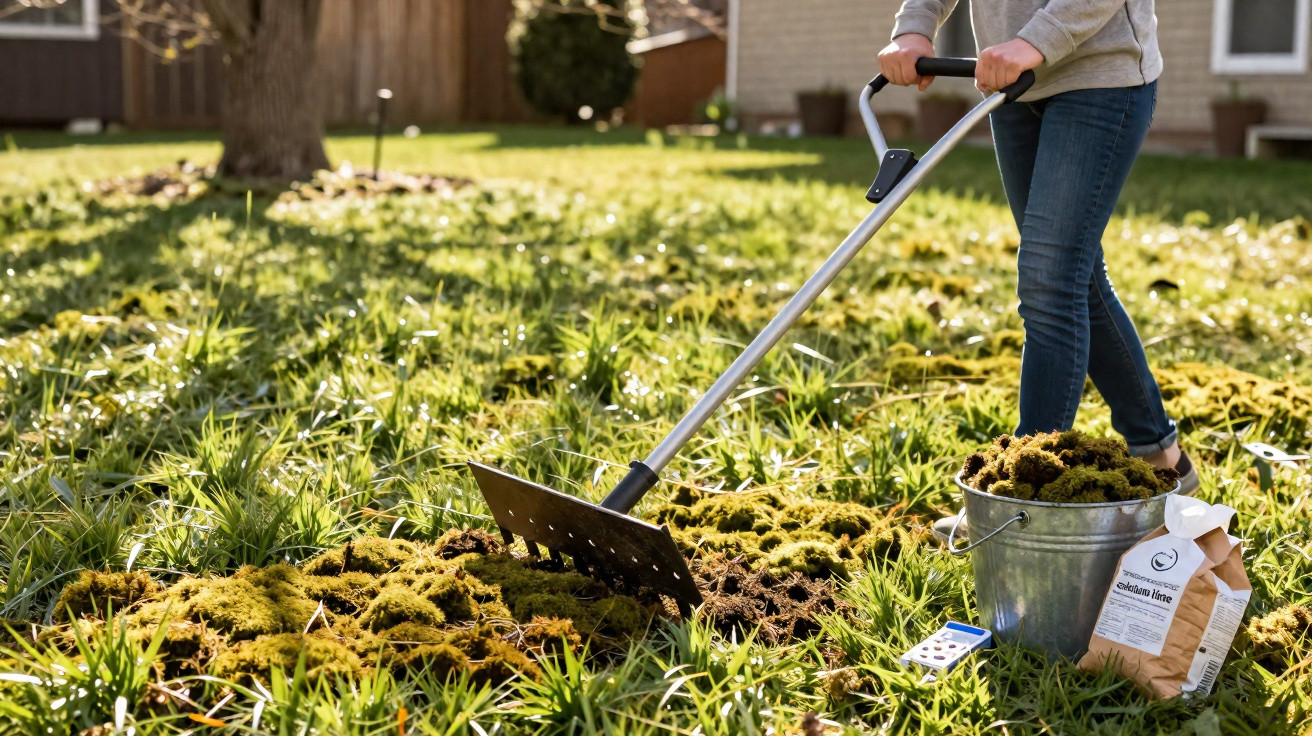
After months of rain and frost, plenty of lawns end up feeling less like a resilient green carpet and more like a saturated bath mat.
Step outside on a mild morning in March and you may feel the ground give way beneath your shoes, with grass overtaken by vivid, springy moss. This squashy feeling is not simply a passing seasonal oddity. It is a clear warning from the soil, one that professional landscapers know how to interpret - and address - through a fairly straightforward routine.
Why your lawn becomes spongy each spring
Shade and retained moisture: ideal conditions for moss
Following winter, soil is commonly cold and thoroughly waterlogged. Weak sunshine, tall fences, boundary walls and established trees can all create long periods of shade precisely when grass needs daylight to recover. Moss flourishes in these cool, poorly lit areas.
Moss has no need for deep roots or fertile ground. It can survive in places where grass finds it difficult: wet, compacted and shaded spots that rarely dry properly. When there is little light and the lawn surface remains damp for several days, grass blades become weak and sparse. Moss then rapidly covers the exposed areas with its bright green growth.
When moss spreads fast in late winter or early spring, it usually means the spot suits moss far better than grass.
This does not mean that the lawn cannot be saved. It simply indicates that growing conditions are favouring moss rather than grass. Improve those conditions and grass can gradually reclaim the space.
Compacted soil: the unseen problem beneath your feet
Children playing, frequent mowing, garden gatherings and heavy winter rainfall gradually compress soil. Ground with a high clay content is especially susceptible. The outcome is compacted soil: dense, hard and lacking sufficient oxygen.
Grass roots require pockets of air both to breathe and to grow further into the ground. As soil becomes compressed, these spaces disappear. Roots are left sitting in a close-packed, heavy layer of mud, causing them to weaken and eventually die back.
Moss, on the other hand, spreads across the surface. Because it does not depend on a deep root system, it gains a considerable advantage once the soil has formed a hard pan.
Spongy underfoot on top, rock hard a few centimetres down: that contrast is a classic sign of compaction.
What moss is actually revealing about your soil
Acidic soil gives moss a welcome advantage
Heavy moss growth can often be nature’s indication that soil has become more acidic. Lawn grasses tend to grow best in neutral to slightly alkaline ground, usually at around pH 6 to 7.5.
As pH falls, soil chemistry changes too. Nutrients including phosphorus and potassium become more difficult for grass roots to take up. Even where fertiliser has been used, the lawn can still appear pale and undernourished. Moss is far less demanding, so it readily takes over the available space.
A simple soil-testing kit can provide an approximate pH result in minutes. Rather than making assumptions, many landscapers carry out this test quietly in early spring before choosing a treatment.
Poor drainage leaves roots sitting in cold water
If rain remains in puddles, or the lawn surface continues to look wet long after a shower, drainage is probably inadequate. Water is being held near the surface, leaving the root zone saturated.
Roots need air as well as water. When they remain submerged for long periods, they are deprived of oxygen and can begin to rot. Grass becomes yellow and patchy, while moss benefits from the uninterrupted moisture.
- Waterlogged areas encourage moss and disease.
- Freely draining soil helps grass remain thick and robust.
- Quick-drying sandy ground may require more organic matter rather than improved drainage.
Persistent surface water is less about “too much rain” and more about soil that can’t move that water downwards.
The early-spring lawn rescue used by landscapers
Scarifying: a harsh-looking clear-out that benefits grass
The first step taken by many professionals is scarification. This involves running a scarifier - a rake-style tool with sharp blades, available in manual and powered versions - deeply across the lawn surface.
Its blades pull up moss, dead grass and the thick layer of “thatch” that accumulates over time. During the process, the lawn may look alarming, appearing brown, bare and badly damaged in places.
However, removing this material is essential. It allows water and air to reach the soil rather than being trapped beneath a suffocating surface layer. Landscapers often compare the process to giving the lawn a deep breath.
Scarifying feels brutal for one afternoon, then opens the door to months of healthier growth.
Aeration: creating space for the soil to breathe
Clearing the surface does not resolve the deeper problem of compaction. Aeration addresses this by making holes in the soil. You can do this using a garden fork, a plug aerator that extracts small cores of soil, or spiked aerator shoes worn over boots for lighter work.
These holes form channels through which oxygen, nutrients and rainwater can move down into the root zone. With repeated aeration over time, the compacted layer begins to break apart, encouraging grass roots to grow deeper. This helps anchor the lawn and makes it more resistant to stress and drought.
Many landscapers carry out this work in March or early April, once the soil can be worked but before it becomes dry. Aerating a lawn that is fully saturated will only increase compaction.
Correcting the soil gently to prevent moss returning
Light liming: moving pH gradually towards neutral
Where a pH test confirms that soil is overly acidic, a modest application of lime - such as garden lime or dolomitic lime - may be useful. The intention is not to force a dramatic change in pH, but to interrupt the conditions that give moss an advantage.
The product is generally spread evenly on a dry day using a spreader, then rain is allowed to work it into the soil. Landscapers emphasise the importance of restraint, as excessive lime can restrict nutrient availability just as too much acidity can.
Think of lime as a gentle correction, not a chemical sledgehammer.
Overseeding bare areas so moss cannot move in
Scarifying often exposes bare sections of lawn. Leaving this soil uncovered creates an opening for a new flush of moss or opportunistic weeds. Overseeding - scattering fresh grass seed across existing turf - can make a significant difference at this stage.
Seed mixtures intended for shade, heavy use or children’s play lawns make it easier to select grass suited to each part of the garden. Lightly rake the seed into the surface, then keep it consistently moist for several weeks. As new grass fills the gaps, the turf grows denser, shading the soil and physically crowding out moss.
| Problem area | Best grass seed type |
|---|---|
| Beneath trees or beside north-facing walls | Shade-tolerant mix, often containing fescues |
| Children’s play areas and footpaths | Hard-wearing, sport or high-traffic mix |
| Decorative front lawns | Fine ornamental mix, with regular mowing |
March lawn care for firmer ground all year
Combining straightforward jobs for a lasting result
Used together, scarifying, aerating, light liming and overseeding deal with the three main causes of a spongy lawn: insufficient air, excessive surface moisture and unsuitable soil chemistry.
Within a few weeks, grass will generally respond by producing thicker blades and taking on a richer colour. Even after rainfall, the lawn should gradually feel firmer underfoot. Regular mowing at a sensible height, rather than cutting the grass extremely short, will then help maintain this renewed vigour.
Most “miracle” lawn transformations are not miracles at all, just consistent, targeted maintenance.
Common gardening terms and what they actually describe
Two terms frequently used in professional lawn advice deserve explanation: “thatch” and “drainage”. Thatch is the matted layer of old clippings and dead stems that lies between the soil and living grass. A small quantity helps protect the lawn, but too much behaves like a sponge and a barrier, holding water while preventing air from entering.
Drainage describes the speed at which water travels through the soil profile. On a sloping garden with sandy ground, water may disappear too rapidly, leaving grass short of moisture. On level, heavy clay soil, it can remain on the surface. These extremes require different solutions: sandy soils benefit from added organic matter to retain moisture, while clay soils need sand and compost alongside regular aeration to create open channels.
Situations, risks and small changes with major effects
What happens if you leave a mossy lawn alone?
A moss-covered lawn may seem harmless if you enjoy its appearance. In time, though, the underlying grass becomes even weaker. Patches of bare soil widen, wet weather creates muddy areas, and any later attempt to restore the lawn is likely to be more difficult and costly.
There is a risk of slipping as well. Dense moss on wet, compacted ground can become unexpectedly slippery, particularly on slopes and around patios.
Lawn care choices that also support wildlife
Many gardeners would like both a tidy lawn and greater biodiversity. These objectives can work together. A healthy, well-drained lawn can accommodate patches of clover, daisies or a small wildflower strip around the edge without deteriorating into mud.
Physical techniques such as aeration and scarifying reduce the need for repeated applications of harsh chemicals, helping preserve more soil life. Earthworms in particular benefit from looser ground, and in return they naturally improve its structure and drainage over time.
For anyone looking at a luminous green blanket of moss this spring, the message from professional landscapers is simple: a soft, sponge-like lawn needs air, balance and room for grass to establish itself. The answer is not usually a secret product, but a practical physical routine repeated annually as winter finally turns to spring.














Comments
No comments yet. Be the first to comment!
Leave a Comment