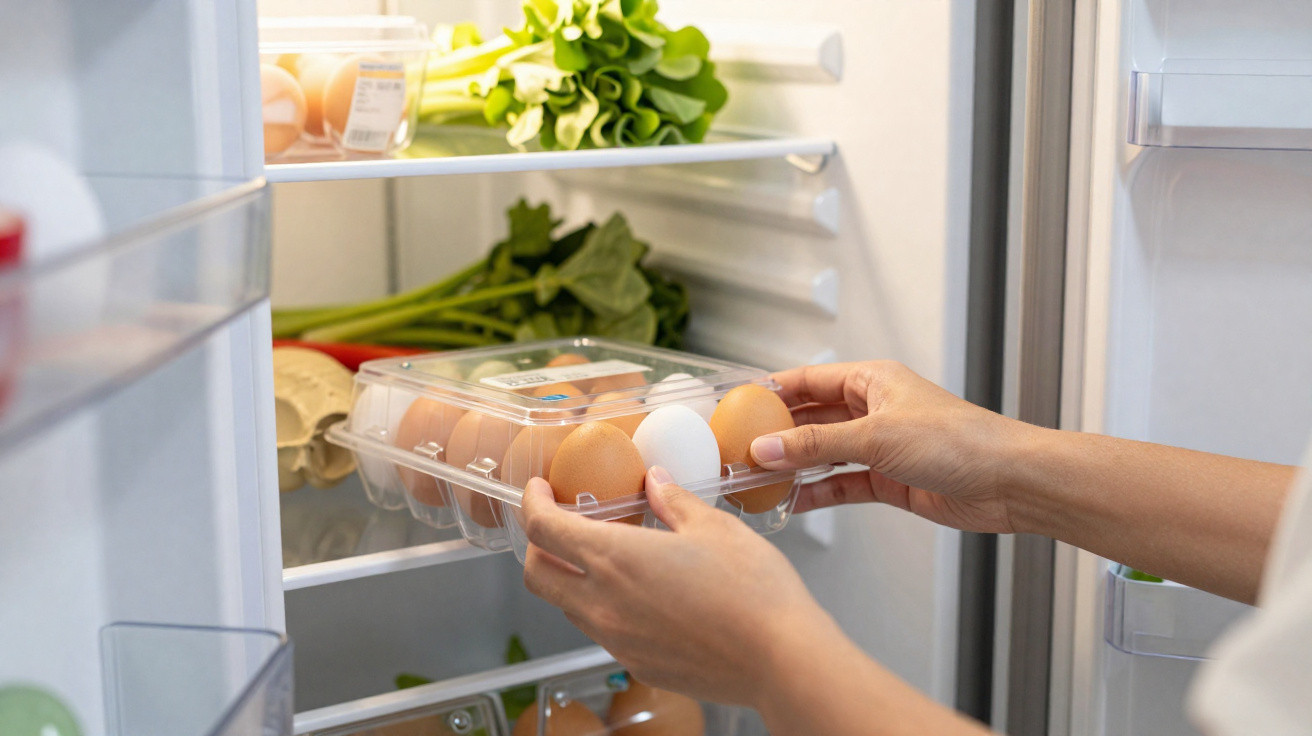
Opening the fridge often prompts an almost automatic move: you reach for the door and place fresh eggs in the moulded slots provided. It seems sensible, tidy and simply “the way it is done”. Yet recent guidance from manufacturers and food experts suggests that this compartment was originally intended for something quite different – and that this familiar kitchen habit conflicts with what eggs actually need.
Why the egg compartment in the door is a problem for fresh eggs
A quick look at the physics inside your fridge explains why. The door is the warmest and least stable area of the entire appliance. Every time it is opened, warm air enters precisely this section.
“Fresh eggs prefer consistency: fluctuating temperatures put strain on the shell and increase the risk from germs.”
European food safety authorities have pointed this out for years: eggs should be kept at a consistently cool temperature wherever possible. The fridge door provides the exact opposite:
- frequent temperature changes every time the door is opened
- a higher average temperature than the middle shelf
- direct exposure to warm room air
Whenever the temperature changes, moisture can form on the shell. This condensation may make it easier for microorganisms to pass through the porous eggshell. That sounds more alarming than it often is in everyday life, but the risk does increase slightly – especially when eggs are stored this way for several days or weeks.
What the small plastic egg holder was actually designed for
The obvious question is this: if the door is not an ideal place for fresh eggs, why do manufacturers fit this compartment at all?
Several appliance makers and household experts point to the original purpose behind the design: the insert was primarily meant for eggs that had already been boiled, rather than fresh ones.
“The door compartment was intended as a practical place for hard-boiled eggs and other ‘snack reserves’ – easy to reach, clearly visible and ready to eat.”
During the 1970s and 1980s, many families planned meals more carefully in advance. Hard-boiled eggs for salads, school sandwiches or Sunday brunch were often prepared and kept in the fridge. This is exactly where the industry saw a need: a small, limited holder for a few cooked eggs, not for an entire weekly shop.
Its often modest capacity supports this idea. Many of these inserts hold only four to six eggs, while a standard box of ten will rarely fit in full. There is enough room for several prepared snacks, but not really for storing a complete supply.
Why we all use it “wrong” – and hardly anyone notices
Eating habits changed over time. Fewer people now boil eggs in advance, but the plastic component in the door remained and its original purpose faded from view. The egg-shaped moulds looked like storage for eggs – and the rest followed naturally.
As a result, many households use the insert for fresh eggs without ever seeing an obvious problem. Modern fridges are also much better insulated, meaning temperature peaks are often less severe than they were in older appliances.
Even so, experts now recommend a different approach, especially for households with children, older people or anyone with a weakened immune system.
How to store fresh eggs properly
The good news is that there is no need to reorganise your entire fridge. A few straightforward rules can make a clear difference.
The best place in the fridge
- Keep fresh eggs in their original cardboard carton on a middle or upper shelf.
- Leave some space between them and the back wall so that nothing freezes.
- Do not store the carton beside strongly scented foods such as fish or onions.
The cardboard carton protects eggs from odours and knocks. It can also contain any cracks or small leaks, which is particularly useful in fridges used to store supplies.
What is best avoided
“The fewer temperature changes your eggs experience, the better their quality and safety are preserved.”
- Avoid moving eggs from warm conditions to cold ones and back again wherever possible.
- Do not repeatedly take the carton out merely to check how many eggs remain.
- Do not wash eggs before putting them away, as this can damage the natural protective coating on the shell.
If you buy very dirty eggs, clean them only shortly before using them rather than beforehand. The fine, invisible protective layer on an eggshell works like a natural filter against microorganisms. Water and rubbing weaken this coating.
When the fridge door compartment can still be useful
The compartment in the fridge door is not completely pointless. You can use it deliberately – just not in the way many people assume.
| Situation | Use of the egg compartment |
|---|---|
| Hard-boiled eggs for the following day | Ideal: easy to grab for snacks or salads |
| Easter eggs that have already been boiled and coloured | Neat, clearly organised storage for several days |
| A weekend breakfast buffet | Cooked eggs can be kept ready in the door while other shelves remain free for larger foods |
For raw eggs, the door is better suited only to short-term use: for example, if you are baking or preparing a larger meal that same day and the eggs will sit there for only a few hours.
Common misconceptions about eggs in the fridge
Do eggs always need to go in the fridge?
In many countries, eggs are sold unrefrigerated on supermarket shelves. After buying them, the question is whether to keep them cold at home. In Central Europe, experts advise refrigerated storage because eggs are often kept for a long time and supply chains are designed around chilling.
The key point is this: once eggs have been stored in the fridge, they should stay there. Repeated changes between room temperature and refrigeration put stress on the shell and therefore on its protective function.
Round end, pointed end, or pointed end down?
Many people place eggs in the moulded slots with the pointed end facing down. Others prefer to keep them lying flat in the carton. For shelf life, experts generally recommend storing eggs with the pointed end down. This keeps the air cell at the top and means the delicate yolk touches the shell less firmly.
However, the shape of most door compartments does not enforce any particular position. That is another indication that they were more likely intended as a convenient holder for already cooked eggs, rather than a perfect long-term storage system.
What can happen if eggs are stored badly
Most fridges forgive everyday mistakes, and not every egg kept in the door compartment automatically becomes a risk. Nevertheless, it is worth considering the possible consequences.
- Bacteria such as salmonella are more comfortable in warm temperatures than in steady cold conditions.
- Cracks in the shell make it easier for germs to reach the inside of the egg.
- Condensation can mobilise microorganisms on the surface.
For healthy adults, a lightly contaminated egg may cause no more than stomach upset. For children, pregnant people and older adults, the situation can be different. Anyone in a higher-risk group benefits particularly from careful storage and thoroughly cooked food.
How to improve your own fridge quickly
Picture a typical Sunday morning: the fridge is well stocked, breakfast is ready and the family is sitting at the table. You open the door and reach for the milk – while the eggs beside it have been rocking in the door for days or weeks.
A few simple changes can alter that picture:
- Move fresh eggs, still in their carton, to the middle shelf.
- Use the door compartment for products that cope more easily with temperature changes, such as sauces, mustard or jam.
- Keep the egg compartment for cooked eggs that you plan to eat within a few days.
This small adjustment alone can reduce the risk of germ contamination, without requiring you to buy new containers or completely reorganise the fridge.
A small look behind fridge design
It is also interesting to ask why manufacturers continue to include an egg compartment despite what is now known. Habit plays a part: many buyers expect this insert because they have known it for decades. Fridge design is also a compromise between cost, tradition and how people actually use the appliance.
Newer models increasingly feature flexible systems, including removable inserts, sliding shelves and adjustable door compartments. If you are buying a new appliance, it is worth considering how adaptable the interior is and whether the supposed egg compartment might be more useful for something else – such as small sauce bottles or yoghurt pots.
Ultimately, this inconspicuous compartment in the fridge door is a good example of everyday kitchen habits. Many routines happen automatically, without ever being questioned. Sometimes, a brief look at the technology behind them is enough to shift long-standing habits – and improve food safety at the same time.





Comments
No comments yet. Be the first to comment!
Leave a Comment