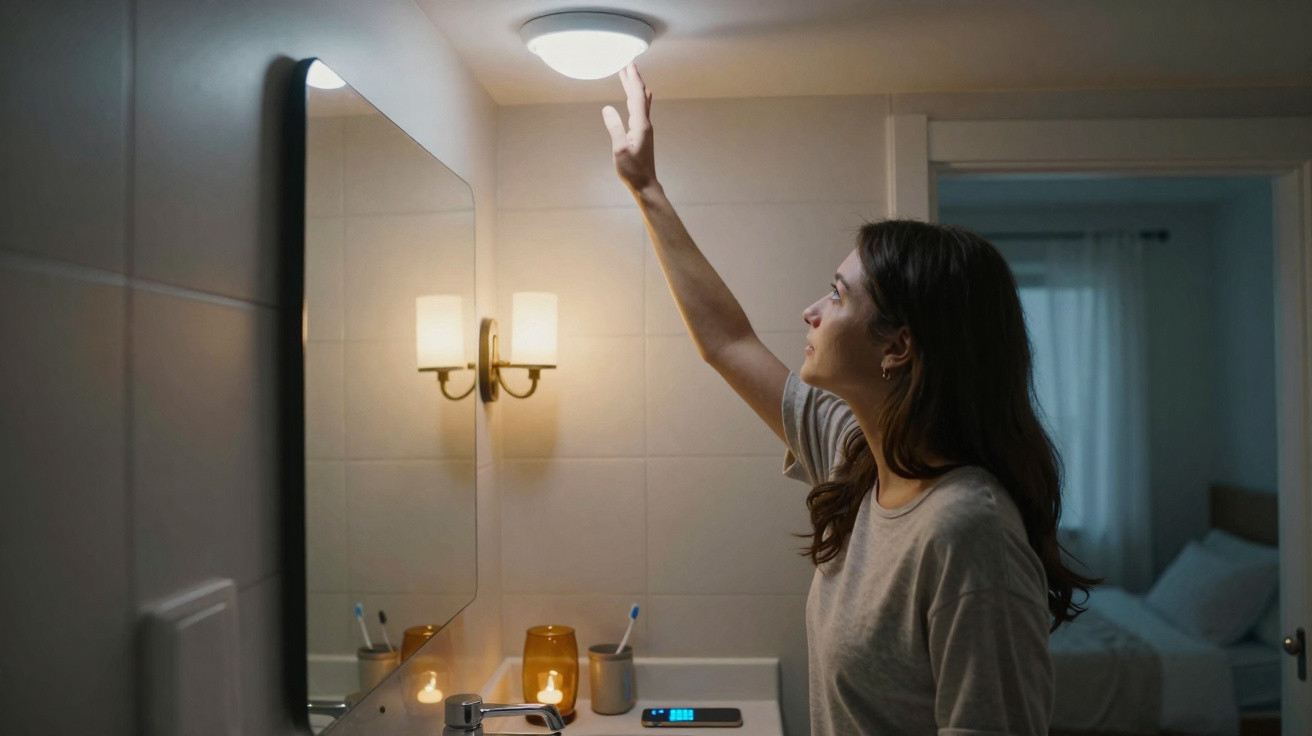
You shuffle towards the bathroom half asleep, having finally placed your phone face down and switched on its blue-light filter, feeling rather pleased with yourself. Then you flick the switch. The room is flooded with stark white light-the sort suited to a dentist’s chair, not the space above your toothbrush. Your eyes smart, your mind jolts into action, and your body suddenly behaves as though morning has arrived.
Later, you lie awake looking at the ceiling, puzzled by why your sleep still feels light despite having “done everything right” with your screens. Your phone is tucked under the pillow and notifications are disabled, yet your brain is humming like a fluorescent tube.
Perhaps the real offender is not in your hand at all. Perhaps it is above your head.
That harsh bathroom light is sending signals to your brain
When sleep comes up, most people focus on phones. Hardly anyone mentions the painfully bright bulb in the bathroom. But your body interprets light as a language. Cool light rich in blue wavelengths says, “Hey, it’s daytime, wake up.” Warm amber illumination gently suggests, “Night has started, slow down.” At 11.30 p.m., your bathroom may effectively be shouting “office at 9 a.m.” directly into your eyes.
A screen filter can reduce some blue light. By contrast, a 4000K or 5000K LED in the ceiling fills your full field of vision with cool, daylight-like tones. This affects the photoreceptors in your eyes that communicate directly with your body clock. You may believe you are simply brushing your teeth; your brain may interpret it as sunrise.
Bathrooms were designed to feel energising for morning routines. We simply neglected to give them a night setting.
A Swiss sleep laboratory once carried out a straightforward experiment: participants encountered bright, cool light late in the evening or gentler, warmer light at identical intensity. The lux level was the same, but the colour temperature differed. Those exposed to cooler lighting experienced greater melatonin suppression and took longer to enter deep sleep. Participants under warmer illumination reached deeper sleep sooner, although the brightness appeared broadly similar to the eye.
Bring that into everyday life. Imagine a compact flat whose only bathroom has a harsh, blue-tinged “daylight” LED panel. A young parent gets up twice each night to comfort a toddler and passes through that light every time. Their phone is in night-shift mode at low brightness. Yet their sleep remains fragmented and shallow. “I wake up exhausted,” they say, “even when the kid sleeps through.” The ceiling is rarely considered the cause.
We fixate on the rectangle we hold, while the beams above us go unnoticed, night after night.
Biologically, this conflict is severe. Your body follows a rhythm known as the circadian cycle, controlled by a group of brain cells called the suprachiasmatic nucleus. This group receives information from specialised cells in your eyes that are highly responsive to short-wavelength-or “blue”-light. Light with a high colour temperature (4000–6500K) delivers more of this effect. It tells your internal clock: “Stay alert, delay melatonin, stay in lighter sleep.”
Warmer lighting at roughly 1800–2700K contains considerably less blue light. Candlelight, traditional incandescent lamps and low-pressure sodium streetlights all fall within this comforting range. Your phone’s blue-light filter can move its spectrum in that direction, but the phone remains a small, localised source. A high-Kelvin bathroom downlight can undo that work during a visit of only 30 seconds.
So, while apps adjust your display, the colour temperature of your bathroom lighting may be rewriting the script for your entire night.
Bathroom light colour temperature changes that matter more than any blue-light app
The simplest improvement is remarkably direct: alter the colour temperature of your bathroom lighting, at least in the evening and overnight. Choose bulbs between 1800K and 2700K, commonly labelled “warm white”, “soft white” or “amber”. Where possible, fit a second light fitting or a smart bulb specifically for night use. With a tap on your phone or a basic remote control, the bathroom can change from a “morning clinic” into a “night cocoon.”
If smart technology does not appeal, choose an inexpensive plug-in nightlight with a warm tone. Leave the main light off after a particular hour and use its softer glow to move around. It need not be flawless; the aim is lighting that feels nearer to candlelight than a co-working space.
Consider it a way to give your brain one consistent message: “We’re winding down now. Nothing dramatic is happening in here.”
Many people begin with bedroom improvements: blackout blinds, no television and a phone kept outside the room. These are all worthwhile. Yet they still expose themselves to icy bathroom lighting 30 minutes before bed and on every overnight visit. It is like attempting to meditate while someone claps beside your ear every hour.
The same practical errors occur repeatedly. People purchase “daylight” LEDs because the packaging promises “better visibility” or “true color”, then fit them everywhere: the bathroom, kitchen and hallway. They are ideal for applying make-up at 9 a.m., but punishing at midnight. Others combine different colour temperatures between rooms, leaving the body without a clear sense of what time it should feel.
There is also simple tiredness on a human level. You improve the bedroom, programme app limits and purchase blue-light glasses. Compared with all that work, replacing a bulb can seem almost absurdly insignificant. That tiny detail still hits your biology harder than the prettiest sleep app on your home screen.
There is a quiet relief in being shown a small, practical adjustment that genuinely suits daily life. You do not need to stop scrolling forever or live like a monk. You can simply soften the light in the place that disrupts your night most.
“We found that short bursts of high color temperature light in the late evening could delay deep sleep more than continuous screen use with filters,” notes a sleep researcher from a European chronobiology team. “People underestimate how much a single bright bathroom visit can reset their internal clock.”
Think about how often you use the bathroom after dark: brushing your teeth, doing last-minute skincare, getting a drink of water or making a middle-of-the-night toilet visit. Every trip becomes a micro-dose of circadian confusion. The answer is not heroic self-discipline, but environmental design. Light that doesn’t shout at your brain. Lighting that resembles dusk rather than midday.
- Pick warm bulbs (1800–2700K) for the bathroom and hallway.
- Use a dimmer or nightlights after a fixed evening hour.
- Avoid “daylight” LEDs along the routes you use through your home at night.
- Keep screen filters enabled, but do not depend on them alone.
- Monitor changes in your sleep depth over one or two weeks.
Rethinking night as a whole-body lighting ritual
Once you start paying attention to colour temperature, it becomes difficult to ignore. The difference between a calm amber-lit bedroom and a stark blueish bathroom soon feels unsettling. You may find yourself hesitating with your hand on the switch and asking, “Do I really want to blast my brain right now?” That brief hesitation is where the habit begins to change.
Some people make it a modest ritual. After a chosen time, they only use low-level, warm lighting. Ceiling spotlights remain off while lamps and nightlights take over. The bathroom is lit with a soft amber glow, and the hallway becomes a gentle passage rather than a runway. On such nights, deep sleep can feel weightier, slower and more grounding. It is not magic; it is simply more consistent with what your biology has been trying to achieve all along.
We all know someone who proudly says they have “quit screens two hours before bed” as though it were an Olympic event. Good for them. But light surrounds you from every direction. The cold LED overhead does not care that your phone is in airplane mode. Your cells register only brightness and spectrum, not your good intentions. Let’s be honest: nobody really manages that every day.
What tends to spread quietly between friends, couples and housemates is something less ambitious: “We swapped the bathroom bulb, and I weirdly sleep better.” Or, “I put a warm nightlight in the hallway, and now I can pee at 3 a.m. without waking up my whole brain.” These are not dramatic lifestyle transformations. They are small lighting adjustments that affect how rested you feel, how you cope the following day and how patient you are with the people you love.
After trying it, you may begin to see every harsh blue-white bathroom as a minor enemy of deep sleep. Not in a dramatic way, but with the calm recognition that certain forms of tiredness are created by people. We have wired lighting as though every room were a hospital corridor. We can rewire it to feel more like dusk in a quiet town, where your body understands at a deep level that night is not merely the absence of tasks, but a different kind of light.
| Key point | Detail | Benefit for the reader |
|---|---|---|
| Colour temperature matters more than screen filters at night | High-Kelvin bathroom lights send powerful “daytime” signals that delay deep sleep, even when blue-light apps are enabled | Helps explain why sleep can feel shallow despite careful screen habits |
| Warm bulbs on night-time routes | Changing bathroom and hallway lighting to 1800–2700K reduces circadian disruption | Provides a quick, inexpensive adjustment with a measurable effect on rest |
| Micro-rituals around evening light | Using dim, warm lighting after a chosen hour trains your body to move into deeper sleep stages | Offers a realistic, sustainable routine suited to modern life |













Comments
No comments yet. Be the first to comment!
Leave a Comment