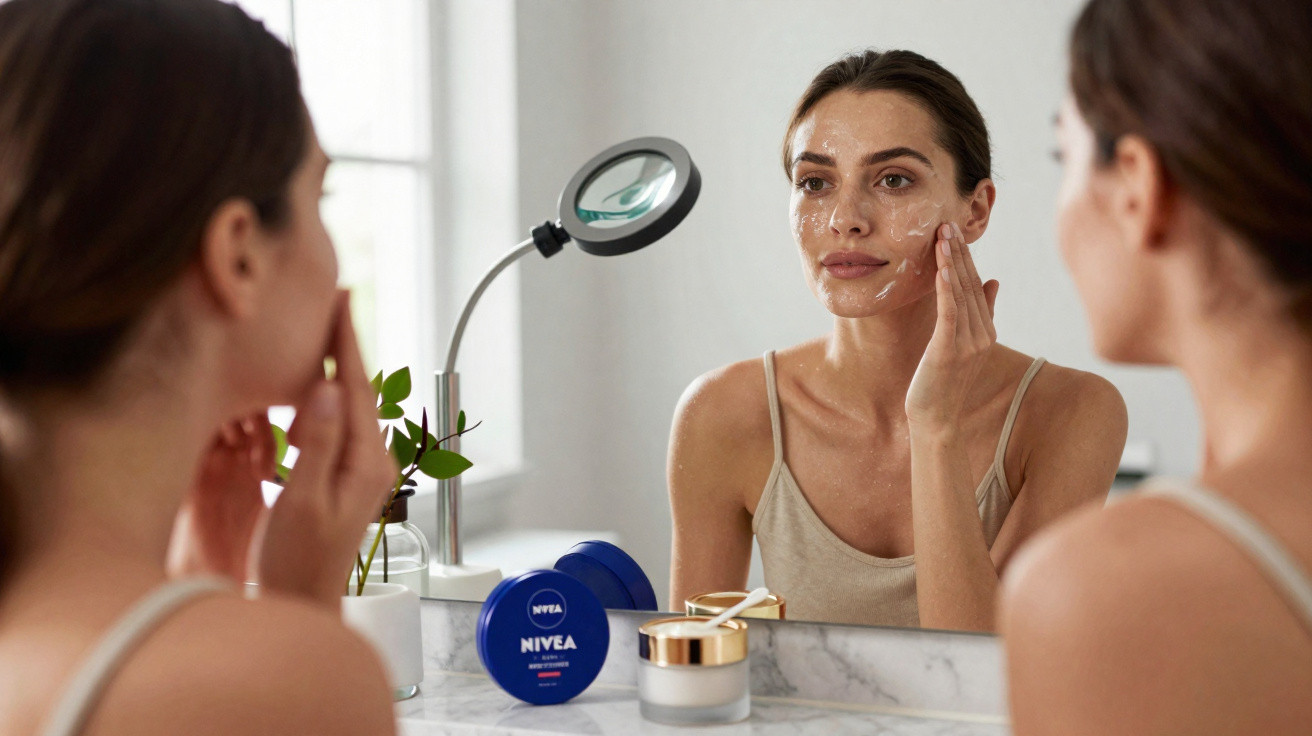
How much do you really need to spend on a good face cream? A UK journalist wanted a definitive answer, so for one month she used the famous blue Nivea tin on one half of her face and a luxury cream costing nearly €500 per 100 ml on the other. At the end, a dermatologist examined the results closely.
The experiment: budget cream on the left, luxury skincare on the right
The focus of the test was Claire Cisotti, a journalist at the British Daily Mail. She set out to establish whether a high price genuinely delivers better skin automatically. Her approach was strikingly straightforward: pit a familiar everyday cream against a high-end product that only a small number of people can afford.
- Left-hand side of the face: classic blue Nivea Cream, around €2 per 100 ml
- Right-hand side of the face: La Mer luxury cream, nearly €490 per 100 ml
- Test period: 4 weeks, applied daily
- A dermatological skin assessment before the trial, followed by a final appointment with the same specialist
Before the experiment began, Claire had her skin assessed professionally. The verdict was relatively dry, dehydrated skin, visible fine lines, some wrinkles and mild redness consistent with early rosacea. It was therefore exactly the type of complexion on which both products had to prove their worth.
What the two face creams claim to offer
The classic Nivea cream is primarily designed to provide intensive basic skincare. Its manufacturer promotes rich hydration, a soft and supple skin surface, and a protective layer intended to prevent moisture loss. Anti-ageing is not its main focus; instead, it is positioned as skincare for everyone.
La Mer cream makes a very different promise. Regarded as a luxury product, it is intended not only to hydrate but, above all, to smooth wrinkles and fine lines. A specialist algae complex and an elaborate production process are said to regenerate the skin and make it look noticeably younger.
“Expensive active ingredients, high-end marketing, a luxurious jar – in theory, the luxury cream ought to be clearly ahead in the wrinkle showdown.”
This assumed advantage was precisely what made the experiment so interesting: could an affordable heritage cream genuinely keep pace?
Week 1: Hardly any difference, except slightly less redness
After seven days, Claire’s first observation in the mirror was that both sides of her face looked smoother and more hydrated. Her skin felt less tight and the dryness had eased. In photographs, she could barely spot a difference.
Only one detail stood out: the redness appeared to have reduced slightly on the side treated with the luxury cream. That area looked marginally calmer, which was particularly pleasant for sensitive skin. At this stage, however, she could not name a clear winner.
Week 2: Small spots on the expensive side
At the start of the second week, Claire encountered an unexpected development. Tiny spots appeared beside her nose, on the side where she had been applying the expensive cream. They disappeared again after a few days, but the episode showed that high-end skincare is not necessarily better tolerated.
Visually, the competition remained extremely close. Both sides appeared nourished and well hydrated. In her report, Claire noted how remarkably well the affordable tin was performing when its price was taken into account.
“For a product that costs only a fraction as much, the affordable cream delivers a result you would more readily expect from expensive skincare.”
Week 3: Colleagues think the affordable side looks better
During the third week, Claire inspected her face more closely, armed with a mirror and a critical eye. Her impression was that the fine lines around her eyes looked a little softer on the Nivea side, while the skin there seemed plumper.
To avoid relying only on her own judgement, she asked colleagues in the office, without giving them any background information, to decide which half of her face looked younger. The outcome surprised even her: every one of them chose the left-hand side, the one treated with the affordable cream. Not a single person picked the luxury jar.
The tester said the skin on the “budget side” looked more alive and elastic. The expensive half was clearly well cared for, but it did not look better.
Week 4: People suspect Botox
Towards the end of the month, friends and even Claire’s sister said that her face somehow looked smoother and fresher. One person asked whether she had had Botox injections. The improvement was visible, but it was apparent on both sides of her face.
Both creams reduced dryness lines, produced a more even complexion and created a more rested overall appearance. Based on what she saw in the mirror, Claire would still give a slight advantage to the affordable side, especially around the eyes.
Dermatologist’s assessment: affordable Nivea cream beats the luxury product
The decisive moment came at the follow-up appointment with the dermatologist. He again assessed hydration, skin appearance and fine lines on both sides of Claire’s face separately.
“His conclusion: the half of the face treated with Nivea shows better results than the half treated with the expensive luxury cream.”
The dermatologist found that the Nivea side had retained more moisture. Redness had reduced more noticeably there, and several fine lines around the eyes had visibly softened. In his view, that side of the face looked around five years younger.
Although the luxury cream also delivered a skincare benefit, it could not translate its price advantage into visibly superior performance. For Claire, the result was unambiguous: a high price does not guarantee a better outcome for the skin.
Why a high price does not necessarily mean better skin
Cosmetics manufacturers spend substantial sums on marketing, packaging and fragrances. Part of the price goes into the jar, while another part pays for advertising hoardings and influencer campaigns. For the skin, though, what ultimately matters is the specific ingredients and their concentration, rather than image.
Traditional skincare tins such as Nivea often rely on established fats, wax components and moisturising agents. These ingredients lock in moisture, support the skin barrier and help dryness lines appear less pronounced. It may sound unglamorous, but it is dependable.
Luxury creams often attract buyers with specialist active-ingredient complexes. Some may have potential, while the scientific evidence for others is less robust. If fragrances or rich textures are added, sensitive skin may even react with redness or blemishes.
What consumers should actually consider when choosing face creams
Anyone who does not want to conduct their own half-and-half trial for months can follow a few simple guidelines:
- Know your skin type: oily, dry, sensitive or combination skin – the foundation needs to be suitable.
- Check the ingredients: moisturisers such as glycerine, certain oils and hyaluronic acid are often useful.
- Question fragrances: an intense scent may smell pleasant, but it can irritate some skin unnecessarily.
- Consider the packaging: jars look luxurious, but pump bottles are more hygienic.
- Keep the price in perspective: skincare performance does not increase in the same proportion between a few euros and several hundred.
Those looking for anti-ageing benefits will generally gain more from sunscreen, consistent UV protection and, where appropriate, ingredients such as retinol or niacinamide than from a luxury label on the bathroom shelf.
What this experiment means in everyday life
Claire’s test shows that a well-known high-street product can not only match luxury skincare but even outperform it. For many readers, that is welcome news. You do not need to keep a small fortune in the bathroom to make fine lines look less noticeable and care for your skin properly.
One point nevertheless remains individual: skin reacts very differently from person to person. What worked for Claire may produce a different outcome for someone else. Anyone who is unsure should seek advice from a dermatologist, particularly in cases of rosacea or severe redness.
Above all, the lesson is that examining the ingredients and your own skin’s reaction matters far more than the price on the label. Sometimes, a simple blue tin contains more benefit than a gold-glinting jar might suggest.








Comments
No comments yet. Be the first to comment!
Leave a Comment